
dsh-web
zhu1090093659/dsh-webDeepSeek Harness(DSH)Web 插件聚合生态包 · 一切皆插件,创意工坊分发(dsh-market.com)

Read-only skill invocation monitor for DeepSeek Harness — which Agents are running, which Skill each is calling, status and elapsed time, live in the Web GUI sidebar. · 只读技能调用监控:侧边栏实时展示活动 Agent 正在调用的 Skill、状态与耗时。
English | 简体中文
A read-only DeepSeek Harness (DSH) plugin that puts every skill invocation on one screen: which Agents are running, which Skill each one is calling, whether it is running / finished / failed, and how long it has been going — live, in the Web GUI sidebar.
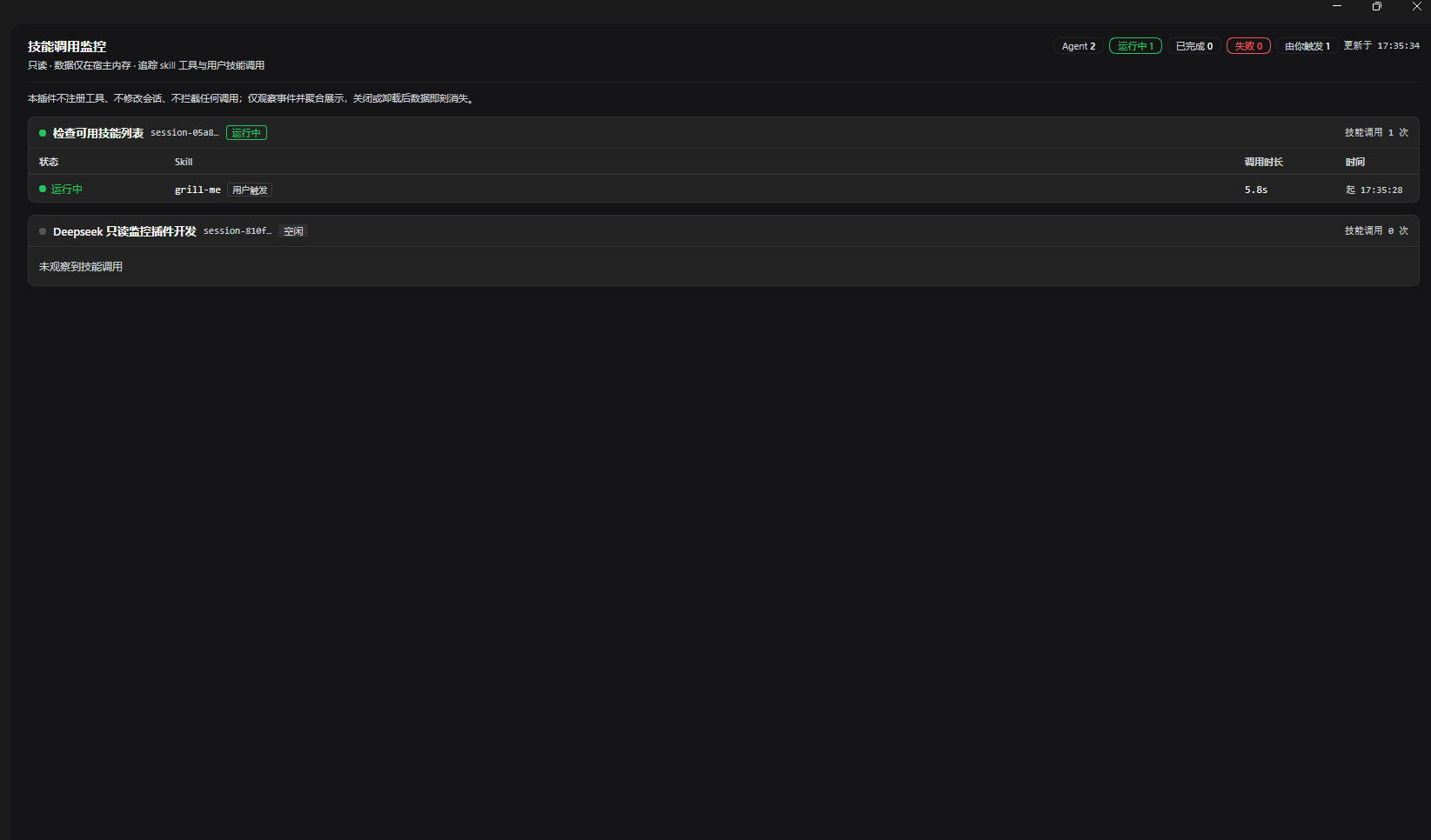
Captured from the running plugin: the sidebar entry opens a panel listing every Agent, and each row is one skill call with its status, elapsed time and start clock.
Skill invocation in DSH is invisible. The model loads a skill, and you see the answer — not the call, not the timing, not the one that never came back. After installing this plugin:
skill tool, and
you triggering a skill yourself, which carries a 用户触发 badge on its row;# from npm (recommended — prebuilt, so no build-script permission is needed)
dsh plugin --profile web add @yyc-jnu/dsh-skill-invocation-monitor
# or straight from GitHub (plain ESM JavaScript: no build step, so pnpm never asks for allowBuilds)
dsh plugin --profile web add github:YYC-JNU/dsh-skill-invocation-monitor
Then restart DSH and refresh the page. Both halves — the host observers plus the read-only route, and the browser bundle — are scanned during host start-up, so no sidebar entry appears before that restart.
Verify the layer before booting:
dsh --profile web --dump-config # look for: # == @yyc-jnu/dsh-skill-invocation-monitor
If that layer is missing, the package installed as a plain dependency and the plugin never activated.
Uninstall:
dsh plugin --profile web remove @yyc-jnu/dsh-skill-invocation-monitor
| Live Agent list | Every live Agent, its session title, and whether it is running or idle |
| Per-call rows | Skill name, status (运行中 / 已完成 / 失败 / 未观测到结果), elapsed time, start clock |
| Both invocation paths | The model's skill tool call, and a human triggering a skill — marked 用户触发 |
| Ticking durations | The elapsed time updates every second while a call is running |
| Sidebar badge | The running-call count sits on the sidebar entry, so you can see activity without opening the panel |
| Honest failures | A failed call shows a truncated reason, e.g. skill "…" is unknown or no longer available |
| Self-check diagnostics | Every response carries counters describing what the plugin observed, so a wrong assumption is visible rather than silent |
| Zero dependencies | Neither half imports a third-party package (the browser half uses only react from the host module table) |
This plugin exists to observe, and its whole design is built around not participating.
| Observes (read-only) | Five Cordis events: tools/pre-execute, tools/result, session/event, agent/status, agent/disposed |
| Reads | The live Agent list, session titles, and the durable session-event feed as it is appended |
| Does not write | No session state, no session log, nothing on disk, no config, no tool, no command |
| Does not interfere | The tools/pre-execute listener returns next() unchanged and never denies, cancels, rewrites or delays a call; every observer is wrapped so a bug in this plugin cannot break a dispatch |
| HTTP surface | Exactly one route, GET /api/plugins/skill-monitor/state — no body, no mutation, cache-control: no-store |
| Network exposure | Loopback only: a non-loopback peer, a cross-site fetch marker or a foreign Origin gets 403; any non-GET method gets 405 |
| Where the data lives | One Map in host memory. Records are capped (200 by default) and expire (10 minutes after they settle); restarting DSH clears everything |
| Not collected | Prompt text, model output, file contents, credentials, or anything else the plugin never reads |
| DSH | Verified against 0.2.0-rc.2 (the build this plugin was developed and tested on). The seams it uses are documented core surfaces, so other 0.2.x builds are expected to work |
| Node.js | Declared >=20. The plugin runs inside the DSH host, so the host's own Node requirement is what matters |
| Surface | Web GUI (dsh.client.platform: "web"). Uses only official Slots — sidebar.panellist for the entry and main for the panel — never DOM injection |
| Skill paths | Uses the durable contracts for both paths: tool calls on tools/pre-execute / tools/result, and human invocations through the skill-invocation message source declared by the skills seam |
A skill can be reached two structurally different ways in DSH, and the plugin observes both.
| Model path | User path | |
|---|---|---|
| Trigger | The model calls the skill tool | You invoke a skill (e.g. /grill-me) |
| What DSH does | Runs the tool pipeline and produces a tool result | Appends the skill's instructions to the conversation as a user/message — no tool call and no command event |
| Pairing key | callId | the message id |
| Duration measured | tools/result − pre-execute | turn/end − injection (see the note below) |
| Row marker | none | 用户触发 |
The human path is read from the structured source the skills seam itself attaches
(SkillInvocationSource, in the persistence catalog):
{ "type": "user/message", "data": {
    "source": { "kind": "skill-invocation", "name": "grill-me", "form": "instructions" },
    "role": "user", "id": "7c2e0f5a-3b9d-4e18-9a6c-1d2f3a4b5c6d" } }
The name comes straight from source.name, so no skill-catalog lookup and no text parsing is involved. That
is a measured result, not a guess: an earlier implementation assumed the human path went through
command/run / command/done, and a real session log disproved it — a human-invoked skill produces no
command event at all, which removed an entire catalog cache and its 60-second TTL.
One deliberate choice: a human skill has no result event of its own, so its duration is the turn window
(injection until turn/end), not the skill's own execution time. That is a stated convention, not a
measurement — if you would rather see an instantaneous event with a duration of 0, only the settling point
changes.
| Status | Meaning |
|---|---|
运行中 | A start was observed (a pre-execute or a skill message) and no ending event has arrived; the duration grows live |
已完成 | The tool reported isError === false, or the turn that carried the skill ended normally |
失败 | The tool reported isError === true; the row shows a truncated reason |
未观测到结果 | No ending event arrived within 15 minutes (the call was denied before dispatch, its parent was cancelled, the host crashed). This is a derived status and is never written back into the record |
This is the plugin's core constraint, and there are tests asserting each row.
| Constraint | How it is implemented |
|---|---|
| Registers no writable tool | Never touches ctx.tools — no register, restrict or guard; apply() adds no member to ctx (asserted by a test) |
| Modifies no session state | Never appends a session event, never writes a session log, never calls a service method; only reads agents.list() / sessions.get() / sessionTitle.get() |
| Intercepts nothing | The tools/pre-execute listener returns next() untouched and never denies, cancels, rewrites or measures; a hostile arguments Proxy cannot make it block a call (asserted by a test) |
| Writes nothing to disk | All state is one in-memory Map, capped and expiring; no history, no persistence, no alerting |
| One read-only route | GET /api/plugins/skill-monitor/state only — no POST, no request body, no write path |
| Zero runtime dependencies | Neither half imports a third-party package |
Every state response carries a diagnostics object describing what the plugin actually saw:
| Field | What it tells you |
|---|---|
sessionEvents | The durable event feed did reach the plugin |
skillInjections / trackedInjections | Human skill messages were seen and recorded |
unmatchedInjections | A skill-invocation message arrived whose name could not be read |
turnEnds / settledByTurnEnd | Turn endings arrived, and how many human records they closed |
This is not decoration: it is what caught the disproved command-path assumption in the first place.
- id: skill-invocation-monitor
  name: '@yyc-jnu/dsh-skill-invocation-monitor'
  config:
    maxRecords: 200          # in-memory record cap
    retentionMs: 600000      # keep settled records for 10 minutes
    staleMs: 900000          # no outcome within 15 minutes → 未观测到结果
    maxCallsPerAgent: 20     # rows shown per Agent in the panel
cd dsh-skill-invocation-monitor
npm run verify   # node --check on all three entry files
npm test         # 72 offline tests: node --test
72 offline tests cover three layers: the pure aggregation model (test/tracker.test.mjs, 36 — duration
settling for both paths, pairing keys, staleness, eviction and caps, Agent merging, field-name parsing of the
durable payload), the read-only contract itself (test/host-plugin.test.mjs, 25 — exactly five events, exactly
one GET route, a pure passthrough pre-execute listener, loopback fencing, disposal), and the browser bundle
(test/client-bundle.test.mjs, 11 — loaded the way the shell loads it, asserting the slot registrations and
the rendered output).
The plugin is plain ESM JavaScript: lib/ is the source, there is no build step and no src/.
dsh-skill-invocation-monitor/
├── package.json          # name / exports / dsh.bundle.patch / dsh.client
├── cordis.patch.yml      # the one profile row both halves hang off
├── lib/
│   ├── host/
│   │   ├── index.js      # host half: 5 read-only observers + 1 GET route
│   │   └── tracker.js    # pure aggregation model (no Cordis, no I/O, explicit timestamps)
│   └── client.js         # browser half: ModuleLoader bundle, 2 slot registrations
├── docs/
│   ├── screenshot.png             # the screenshot above
│   └── skill-monitor-flow.json    # archify sequence-diagram source
└── test/                 # 72 offline tests
The code in this plugin was written with AI assistance: the author defined the requirements, reviewed the results and accepted them, while the AI produced the implementation and the documentation. Every behaviour was verified against a running DSH instance; session titles, message ids and timestamps in tests and examples are synthetic and contain no real user data.
DeepSeek Harness(DSH)Web 插件聚合生态包 · 一切皆插件,创意工坊分发(dsh-market.com)
把回答做成一页可视化 HTML:模型只写简短的 Markdown 草稿,随包附带的 `am` 命令行生成页面,支持流程图、时序图、树、时间线、ER 图、表格和提示框。
在 dsh 里装上这个插件即可,无需登录、注册或填 API Key,就能使用包括 Muse Spark 1.3、MiMo V2.6 在内的前沿模型——完全免费,不限量。 All you do is install this plugin in dsh: no login, no sign-up, no API key — the frontier models are just there, Muse Spark 1.3 and MiMo V2.6 among them. Completely free, with no usage cap.

