
dsh-web
zhu1090093659/dsh-webDeepSeek Harness(DSH)Web 插件聚合生态包 · 一切皆插件,创意工坊分发(dsh-market.com)

为 DeepSeek Harness 提供常驻的 Endeavour 与 Challenger 对等会话:负责规划、按序执行任务,并核验汇报的结果。
Two coordinated DSH agents that plan and execute as one pair. Orbital Agents is the project and
repository identity; the published package is dsh-orbital-agents (the predecessor name
dsh-endeavour is superseded and deprecated on npm).
The Endeavour agent investigates, writes the plan, and verifies results. Its persistent Challenger peer is a second ordinary chat that executes the plan and reports back through a durable protocol. The pair is created once and reused for every later plan, so the two agents stay in the same orbit instead of being re-spawned per task.
dsh-orbital-agents/tools row of the Endeavour preset, so the standard
preset never sees them.Waiting to start, Working, Finished, Confirmed, and Failed display stages.osascript -e 'quit app "DSH Desktop"' then open "/Applications/DSH Desktop.app".Open Challenger opens the paired chat
that executes the tasks.Two ordinary presets ship together: Endeavour (planner: endeavour_plan, endeavour_verify)
and Challenger (executor: challenger_start_task, challenger_report). A plan is delivered once
to the persistent Challenger session paired with its Endeavour session; the companion is never a
subagent and is reused by every later plan of that pair. If a user asks for the
Challenger directly, Endeavour uses that paired companion and starts work only
through endeavour_plan; it never spawns a native subagent to replace it.
A paired Endeavour session shows a native Challenger view tab next to Chat and Trajectory, and
the Challenger session shows the reciprocal Endeavour tab; either tab opens the other ordinary
session of the pair (see docs/architecture.md). An existing Challenger row is
never promoted by reselecting Endeavour in it; the runtime repairs its Challenger selection instead of
creating a second companion.
git clone git@github.com:Qulierm/orbital-agents.git
cd orbital-agents
pnpm install --frozen-lockfile
pnpm run build
pnpm pack
node scripts/install-local.mjs --tarball ./dsh-orbital-agents-0.2.8.tgz
The installer backs up the desktop profile and any existing user preset first, installs the package
into ~/.dsh/profiles/desktop, and preserves existing plugin order. The two agent presets ship inside
the package as bundle patches (presets/endeavour.patch.yml, presets/challenger.patch.yml), so no
preset directory is written; an upgrade retires the ownership-marked directories earlier releases
installed under ~/.dsh/.agent-presets. Re-running it is
idempotent; a changed tarball at the same name/version still refreshes the installed artifact
(remove-before-add). See docs/install.md for the full lifecycle.
The same source is published to the public npm registry as
dsh-orbital-agents (MIT), so a released artifact can be
inspected or fetched by version instead of building it locally. After v0.2.8 is available on npm:
npm view dsh-orbital-agents version # latest published version
npm pack dsh-orbital-agents@0.2.8   # download the published 0.2.8 tarball
node scripts/install-local.mjs --tarball ./dsh-orbital-agents-0.2.8.tgz
npm pack writes the published tarball into the current directory, and the installer is run from a
clone of this repository with that path — the same installer documented in
docs/install.md. Installing the package as a plain library dependency is not a
supported way to load it into DSH Desktop: the plugin is mounted by the desktop profile and its
presets, which is what the installer configures.
Think of a rendezvous in orbit: one vehicle does the planning and holds the checklist, a second flies the burn. Neither is a passenger, and neither is a throwaway stage — they stay docked for as long as the mission lasts.
Two persistent ordinary sessions, not a subagent system. Endeavour and Challenger are two regular chats that are paired once. The Challenger has its own conversation, its own model selection, and its own history; it is provisioned through the same ordinary session path the UI uses, is never recreated per plan, and is never spawned as a subagent. What connects them is a durable protocol, not a parent process: Endeavour sends the whole plan once, the Challenger reports evidence back, and Endeavour answers with a verdict.
The split of work. Endeavour owns requirements analysis, architecture, acceptance criteria and
verification. The Challenger receives the finished plan and executes its bounded, sequential tasks,
reporting for each one a summary, the files it touched, the validation it actually ran, and — when
something goes wrong — a blocker or failure. Endeavour then accepts or rejects each item against the
criteria it wrote. A task is only Confirmed after that review; until then it stays Finished.
Because the plan constrains the execution, the Challenger's job is usually narrower than the
planner's: follow the decisions, run the checks, report honestly.
Why that can be economical. This shape lets you spend differently on the two halves. Put an expensive, strong-at-reasoning model on Endeavour, where the plan, the constraints and the acceptance checks are decided, and a faster, lower-cost model on the Challenger, where the work is already bounded by that plan and every task is verified afterwards. Depending on your provider and pricing, that division can reduce what a long run costs compared with using the strongest model for everything, and the two routes are configured independently — see Model selection. Examples people use for the two roles, purely as provider-dependent illustration and not as a claim about what this project supports or what any provider offers:
Whatever you choose, decide it in your own provider setup: which models exist, what they cost and how they behave are properties of your deployment, not of Orbital Agents. Savings are a possible outcome of the split, not a guarantee, and quality is supported by Endeavour's acceptance criteria and its review of the Challenger's evidence — not promised by the pairing.
The panel is the protocol made visible. Directly above the composer (and as a card in the
transcript) the plan panel shows the run as it happens: how many tasks are confirmed, which task is
current, a live timer on the working row, and the frozen duration afterwards. Its rows are the durable
task states, not decoration — Waiting to start, Working, Finished (reported, awaiting review),
Confirmed (accepted after Endeavour's check) and Failed. The row colours make the stages readable
at a glance: a gray ring while waiting, a blue animated ring while working, a green check once a task
has been reported, the same check in violet once Endeavour has accepted it, and a red cross on
failure.
When the Challenger stops, the plan says so. If the paired Challenger session is no longer
running while the plan still expects execution work — the turn was stopped, it errored, or the
session went away — the row the plan is waiting on switches to Challenger stopped with a static
orange circled exclamation, on both the panel above the composer and the transcript card. It covers
stopping before the first task, in the middle of one, and between sequential tasks, and it clears by
itself as soon as the Challenger runs again. This is deliberately not a fifth durable task state:
it is live session activity read from the official session list, so nothing about the recorded plan,
its events or the protocol changes. A task that had already started keeps counting its elapsed time
while it waits to be resumed, and opening the Challenger is still a normal chat away.
DSH Desktop serves this plugin, so quitting it also kills whatever tool call is running inside it. That makes an in-app restart asymmetric: a manual restart is always safe, while an agent-driven one must be scheduled before anything is reported.
osascript -e 'quit app "DSH Desktop"', then
open "/Applications/DSH Desktop.app"), or just use the app's own quit. Nothing else is needed.node "$HOME/.dsh/profiles/desktop/node_modules/dsh-orbital-agents/scripts/schedule-desktop-restart.mjs" --delay-seconds 45 validates macOS, writes its log under
~/.dsh/backups/endeavour/restarts, spawns a detached worker and returns immediately with a
schedule id and the log path. The worker waits, quits the app, waits for the old process to leave,
reopens the bundle and records ready or failed in that log.restart scheduled with the schedule
id and log path and stops; nobody claims the app came back, because the host that would observe that
is the one being restarted. Read the log afterwards for the real outcome.sleep, no tail, no ps/lsof polling after the
quit step. DSH records such a call as interrupted with an unknown outcome and the report is lost.The --delay-seconds floor is 30 seconds, so the report always has time to land before the worker
acts.
The composer keeps the host's native Endeavour selector in DSH's single-occupancy model seat and adds one custom Challenger selector (endeavour-challenger-model) in the trailing-controls list beside it. The native selector is never hidden, restyled or replaced. The custom button stays labelled Challenger; its tooltip and accessible description carry the current model, effort and pending status.
localStorage writers; see configuration.The selector appears only for an admitted Endeavour root; Standard sessions, known subagents and Challenger-side sessions do not receive it. The model directory may need a live scope and UI binding, so the selector can retain the exact validated Challenger while it is mounted and show a local retry state if that peer is unavailable. See docs/configuration.md for the storage and application details.
~/.dsh/backups/endeavour/<timestamp>/ (profile/, preset/, state.json).--list-backups lists them; --rollback <timestamp> restores the profile files and preset state
exactly.--uninstall removes the plugin, its bundle row, and only a preset this package owns (an existing
user-authored preset is left untouched).--force to replace it after
the automatic backup.childId-only plan aborts the install (with the affected session ids and remediation)
before any mutation; terminal historical plans are allowed and stay readable.See docs/install.md for the full lifecycle and docs/architecture.md for the invariants.
These are real captures of a running DSH Desktop session using the plugin — not offline renders or mock-ups.
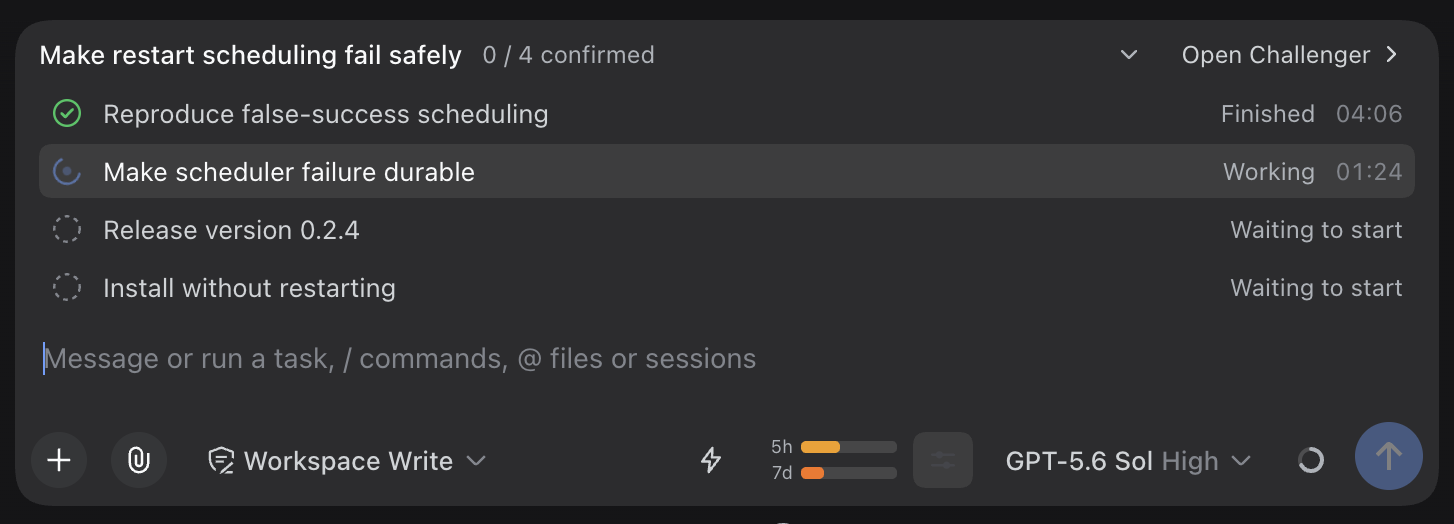
The card tracks the plan as it happens: a green check on the row the Challenger has already reported, the blue animated ring with a live timer on the row it is working on, and gray rings on the rows still waiting to start.
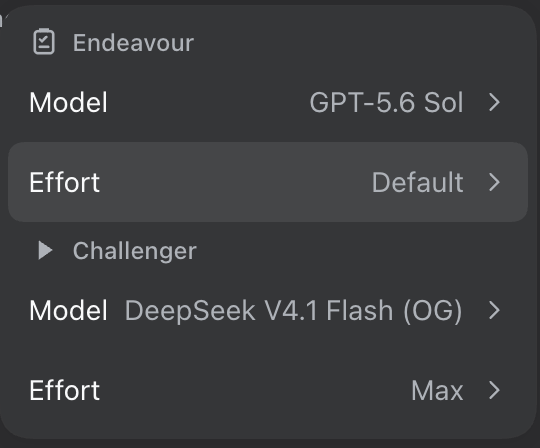
The compact menu shows the Challenger model and reasoning effort beside the composer. The selector behavior, including local pending choices and their timing limits, is described in Model selection.
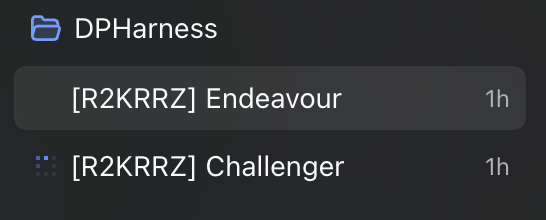
The pair lives in the workspace sidebar as two ordinary sessions, labelled with the shared pair code.
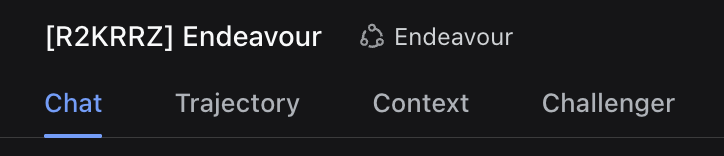
The session header carries the tab that opens the paired Challenger, so the executor's own chat is one click away.
The plugin registry reads screenshots.json from this repository root, so the
Market card and install dialog pick these images up on the next registry build —
no pull request is needed to change them. To replace one, drop a new PNG at the
same relative path declared in screenshots.json.
scripts/screenshots/ holds an offline harness that renders the plan card and
the model control from the plugin's own components against fixture data; it
writes to scripts/screenshots/out/ by default and never touches the committed
captures above.
MIT — see LICENSE.
DeepSeek Harness(DSH)Web 插件聚合生态包 · 一切皆插件,创意工坊分发(dsh-market.com)
把回答做成一页可视化 HTML:模型只写简短的 Markdown 草稿,随包附带的 `am` 命令行生成页面,支持流程图、时序图、树、时间线、ER 图、表格和提示框。
在 dsh 里装上这个插件即可,无需登录、注册或填 API Key,就能使用包括 Muse Spark 1.3、MiMo V2.6 在内的前沿模型——完全免费,不限量。 All you do is install this plugin in dsh: no login, no sign-up, no API key — the frontier models are just there, Muse Spark 1.3 and MiMo V2.6 among them. Completely free, with no usage cap.

