

dsh
OpenPetsHQ/openpets将 DeepSeek Harness 的生命周期状态、错误与审批请求,桥接到本地运行的 OpenPets 桌面伙伴。
License: MIT · Requires: Node ^22.19 · DSH: 0.2.0-rc.2 (
dsh-client-storeera) · Platform: DSH Host + Web settings page
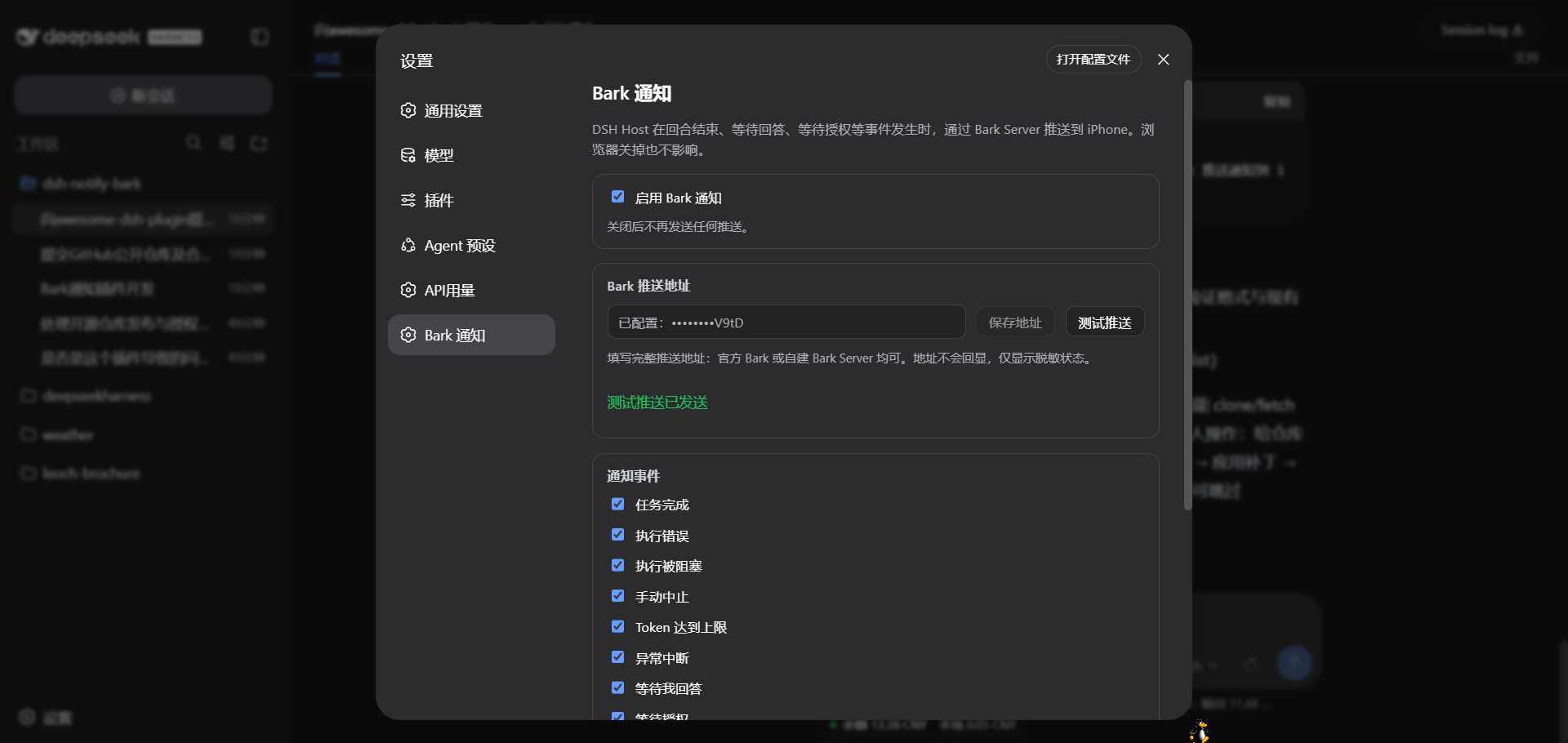
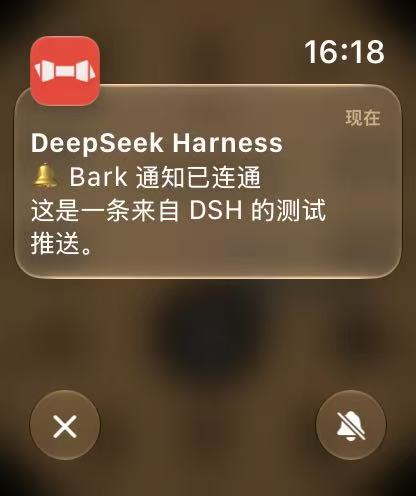
A Bark push-notification plugin for DeepSeek Harness (DSH): the DSH Host listens for events such as turn completion, waiting for your answer, and waiting for approval, and pushes notifications to your iPhone through a Bark Server. Notifications are sent entirely from the Host — closing the browser, refreshing the page, or putting your computer to sleep does not affect delivery.
src/index.ts + lib/*.js): session/event listener + Bark HTTP sending + the plugin entry's own Config schema (volatile fields persisted and hot-applied through DSH 0.2's ctx.settings document) + the barkNotify Typert Remote served on the shared /api channel.src/client/ + lib/client.js): registers a settings.section slot; the form calls the mounted barkNotify Remote namespace. The Bark URL never crosses the wire to the browser — only a masked status is shown (configured: ••••••••3F82).
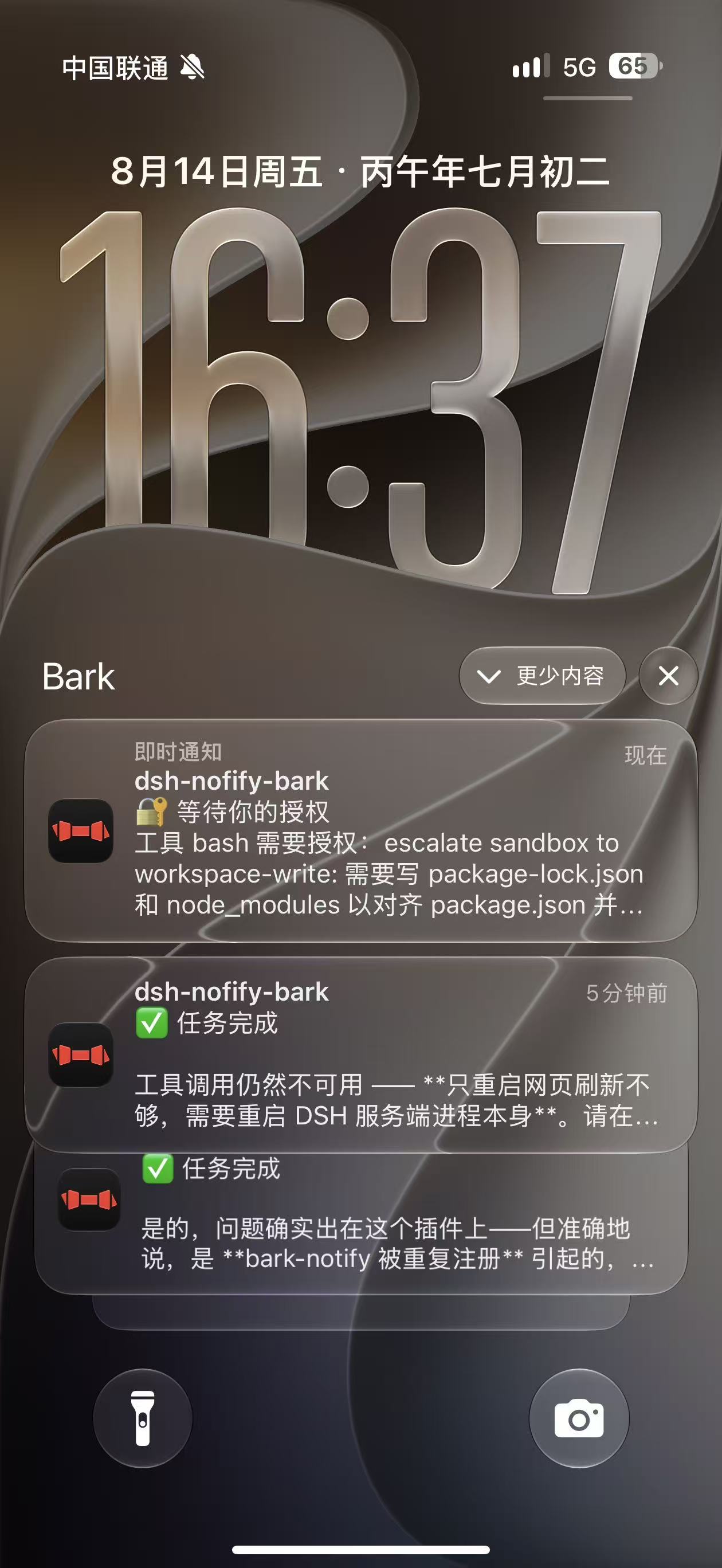
| Event | Trigger | Default | Bark level |
|---|---|---|---|
| ✅ Task completed | turn/end reason completed | On | active |
| ❌ Execution failed | turn/end reason error | On | timeSensitive |
| 🚫 Execution blocked | turn/end reason blocked | On | timeSensitive |
| ⏹ Aborted | turn/end reason aborted | Off | passive |
| ⚠️ Token limit reached | turn/end reason max-tokens | On | timeSensitive |
| ⏸ Interrupted | turn/end reason interrupted | On | timeSensitive |
| ❓ Awaiting your answer | tool/call ask_user_question | On | timeSensitive |
| 🔐 Awaiting your approval | approval/asked | On | timeSensitive |
| 📋 Plan awaiting confirmation | tool/call exit_plan_mode | Off | timeSensitive |
The notification title is fixed to the workspace name (last path segment of session.header.cwd); the status is placed on the first line of the body. Optional extras: the AI's last reply text, a body length cap, and a Bark Group.
Install directly from GitHub (the repo ships compiled output — clone and use, no build step required):
dsh plugin --profile web add https://github.com/pc439527/dsh-notify-bark.git
Or from a local path:
dsh plugin --profile web add /path/to/dsh-notify-bark
dsh plugin add runs pnpm add (writing dependencies + dsh.profile.bundles), and the plugin's own cordis.patch.yml inserts the bark-notify line. A running dsh web watches the profile's cordis.patch.yml through Cordis HMR — appending the same insert line at the user layer hot-loads the plugin without restarting the service:
# $DSH_HOME/profiles/web/cordis.patch.yml
- insert:
    - id: bark-notify
      name: 'dsh-notify-bark'
Refresh the browser settings page (gear → Bark notifications) to see the configuration form.
barkUrl defaults to empty; each deployer fills in their own Bark URL on the settings page (https://api.day.app/your-key). This repository contains no real credentials (tests use only a fake testkey).barkUrl is declared role('secret') in the schema; the Remote get answers only a masked status (configured: ••••••••3F82) and logs only configured: true/false.pnpm install # typescript / @types/node + the DSH 0.2 peer types (lockfile: pnpm-lock.yaml)
pnpm run typecheck # Host half against the installed DSH 0.2 packages
pnpm run typecheck:client # browser-half source against the DSH 0.2 client packages
pnpm run build # tsc compiles the Host half to lib/; the client bundle is maintained directly in lib/client.js
pnpm test # node:test unit + smoke tests (send / mapping / defaults / dedup / masking / remote contract / client bundle)
dsh-notify-bark/
├── package.json          # dsh.client declaration + bundle patch declaration + repo metadata
├── pnpm-lock.yaml        # pnpm lockfile
├── cordis.patch.yml      # plugin line insertion
├── LICENSE               # MIT
├── src/
│   ├── index.ts          # Host entry: Config schema + event listener + Remote service
│   ├── bark-service.ts   # Bark HTTP sending (timeout / error classification)
│   ├── event-listener.ts # session/event → notification intent (dedup / title / content)
│   ├── settings-store.ts # settings model / schema / defaults / masking
│   ├── remote-contract.ts # shared Remote contract: payloads, validation, descriptors
│   ├── bark-remote.ts    # barkNotify Remote service (get masked / set / test)
│   └── client/           # browser-half source (lib/client.js is its bundle mirror)
├── lib/                  # deployment artifacts (tsc-compiled Host + hand-maintained module-loader bundle)
└── tests/                # node:test unit tests
ctx.on('session/event') listens directly (the same path dsh-im-bridge uses); the browser is only a configuration panel.Config schema whose fields are volatile() (stable live references, no remount) and writes go through ctx.settings. The plugin suppresses the auto-generated page (configure({ auto: false })) and owns its settings.section; the barkNotify Remote keeps reads masked and set write-only.ctx.settings.describe() and passes it to ctx.settings.update(), so a stale editor cannot silently overwrite a concurrent change.barkUrl is role('secret') and the Remote returns only masked status (configured: ••••••••3F82); logs output only configured: true/false.sessionId + event.seq key with a bounded ledger, so reconnects or replays never push duplicates.barkNotify methods ride the standard Typert /api gateway (SRC discovery from the live service), not a custom connection.rpc.handle channel — the one surface that cannot work cross-plugin on DSH 0.2.MIT. Provided as-is, without any express or implied warranty; any loss arising from use of this plugin is borne by the user. Contributors agree to license their contributions under MIT.
将 DeepSeek Harness 的生命周期状态、错误与审批请求,桥接到本地运行的 OpenPets 桌面伙伴。
通过二维码或机器人凭据将 IM 机器人接入 DeepSeek Harness(支持飞书、微信、钉钉、企业微信、QQ、Slack、Telegram、Discord 和 WhatsApp 共 9 种渠道)。
通过 WebSocket V2 将 DeepSeek Harness 接入 Avernet Bot 协作网络,支持自动注册、Agent 会话隔离、工具调用事件和多 Bot 路由工具。

