
dsh-web
zhu1090093659/dsh-webDeepSeek Harness(DSH)Web 插件聚合生态包 · 一切皆插件,创意工坊分发(dsh-market.com)

Evidence-first agent memory and durable mission runtime — UNKNOWN states, immutable belief history, governed learning, and missions that survive kill -9. Zero-dependency TypeScript kernel.
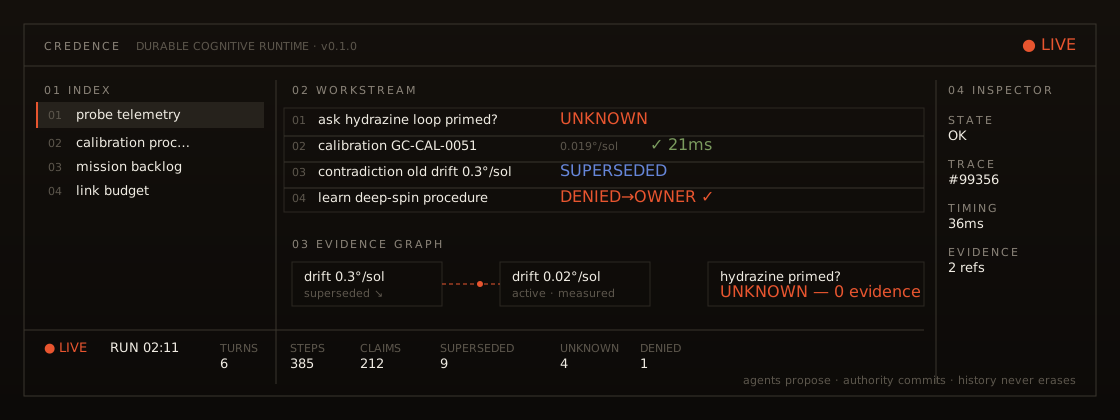
MOST AGENTS REMEMBER TEXT. THIS ONE REMEMBERS EVIDENCE.
credence is an evidence-first agent memory and durable mission runtime. Not a vector store, not a RAG pipeline, not an orchestrator — the layer underneath all of them: an append-only knowledge ledger where every belief carries its evidence, every correction preserves its history, every learning passes an authority gate, and every mission survives its process.
(A timed replay of a real npm run demo:kill run — those are actual captured output lines and PIDs, not a mockup. Run it yourself below.)
Requires Node ≥ 22.6. No install step, no API key, no model — the whole demo is deterministic and local.
git clone https://github.com/MajidAsghariTabrizi/credence
cd credence
npm run demo:kill
That kill-and-resume is one of four signature moments. Or run them one at a time:
| Moment | Command | What you see |
|---|---|---|
| I DON'T KNOW | npm run demo:unknown | A question with hearsay but no evidence → UNKNOWN, with the reason. No guessing. |
| I CHANGED MY MIND | npm run demo:contradiction | New calibration contradicts old belief → old claim superseded, never erased, full chain inspectable. |
| I LEARNED — BUT NOT BY MYSELF | npm run demo:governed | Worker agent proposes knowledge → DENIED. Owner commits. The worker then reuses what it was denied the right to teach itself. |
Or run everything: npm run demo.
Every headline claim in this README has a test, a command, or a fixture behind it — see PROOF, NOT PROMISES.
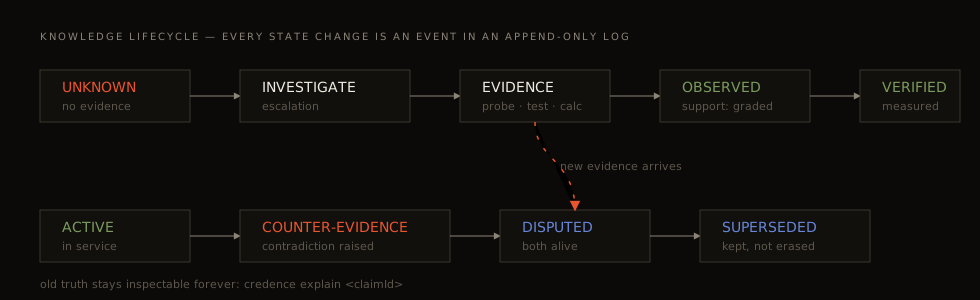
A claim is not a string in a vector. It is a record:
claim c_e21f0106
  text        "star tracker drifts 0.02°/sol after firmware 2.1 recalibration"
  support     measured            (measured > inferred > reported)
  basis       "post-firmware-2.1 calibration run GC-CAL-0051"
  evidence    e_cal0051 — 21-sol drift series, slope 0.019, r²=0.99
  state       active              (active | superseded | disputed)
  supersededBy []                 (grows — never rewrites)
ask returns unknown — with the reason and the nearest rejected candidate — whenever coverage is below threshold or evidence is absent. Retrieval rule → src/kernel/ask.ts · Demo → npm run demo:unknown
Corrections supersede. The old claim stays readable forever, linked to its replacement, with the contradiction event between them. Fold → src/kernel/store.ts · Demo → npm run demo:contradiction
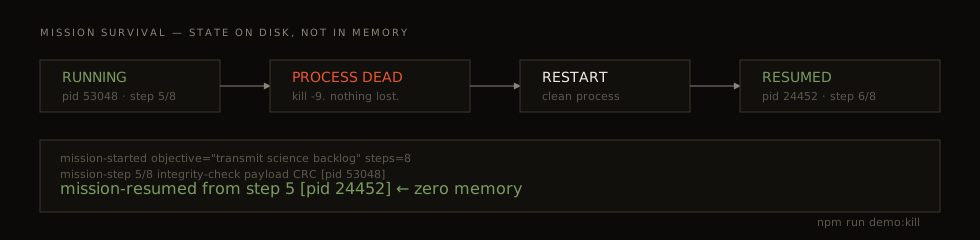
Mission state is an append-only log on disk (keel). Kill the process; a fresh one folds the log and continues. Mission state is operational state — it is never automatically trusted knowledge. src/kernel/keel.ts · Demo → npm run demo:kill
Agents may discover and propose. Only owner/lead commit durable knowledge. A denied commit is logged, not lost — the proposal waits for review. src/kernel/learn.ts · Demo → npm run demo:governed
| Claim | Run this | Read this |
|---|---|---|
| "It says I DON'T KNOW" | npm run demo:unknown | test/kernel.test.ts · unknown |
| "It changes its mind without deleting its past" | npm run demo:contradiction | store.ts · supersession fold |
| "Workers cannot commit" | npm run demo:governed | learn.ts · authority gate |
| "Missions survive process death" | npm run demo:kill | keel.ts · durable resume |
| "Retrieval quality is measured" | npm run bench | bench/ · fixtures + runner |
| "Zero dependencies" | cat package.json | — |
Benchmarks are synthetic, seeded (deterministic), and honest — latest results on this exact kernel: unknown-detection 1.00, hallucination-on-unanswerable 0, paraphrase recall 0.65 (token-coverage retrieval, no embeddings), ask latency p95 ~1.3 ms at 200 claims. Weak numbers stay published.
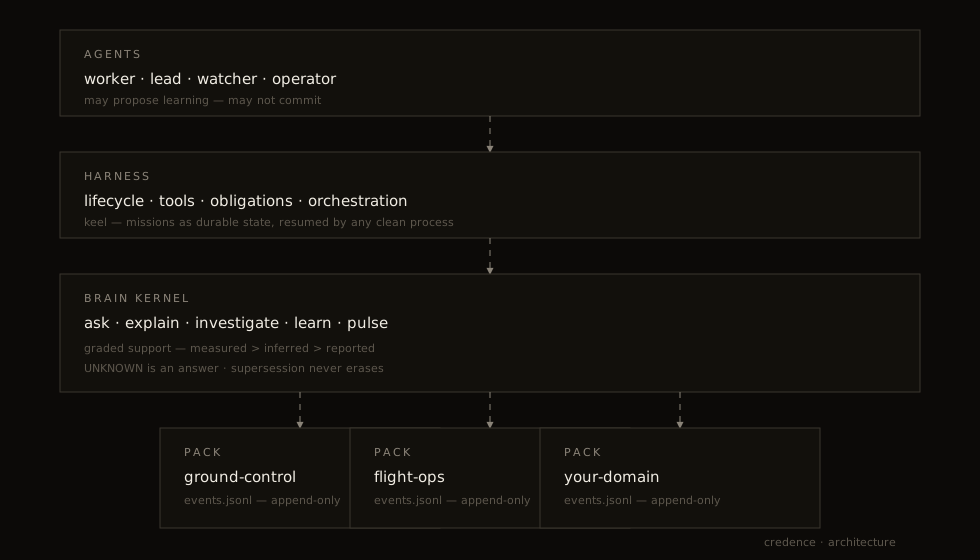
Agents      worker · lead · watcher · operator      (propose, never commit)
Harness     lifecycle · tools · keel missions       (durable operational state)
Brain       ask · explain · investigate · learn · pulse
Packs       ground-control/ … each an events.jsonl  (append-only, one fold away)
One process, one directory, zero dependencies. The event log is the database — no migrations, no server. Deep dive → docs/ARCHITECTURE.md.
ask scores every active claim by query coverage (fraction of your question's content tokens present in the claim) weighted by support grade. Below 0.45 — or any best match with zero evidence — you get state: unknown with why and the nearest rejected candidate. You can then investigate: collectors gather findings, split into durable candidates (commit via learn) and ephemeral observations (never commit — a measured value is wrong tomorrow).
A supersede delta writes two events: contradiction-raised (both ids + the note) and claim-superseded (old → new). The fold marks the old claim superseded and appends the successor id. explain <claimId> walks the whole chain. Nothing is deleted; the log only grows.
Caller identity is a role: owner, lead:*, agent:*, watcher. propose() records the delta as a pending proposal; agent/watcher commits are refused with a learning-denied event — the denial itself is part of history. owner/lead approve with commitProposal. Private claims (sensitivity: private) are filtered out of agent reads at the store layer.
Everything that was appended before the kill: claims, evidence, proposals, mission steps. The keel writes each step after it completes, so a kill mid-step replays that step — never skips, never duplicates. mission-resumed events count interruptions.
| Capability | Status |
|---|---|
| Append-only claim ledger, supersession, provenance | WORKING + TESTED |
| UNKNOWN detection (coverage + evidence gates) | WORKING + MEASURED |
| Authority model (propose/deny/commit) | WORKING + TESTED |
| Durable missions, kill-and-resume | WORKING + TESTED (single-process CLI scale) |
| Packs (domain stores) | WORKING (registry is minimal) |
| Token-coverage retrieval | WORKING + MEASURED — deliberately simple; no embeddings yet |
| Reflex / system-1 layer | NOT IMPLEMENTED |
| LLM-backed collectors | NOT IMPLEMENTED (collectors are deterministic functions — bring your own model) |
| DeepSeek Harness integration | EXPERIMENTAL — integrations/deepseek-harness/ |
This is v0.1.0: a small, complete, honest kernel — not a platform. The gaps above are the roadmap.
Credence is an integration target, not a dependency. The adapter exposes ask / learn / pulse to a DeepSeek Harness agent session via the kernel's programmatic API — an agent can consult the ledger and propose learnings (it will be correctly DENIED if it tries to self-commit). Unaffiliated with DeepSeek; the harness is just a good host.
Issues and PRs welcome — good first issues are marked. Read CONTRIBUTING.md. The kernel is ~700 lines of dependency-free TypeScript on purpose: read it in one sitting before extending it.
MIT · © 2026 Majid Asghari Tabrizi. The synthetic demo domain (probe MNEMOSYNE-7) is fiction; any resemblance to real spacecraft telemetry is a calibration error.
DeepSeek Harness(DSH)Web 插件聚合生态包 · 一切皆插件,创意工坊分发(dsh-market.com)
把回答做成一页可视化 HTML:模型只写简短的 Markdown 草稿,随包附带的 `am` 命令行生成页面,支持流程图、时序图、树、时间线、ER 图、表格和提示框。
在 dsh 里装上这个插件即可,无需登录、注册或填 API Key,就能使用包括 Muse Spark 1.3、MiMo V2.6 在内的前沿模型——完全免费,不限量。 All you do is install this plugin in dsh: no login, no sign-up, no API key — the frontier models are just there, Muse Spark 1.3 and MiMo V2.6 among them. Completely free, with no usage cap.

