
liangmianya/dsh-synapse
liangmianya/dsh-synapseDeepSeek Harness 的可视化非线性对话工作区:把会话、追问与分支变成可浏览、可拖拽的对话地图。

无论侧栏「归档显示」如何设置都强制隐藏已归档会话,并提供管理面板:取消归档,或彻底删除会话日志目录、归档与置顶登记及投影缓存。
Keeps archived sessions out of the DSH conversation list, and gives them one place to be restored — or deleted for good, which DSH itself deliberately has no path for.
Looking for the npm name
dsh-archive-manager? That one belongs to a different, unrelated plugin. This isdsh-archive-purge.
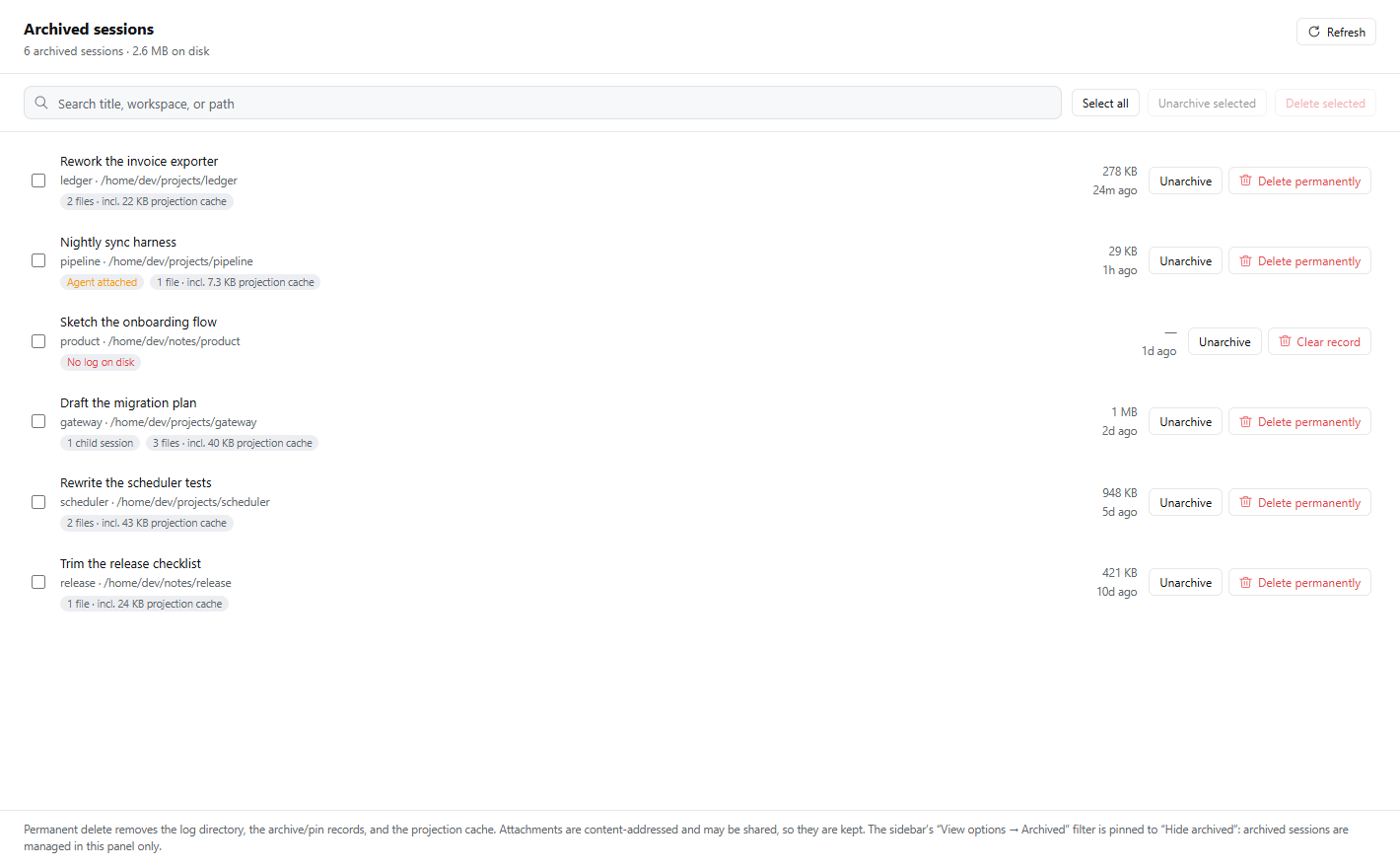
Every screenshot here is rendered from invented sessions — no real titles, paths or sizes.
DSH can archive a session, but:
dsh-client-ui-workspace documents no session deletion and dsh-session-persistence documents no delete seam, so archived sessions accumulate on disk forever.This plugin closes both: it pins archived sessions out of the list, and it owns the erase path.
dsh plugin --profile desktop add dsh-archive-purge
Use your own profile name in place of desktop (for example web). Then switch it on under Settings → Plugins, where it appears as dsh-archive-purge. Turning it off disables the host routes and the browser panel together and leaves session data untouched.
| Behaviour | |
|---|---|
| Always hidden | In the sidebar conversation list, an archived session row is never shown — whatever View options → Archived is set to. A component registered on shell.overlay writes [data-row-key="session:<id>"]{display:none} for every id in the registry's archivedSessionIds, plus a fallback rule keyed on the accessible description so archived search-result rows are covered as well. |
| Filter reset | The browser-persisted dsh.workspace.view.v5 has its archivedFilter reset to the shipped default (default, i.e. "hide archived"), so the menu stops claiming "All conversations (show archived)" while showing nothing. |
| Management panel | A sidebar icon plus a centre-column panel lists every archived session with its workspace, path, disk footprint, creation time and child-session count; it supports search, multi-select and batch unarchive. |
| Permanent delete | Delete sessions one at a time or in bulk, behind a confirmation dialog that names the sessions, their size, and exactly what will be removed. |
The panel takes its colours from the host's --dsw-alias-* tokens and ships English and Chinese wording, so it follows whichever theme and locale the app is in rather than a look of its own.
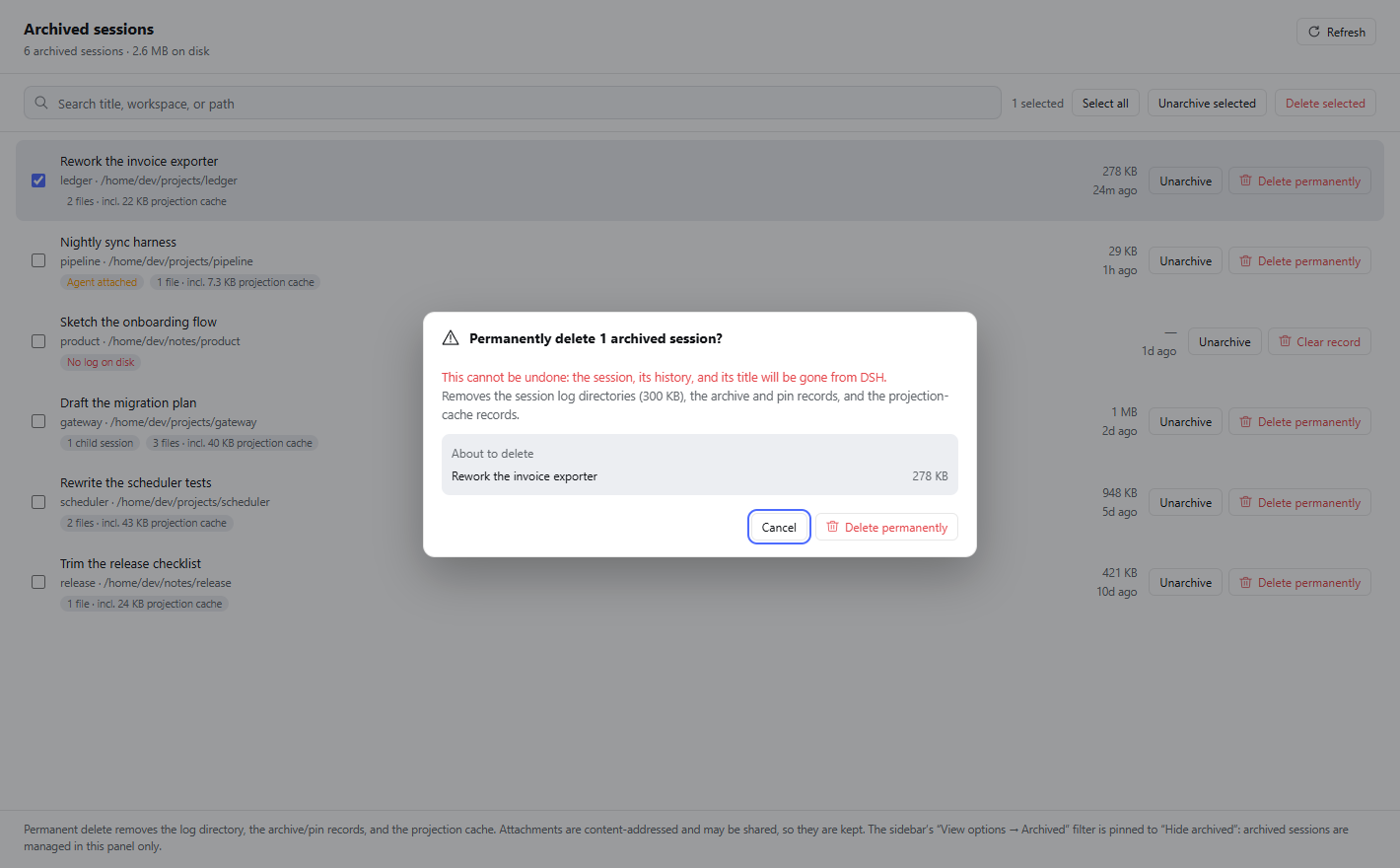
One delete removes four things:
<DSH_HOME>/sessions/<project>/<encoded-session-id>/ — the session's own directory, every format generation in it, and any session-local artifact;<DSH_HOME>/storages/session_projcache/sessions/<id>.json;archivedSessionIds / pinnedSessionIds in the workspace registry);api-session/removed remote event (@mode emit) so the client drops the row instead of leaving a clickable ghost.Deliberately kept: attachment files. Attachments are content-addressed and may be shared with other sessions, so they are out of scope. The panel says so at the bottom. An archived entry whose log is already gone from disk only has its record cleaned up, and the button reads "Clear record" instead.
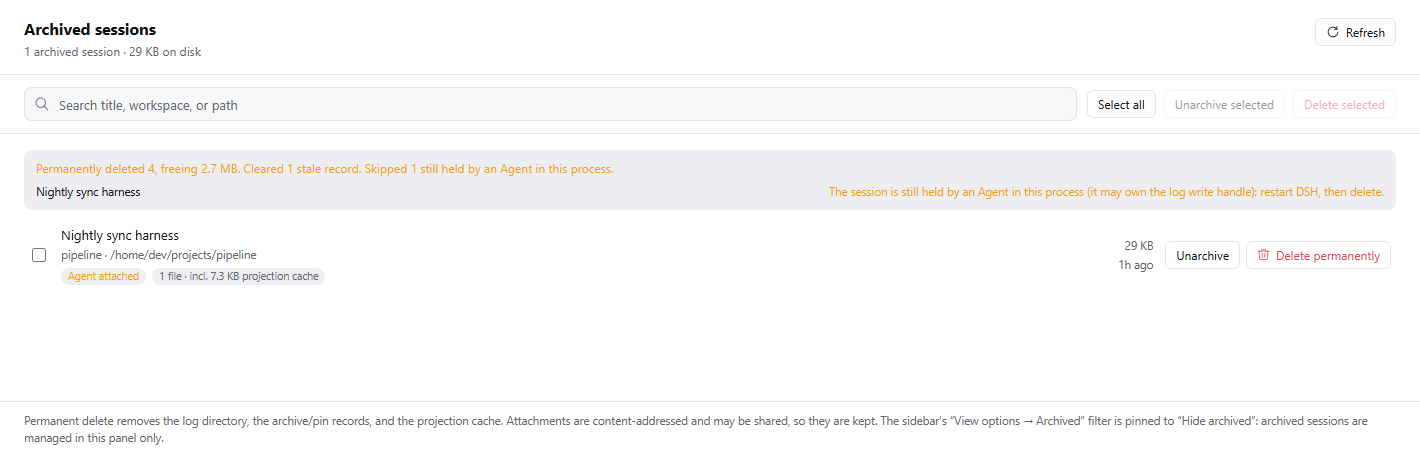
A batch reports each outcome separately: what was deleted and how much it freed, what had no log left to delete, and what was refused — named, with the reason.
ctx.agents.get(id)) → refused (live). An agent may already hold the log's write handle, and deleting the file underneath it would let the writer resurrect the log.workspace/session-activity waterfall still reports work in progress → refused (active).outside-root).Being merely loaded is deliberately not a refusal reason: the browser keeps an in-memory mirror for every rendered session row and never releases it, so refusing on that would make every archived session undeletable after enough browsing. The gate matches DSH's own archive gate (the activity waterfall) plus one cheaper agent check. Skipped and failed sessions are listed individually in the panel, with the reason.
DSH's browser session list is event-driven: it only adds and removes entries in response to api-session/added / api-session/removed. A deleted session also leaves the archive set, so in the sidebar it goes from "hidden" to "should be shown" — and the cached row becomes a visible, clickable row that fails with session/not-found when opened.
Two layers remove it:
ctx.emit('api-session/removed', id) — the remote event the session controller defines and forwards for exactly this fact. The client receives a { kind: 'remove', sessionId } change and drops the row. Emitting before the registry write avoids a flash where the row is un-hidden and then disappears.persistedIds — the session ids the host's persistence layer actually knows. The panel diffs the browser's cached ids against it, folds the remainder into the same hide rule, and shows the count under the title. The diff is recomputed on every read rather than accumulated, so one failed read cannot permanently hide a live session. Ids deleted within this page session are tracked separately as a union, since that needs no read to take effect.If you deleted sessions before both layers existed, those leftover rows need one page reload to disappear — the client re-fetches the list from the host on load. Deletions made afterwards do not leave them.
tables.workspaces.<id>.sessionIds is a persisted member array and the host exposes no "remove a member" operation (insertSessionBefore only inserts and orders). A deleted session's id therefore stays in that array. DSH tolerates missing members — it looks up a summary while deriving rows and skips what it cannot find — so this never renders as a row. It is bookkeeping residue, not a UI problem.encodeSegment function from dsh-session-persistence-jsonl. If a DSH upgrade changes the session directory layout, that function has to follow it. Until then a delete refuses (because the directory name is not the encoded session id, or holds no session log) rather than removing the wrong thing.data-row-key="session:<id>" attribute, which dsh-client-ui-workspace adds itself. If that ever changes, the aria-description fallback rule still applies.client.js is replaced by client-side HMR automatically.There is nothing to build — both halves ship as they are written. To check a change:
npm test
npm test runs 29 tests on node --test with no dependencies. The test directory is not part of the published package.
test/smoke.test.mjs drives both halves with a stub context and covers the invariants a rename breaks silently: the module id the client registers under, the route prefix the host mounts and the client calls, the slot keys the panel occupies, and the per-id hide rule.test/host-delete.test.mjs runs the real routes against a throwaway DSH_HOME on disk, so the log directory and the projection-cache record are genuinely created and genuinely removed. It pins every refusal to the branch that decides it, checks that a refusal touches nothing at all, and fixes the order the host documents — announce the removal, then rewrite the archive set.test/package.test.mjs checks the manifest against the published file set: everything DSH resolves at runtime — the entry point, the ./client export, the bundle patch — has to be listed in files, and no install lifecycle script may demand a build approval.DeepSeek Harness 的可视化非线性对话工作区:把会话、追问与分支变成可浏览、可拖拽的对话地图。
DSH 会话与工作区管理——工作区:归档与显示。会话:跨工作区移动、预设迁移、删除;收藏、待回看、优先级、标签、备注。批量操作。
把 append-only 会话日志导出为按轨迹来源分组的可读 Markdown 或 HTML。

