
dsh-web
zhu1090093659/dsh-webDeepSeek Harness(DSH)Web 插件聚合生态包 · 一切皆插件,创意工坊分发(dsh-market.com)

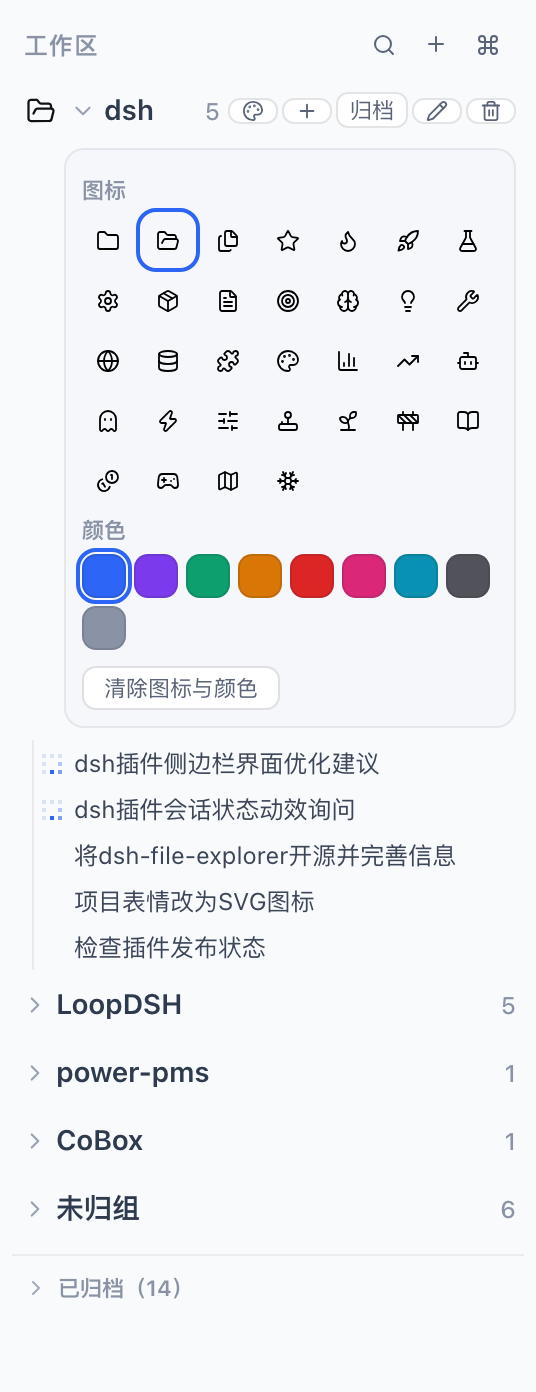
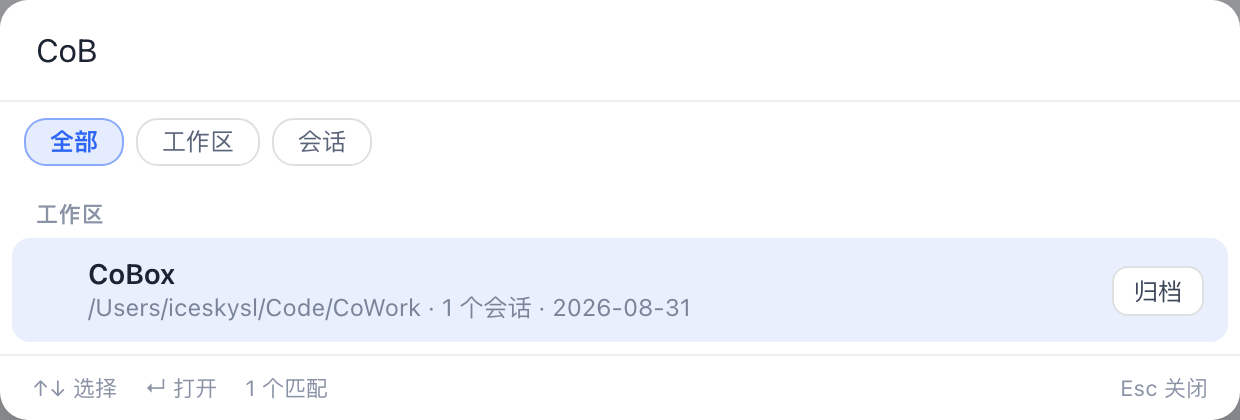
面向 dsh Web 的工作区优先增强侧栏:以低优先级 shadow 内置工作区浏览器(可一键切回官方版),提供软归档/恢复、每工作区 SVG 图标与强调色、拖拽排序与标题/路径/会话内容搜索;另提供 ⌘K Spotlight 面板模糊搜索工作区/会话;宿主侧附带只读 workspace_find/workspace_list 工具与 /workspace-find /workspace-list 斜杠命令(中英双语)。
GitHub: https://github.com/ice5kysl/dsh-workspace-kit | MIT License | Target dsh:
@deepseek-ai/dsh≥ 0.1.1-rc.2 | English · 简体中文
A dsh (DeepSeek Harness) plugin written to official conventions, in the Cordis "bundle" form. It solves two pain points:
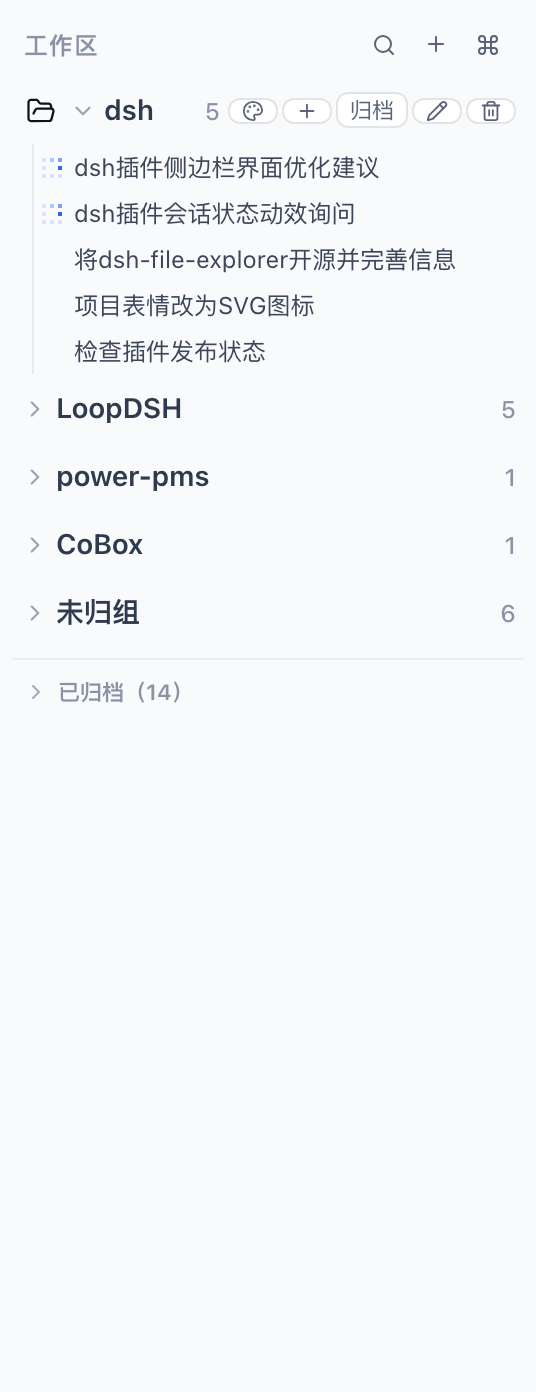
sidebar.workspaces slot at low priority (-1), replacing the shipped workspace browser — archived workspaces leave the "Workspaces" list and move into a collapsible "Archived (N)" section where you can restore / open / start a new session; ungrouped sessions live in their own section too.The plugin ships two faces carried by a single Loader entry (dsh-workspace-kit):
| Face | File | Responsibility |
|---|---|---|
| Host (node) | lib/index.js | workspace_find / workspace_list model tools; /workspace-find, /workspace-list slash commands (read-only lookup; write actions stay in the GUI) |
| Browser (client) | lib/client.js | Spotlight palette (registered into the official, otherwise-empty shell.overlay slot) + soft-archive store (localStorage-persisted) + enhanced sidebar browser |
Design rationale: dsh's official model only has session-level (irreversible) archiving and the shipped sidebar browser has no per-row hide seam, so this plugin takes a "view-layer soft archive + shadow the sidebar browser" approach: archive state is managed by the plugin (browser-persisted) and, by shadowing
sidebar.workspaceswith its own browser that carries the collapsible "Archived" section, archived workspaces truly leave the main sidebar list. The v1 capability boundary of the replacement browser is documented in known-limitations.md.
Beyond archive/restore, the enhanced sidebar (when active) adds:
insertBefore; drag sessions within their workspace → insertSessionBefore; once a workspace is manually dragged its sessions switch to the manual (account) order, matching the shipped Manual semantics.prompt/confirm.You can also say things like "use workspace_find to find the pms workspace" in a session, or type /workspace-find pms.
| Enhanced workspace sidebar | Per-workspace icon & color picker | ⌘K Spotlight search |
|---|---|---|
 |  |  |
All user-facing copy is bilingual (Simplified Chinese / English):
localStorage key dsh.workspace-kit.locale (zh | en) when set, otherwise from navigator.language(s) (zh* → Chinese, anything else → English).WSKIT_LOCALE environment variable (zh | en) when set, otherwise from LC_ALL / LANG (zh* → Chinese), defaulting to English.L('中文', 'English', vars?) helper backed by src/shared/i18n.ts; see the per-side src/client/locale.ts and src/host/locale.ts for detection.Published on npm — if you already run dsh Web, install in one line:
dsh plugin --profile web add dsh-workspace-kit
The git route below is for development / running the latest source.
Prerequisites: dsh on PATH (@deepseek-ai/dsh ≥ 0.1.1-rc.2), Node 20+.
# 0. Get the source (or use a local directory)
git clone https://github.com/ice5kysl/dsh-workspace-kit && cd dsh-workspace-kit

# 1. Build (produces lib/index.js + lib/client.js; the prepare hook of
#    npm install already runs the build for you)
npm install                # installs build-time deps (typescript/esbuild/@types …)
npm run build

# 2. Install into your web profile (equivalent to the official `dsh plugin add`)
bash scripts/install-personal.sh
#    The script locates this directory itself and runs
#    `dsh plugin --profile web add .`, which appends the package to
#    `dsh.profile.bundles` in ~/.dsh/profiles/web (after dsh-web-app) and
#    lets the in-package cordis.patch.yml insert the single Loader row.

# 3. Verify the composition (no restart needed)
dsh --profile web --dump-config | grep -n "workspace-kit"

# 4. Restart the GUI to activate
#    Quit the current dsh web (Ctrl+C or kill the process), run `dsh web`
#    again, then refresh the browser at http://127.0.0.1:3080
Also usable as a monorepo subdirectory (e.g.
plugins/dsh-workspace-kit): the install script walks up frompackage.jsonto find the plugin directory, so both layouts need no command changes.
npm pack          # produces dsh-workspace-kit-0.1.0.tgz (prebuilt lib/; prepack builds automatically)
# Other machine: dsh plugin --profile web add ./dsh-workspace-kit-0.1.0.tgz
npm run typecheck   # tsc --noEmit (host + client sources)
npm run build       # esbuild: src/host → lib/index.js; src/client → lib/client.js
npm test            # standalone smoke test of the host workspace tools/slash commands
Source layout:
src/host/      Host side: locale.ts (env-based locale), util.ts (search/list pure
               functions), tools.ts (model tools), commands.ts (slash commands),
               index.ts (apply: registers per service availability)
src/client/    Browser side: locale.ts (navigator-based locale), archive-store.ts
               (defineStore soft-archive set + appearance, persist localStorage),
               dialogs.tsx, SidebarToggle.tsx, Spotlight.tsx (⌘K palette),
               WorkspaceSidebar.tsx, index.ts (apply: slot registrations + closures)
src/shared/    i18n.ts (pure locale helpers shared by both faces)
cordis.patch.yml    bundle layer: inserts the single Loader entry `dsh-workspace-kit`
dsh.bundle.patch) + a browser face (dsh.client.platform: 'web' + the ./client export). The host scans enabled Loader entries; one package provides both the node and the browser side from the same entry, and one package may only have one entry (multiple entries resolving to the same package name are rejected by the client module system).shell.overlay (list/root) — the official slot reserved for whole-window custom overlays. The sidebar registers into sidebar.workspaces (single/root) at priority -1 to shadow the built-in occupant (lower priority renders; only equal priorities conflict) — the officially allowed "full replacement" route, at the cost of re-implementing some built-in browser capabilities yourself (see known-limitations).useWorkspaces / useSessions / useStore, plus useSessionStatus on dsh ≥ 0.1.6); actions go through registered inject closures that call the official UI services: ctx.uiWorkspace.startSession(workspaceId) (reuse/create and open that workspace's session), ctx.uiWorkspace.openSession(id) (select a session) and the workspace-controller calls for archive/rename/reorder.defineStore + persist (bare JSON in localStorage under dsh.workspace-kit.archive.v1), the same mechanism as built-in view preferences (e.g. dsh.workspace.view.v5).window keydown listener is attached (⌘K/Ctrl+K); the palette stays mounted and renders null while closed to keep the listener alive.@deepseek-ai/dsh v0.1.1-rc.2 (dsh web, profile web). The browser face targets that release's shell.overlay / IWorkspaces / ISessions contracts; re-validate against the upstream contract on version upgrades.ctx.sessions.open) and dsh ≥ 0.1.6 (navigation moved to ctx.uiWorkspace.openSession, and useSessionPendingInteraction → useSessionStatus). The browser face feature-detects both, so one build serves either. See npm test (tests/smoke.test.mjs).DeepSeek Harness(DSH)Web 插件聚合生态包 · 一切皆插件,创意工坊分发(dsh-market.com)
把回答做成一页可视化 HTML:模型只写简短的 Markdown 草稿,随包附带的 `am` 命令行生成页面,支持流程图、时序图、树、时间线、ER 图、表格和提示框。
在 dsh 里装上这个插件即可,无需登录、注册或填 API Key,就能使用包括 Muse Spark 1.3、MiMo V2.6 在内的前沿模型——完全免费,不限量。 All you do is install this plugin in dsh: no login, no sign-up, no API key — the frontier models are just there, Muse Spark 1.3 and MiMo V2.6 among them. Completely free, with no usage cap.

