
dsh-web
zhu1090093659/dsh-webDeepSeek Harness(DSH)Web 插件聚合生态包 · 一切皆插件,创意工坊分发(dsh-market.com)

Governed semantic layer for AI agents, with a DeepSeek Harness plugin that turns Harness into a data agent.
A governed semantic layer that helps AI agents understand business data and run safe, inspectable queries.
SemaRail turns database schemas, business definitions, relationships, rules, and reviewed SQL into a semantic context that AI agents can use consistently. It provides a visual Semantic Console for managing that context, a stable MCP interface for agent integration, and a governed query boundary for read-only data access.
For the optional Codex desktop integration, metadata policy, Trace API, and replay verification, see Codex desktop Trace v1.
SemaRail is agent-neutral. Any MCP-capable client can use its semantic tools through the authenticated HTTP endpoint or stdio bridge.
Status: Alpha. APIs, configuration, and storage formats may change before the first stable release. The Core tarball can be built from source; npm and PyPI packages are not published yet.
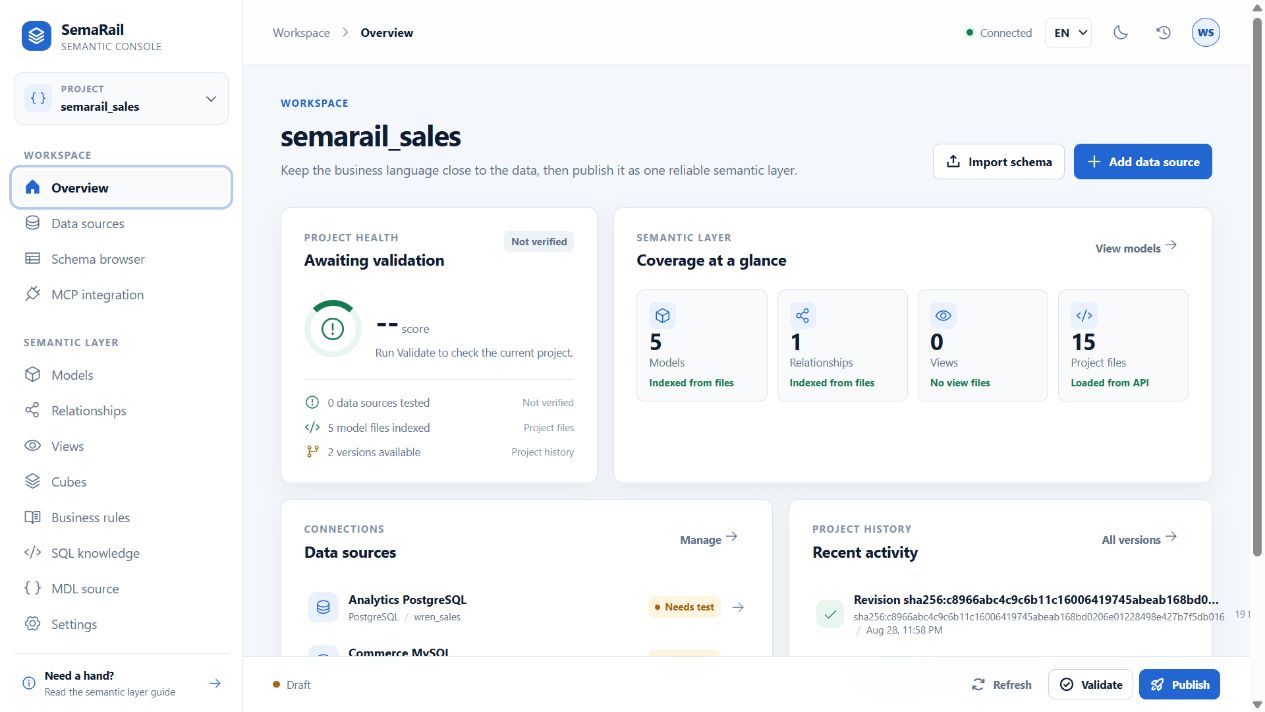
sqlglot, enforce table/column/row rules and physical-object allowlists, and apply read-only, timeout, row, byte, and concurrency limits.semarail_prepare_query returns ready.Datasource credentials stay on the server and are redacted from API responses. The standard Console installation includes PostgreSQL, MySQL, SQLite, ClickHouse, and DuckDB drivers for connection testing, schema browsing, and model import. Local SQLite and DuckDB files are opened read-only.
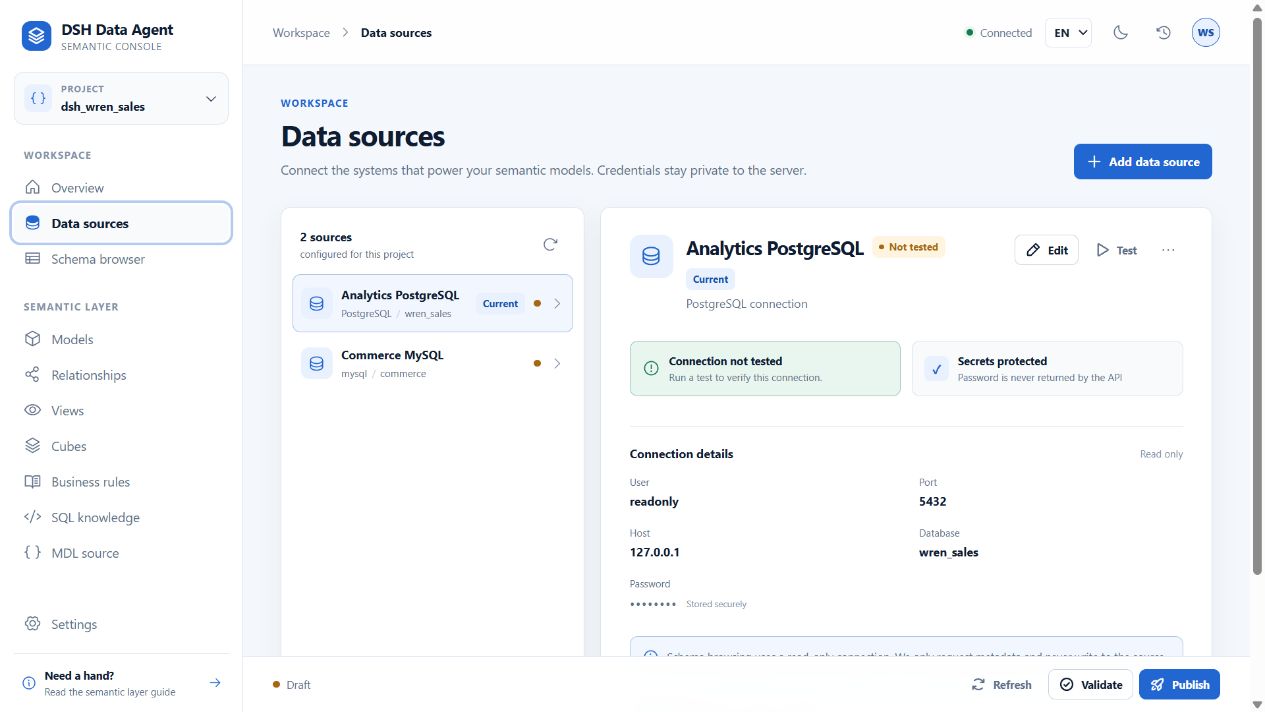
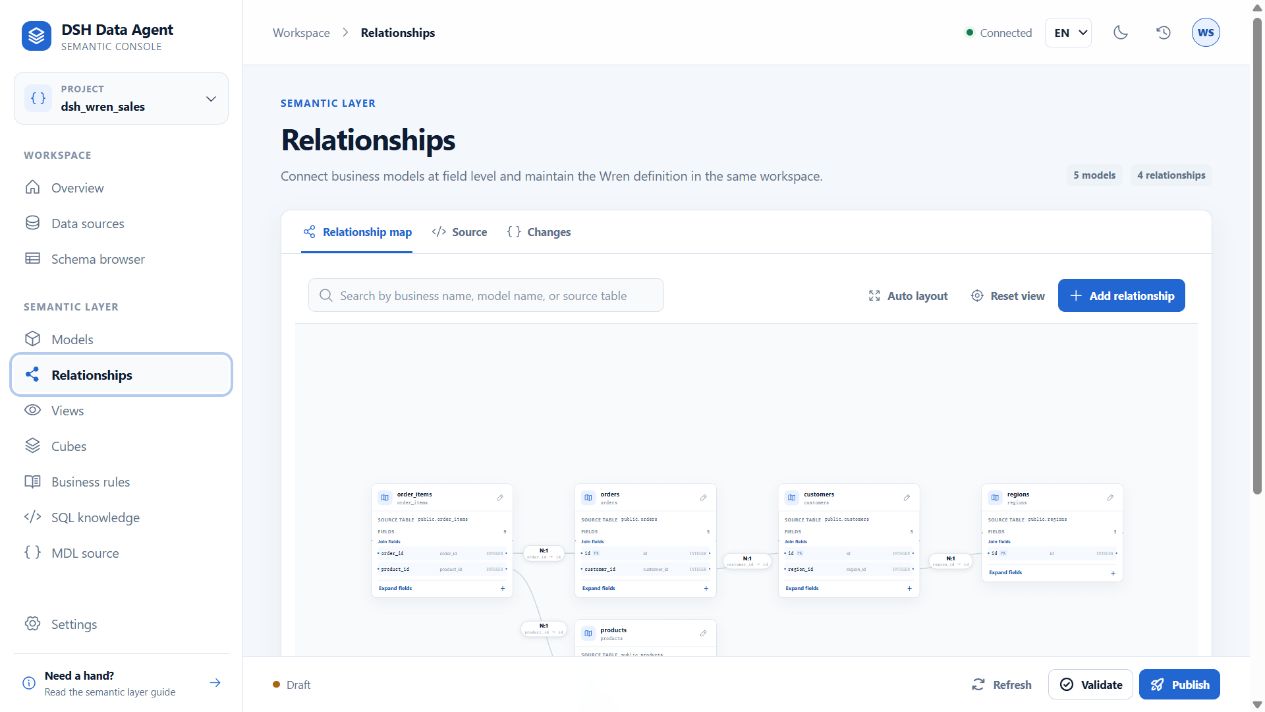
Edit business names, descriptions, visibility, primary keys, and field dictionaries while keeping generated semantic source and a unified diff nearby.
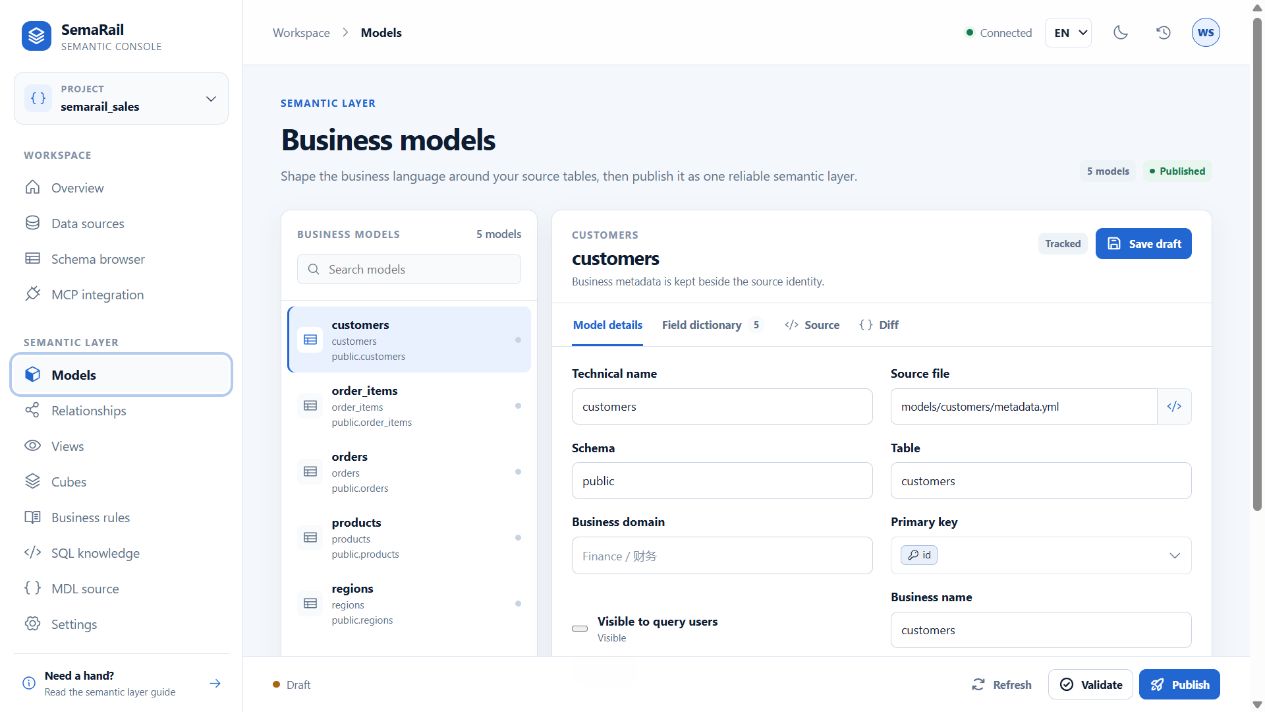
Explore and maintain field-level model relationships in an interactive graph.
Open Quality → Agent traces (质量 → Agent 追踪) to browse execution Traces by time and inspect the persisted event timeline. A Codex chat is a Session; each main Agent turn is one Trace.
| Console page | New functionality |
|---|---|
| Agent traces / Agent 追踪 | Trace list, Session/turn/Agent/subagent/tool/Core hierarchy, parallel activity, status, observed durations, Core authentication/policy/runtime phases, and evidence links. |
| Issues & feedback / 问题与反馈 | Open the originating Agent Trace from a Core traceId; failed tool Spans link directly to their corresponding issue. |
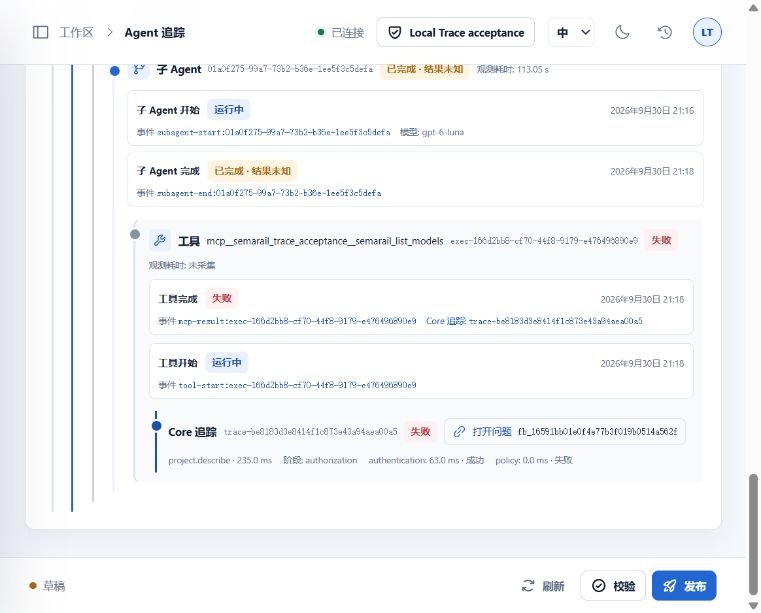
The first version provides structural replay and error location. See Trace v1 setup, API, boundaries, and desktop verification for configuration and acceptance details.
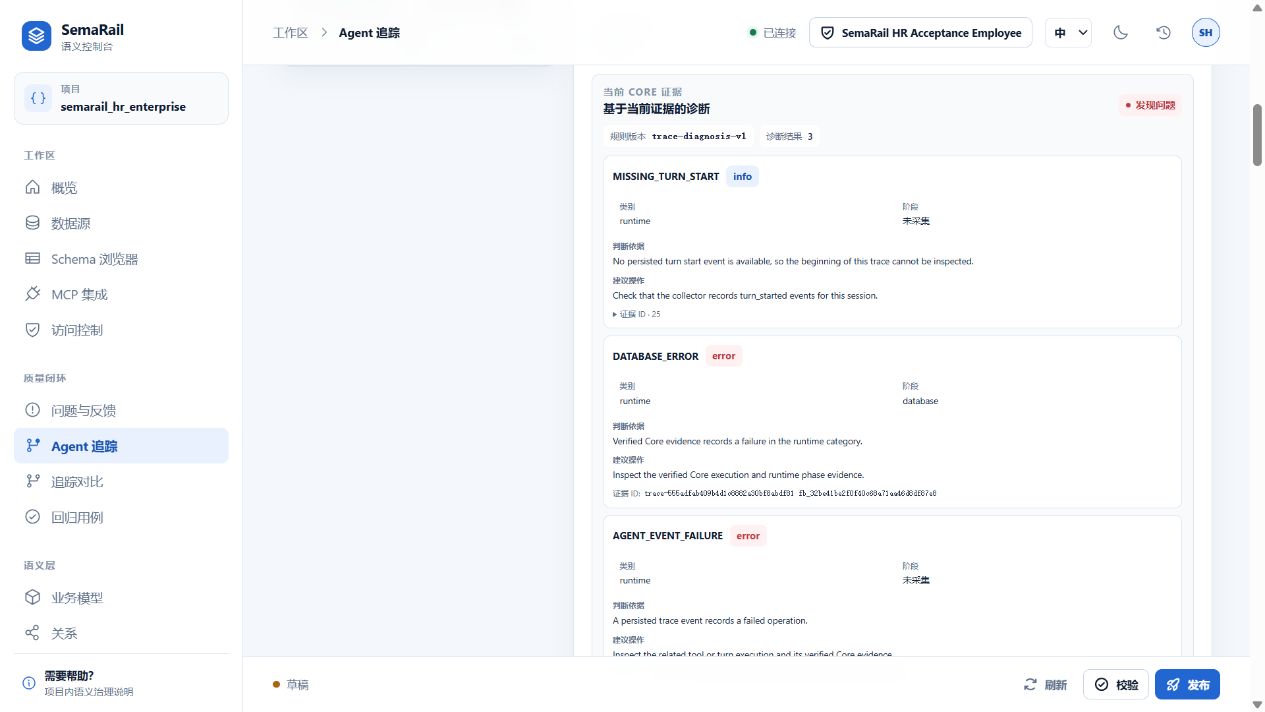
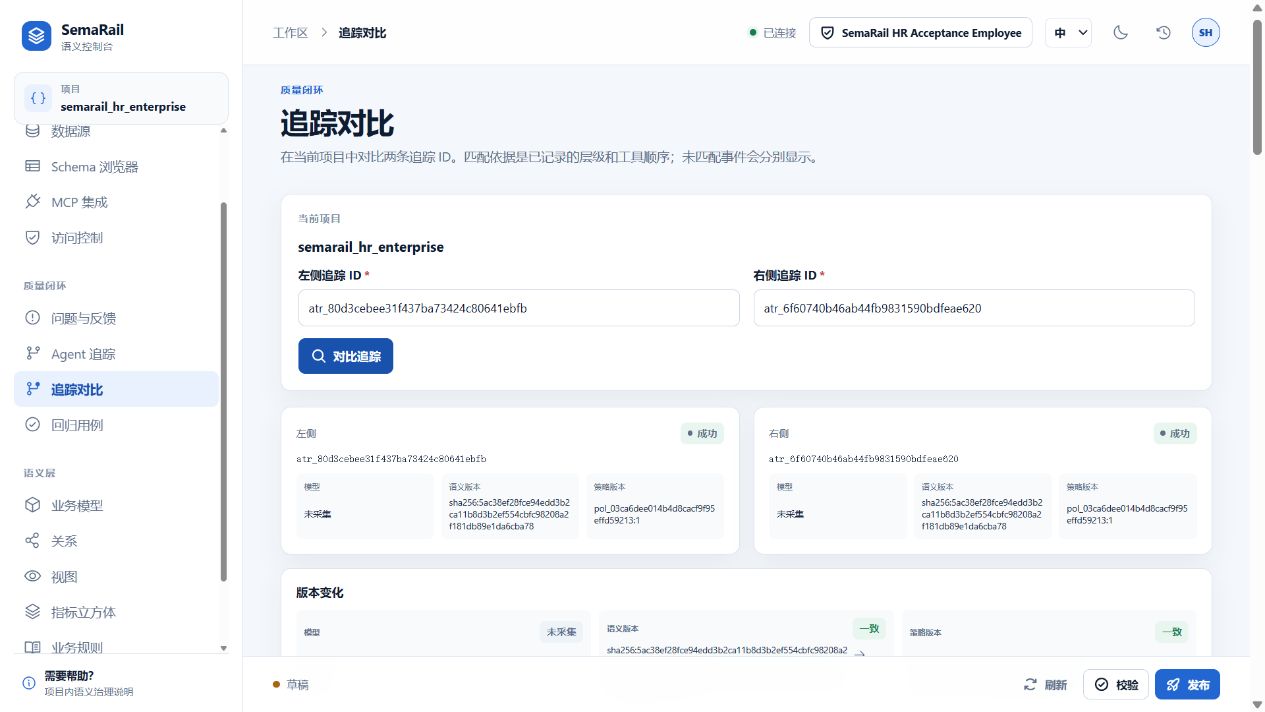
The Quality section adds an independent Trace comparison page and extends Agent traces with session/subject/time/status/issue filters, rule diagnosis and collector health. Findings link to observed evidence; slow Core phases are inspection items. Comparison preserves all observed semantic versions and reports a version change as unknown when either Trace lacks the metadata. Parallel or incomplete activity stays unmatched when correspondence cannot be established.
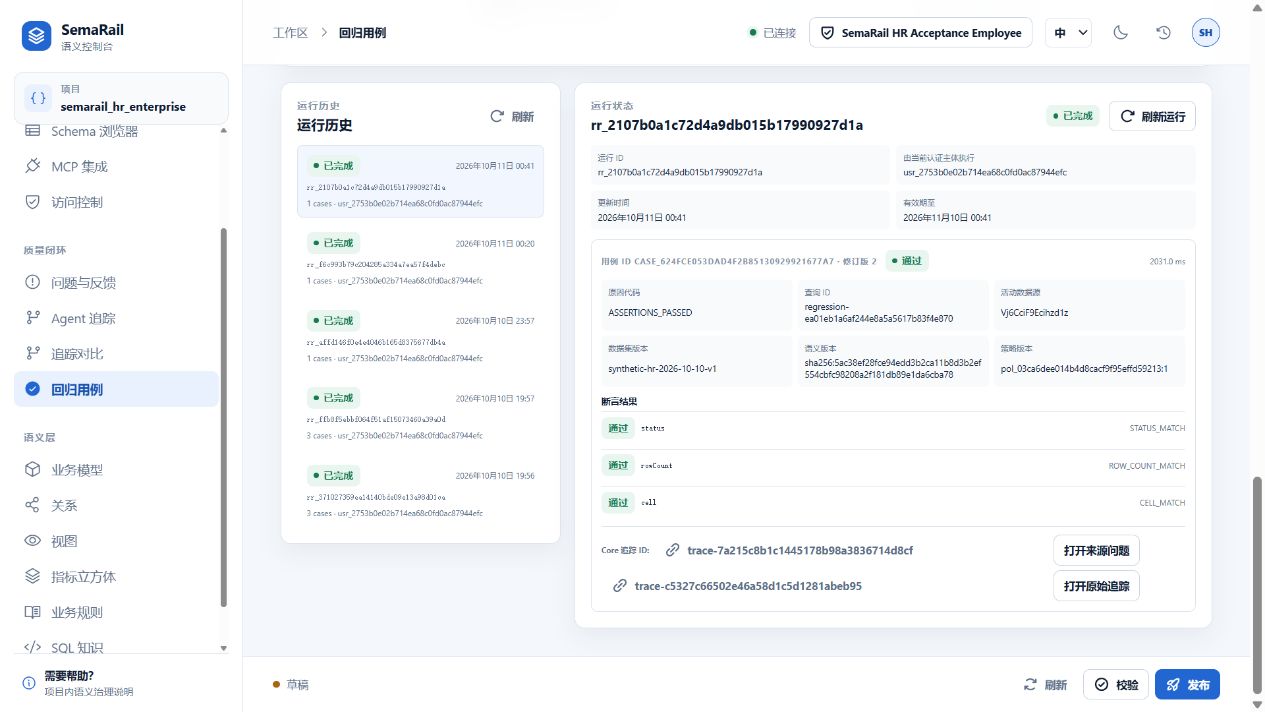
Regression cases supports registering test datasets, reviewing manual question/SQL/clarification inputs, creating drafts, then editing and enabling versioned assertions, running up to twenty cases serially, cancellation and durable run history. Execution uses the current managed caller through Core, and only runs when the active datasource matches the registered test environment. History links to safe Core diagnostics and the source issue/Trace. Result values are not retained in runs; incomplete or ambiguous results are marked inconclusive. Creating a case from an issue opens a blank manual form; it seeds only the feedback ID and an Agent Trace ID when its Core association is verified. Cancel is asynchronous and run history reports the terminal status after the worker settles.
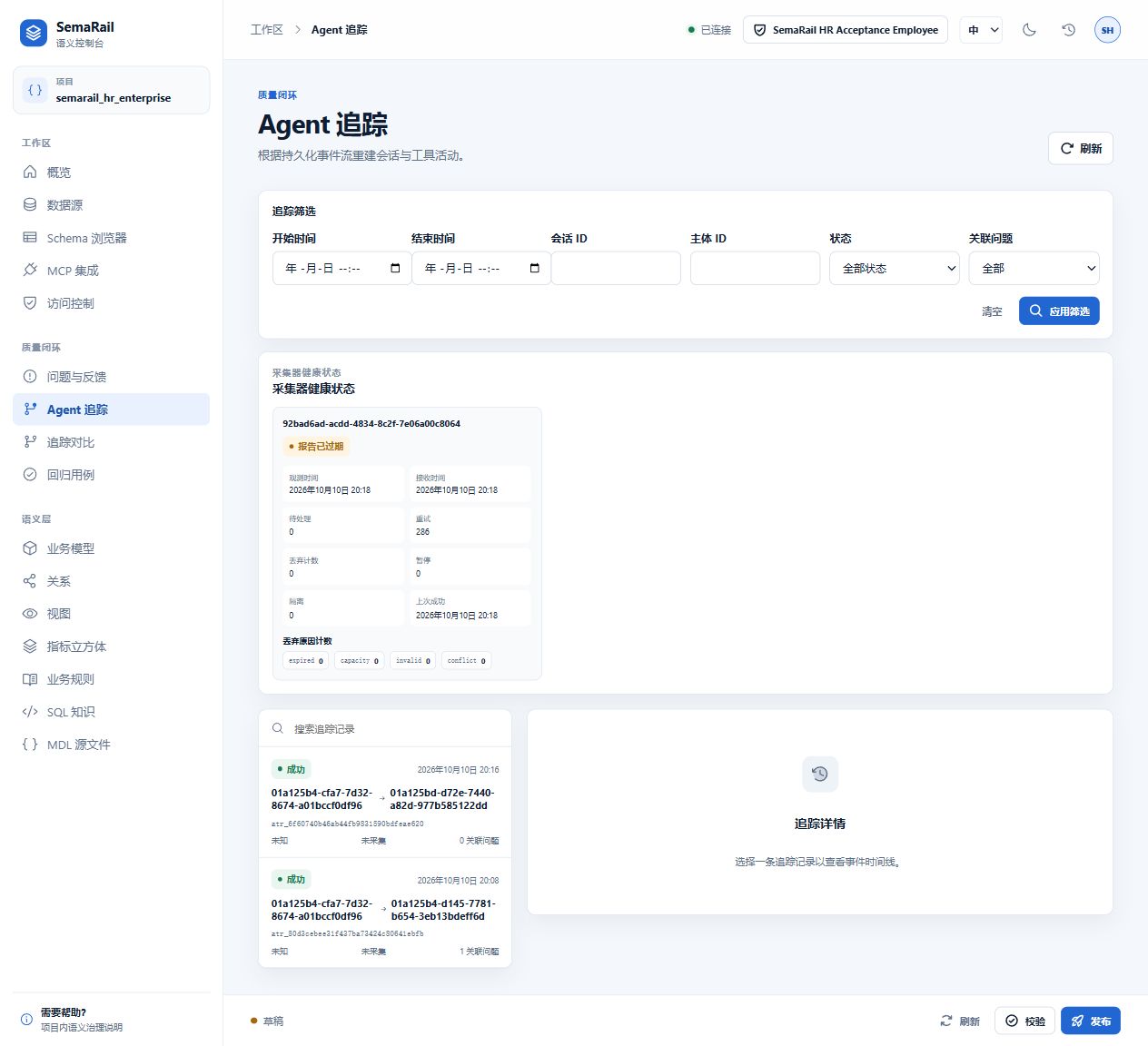
The optional Codex plugin persists safe events before background delivery, retries recoverable failures, and exposes local queue status/flush/cleanup commands. Console health reports show backlog and freshness without estimating unobserved losses. See Trace v2 setup, contracts and boundaries.
The following pages show the isolated synthetic HR acceptance environment.
Agent traces: delivery backlog, retries and report freshness
Trace detail: evidence-based diagnosis
Trace comparison: failed execution and manually corrected execution
Regression cases: reviewed assertions, run history and Core evidence
See the Trace v2 acceptance record for delivery recovery, desktop correlation, privacy and regression verification.
This roadmap highlights major project milestones. For file-level release notes, see CHANGELOG.md.
| Date | Status | Milestone |
|---|---|---|
| 2026-08-30 | Completed | Established the SemaRail brand, Semantic Console, and stable semantic MCP contract. |
| 2026-08-31 | Completed | Added DingTalk and OIDC employee sign-in, revocable sessions, trusted subject attributes, and administrator-managed account access. |
| 2026-09-01 | Completed | Added project-, datasource-, table-, column-, and row-scoped authorization with immediate policy and credential revocation. |
| 2026-09-02 | Completed | Added multi-user authenticated MCP, PostgreSQL-backed access-control storage, transaction-local subject context, and PostgreSQL RLS isolation. |
| 2026-09-03 | Completed | Hardened permission-control acceptance with real PostgreSQL 17 tests, first-request MCP query startup, clean Linux CI builds, and A/B employee row-isolation verification. |
| 2026-09-04 | Completed | Added bounded query-result delivery: up to 50 rows and 128 KiB inline, otherwise a revocable 15-minute CSV artifact with a 20-row Agent preview and 16 MiB ceiling. |
| 2026-09-10 | Completed | Added versioned detailed query errors and traces, independent 30-day diagnostics, explicit feedback and reviewed regression cases, and Core-enforced query clarification rules. |
| 2026-09-30 | Completed | Added the Agent Trace workbench, metadata-only Codex lifecycle collection, Core RPC v3 correlation, parallel replay, and bidirectional issue navigation; verified enabled and unenabled desktop chats. |
| 2026-10-11 | Completed | Added Trace v2 delivery recovery, collector health, evidence-based rules, independent Trace comparison, and reviewed manual query regression with durable history and Core evidence links. |
| Next | Planned | Extend governed query execution beyond PostgreSQL while preserving the same policy, limits, audit, and cancellation contract. |
| Next | Planned | Add a managed CSV/Excel ingestion workflow backed by DuckDB, without exposing uploaded files or local paths to Agents. |
| Later | Planned | Publish versioned SemaRail Core packages after the alpha installation and upgrade flow is stable. |
sqlglot for structural SQL validationRequirements:
^22.19.0 || >=24>=3.11Until the package is published, build the local Core tarball from the repository:
pnpm install
pnpm package:core
npm install --global .\dist\hejielijob-semarail-core-0.1.0-alpha.4.tgz
$env:SEMARAIL_API_TOKEN = semarail token create
semarail start --project C:\path\to\semantic-project
The Core process owns the semantic project, database credentials, execution limits, Semantic Console, and MCP servers. Open http://127.0.0.1:48763 after it starts. Keep SEMARAIL_API_TOKEN private: it is the local bootstrap-administrator credential used to create narrower, revocable service-account keys.
Requirements:
^22.19.0 || >=2411.x>=3.11git clone https://github.com/hejielijob-commits/SemaRail.git
cd SemaRail
pnpm install
pnpm build
For a larger, reproducible local validation against 100,000 synthetic employees and five authorization roles, see the HR enterprise benchmark. It runs separately from CI and requires Docker.
The benchmark contains 60 fixed questions drawn from enterprise HR scenarios, built on a reproducible dataset of 100,000 employees and 1.9 million PostgreSQL rows. It includes 30 basic reporting questions, 15 cross-model analytical questions, and 15 authorization-boundary questions in Chinese and English across five enterprise roles. Together, they validate the MDL models, relationships, metric rules, SQL knowledge, semantic planning, governed execution, and access control. All 60 questions passed.
The checked-in semantic layer and evaluation evidence include:
Create the Python environment and install the semantic runtime, MCP servers, Console, governed PostgreSQL query driver, and Console metadata drivers:
py -3.11 -m venv .venv
& .\.venv\Scripts\python.exe -m pip install `
  -e ".\python\sidecar[wren,mcp]" `
  -e ".\apps\semantic-console[wren]"
The repository includes a deterministic sales project for a local tour:
$stateDir = Join-Path $env:LOCALAPPDATA "semarail\semantic-console\sales-demo"
& .\.venv\Scripts\python.exe -m server `
  --project-dir .\examples\wren-postgres `
  --state-dir $stateDir `
  --static-dir .\apps\semantic-console\web\dist
Open http://127.0.0.1:48763. The server binds to loopback by default.
The default multi-user integration is SemaRail's authenticated Streamable HTTP MCP endpoint. It exposes the same seven stable tools to any MCP-capable Agent:
semarail_validate_projectsemarail_list_modelssemarail_get_contextsemarail_plan_querysemarail_prepare_querysemarail_governed_querysemarail_submit_feedback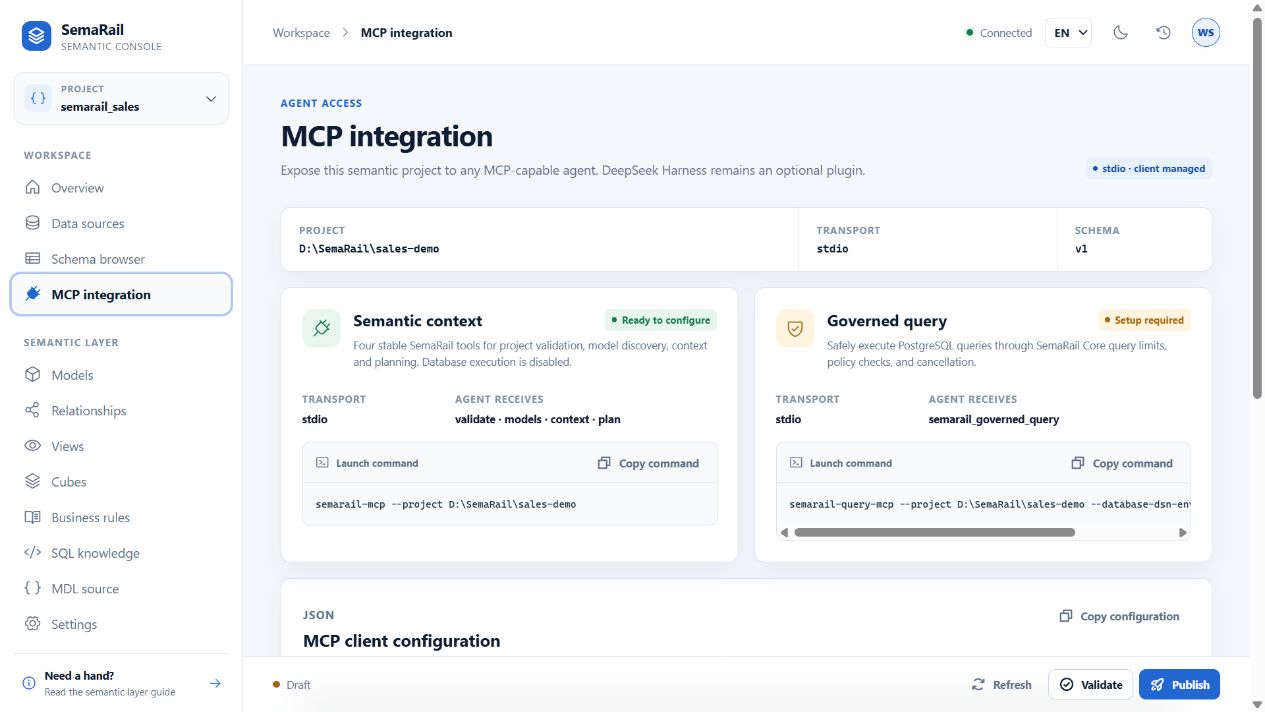
Start the MCP endpoint against the same project and state directory as Core:
$env:SEMARAIL_API_TOKEN = "<local bootstrap token>"
semarail mcp serve `
  --project C:\path\to\semantic-project `
  --state-dir C:\path\to\semarail-state
The endpoint is http://127.0.0.1:48764/mcp. The bootstrap token initializes
the shared control-plane store but is rejected by remote MCP. In Access
control, create a service account, assign trusted attributes, bind a
project/datasource/table/column/row policy, and issue a one-time key. Configure
that managed key in the Agent's private environment or secret manager:
{
  "mcpServers": {
    "semarail": {
      "url": "http://127.0.0.1:48764/mcp",
      "transport": "streamable-http",
      "headers": {
        "Authorization": "Bearer ${SEMARAIL_TOKEN}"
      }
    }
  }
}
Every call re-authenticates the key or employee session and reads current policy,
so disabling an account, revoking a key, changing attributes, or unbinding a
policy affects the next request. Datasource credentials and project paths remain
inside Core and never enter MCP client configuration. Loopback is the safe
default; a non-loopback bind requires an explicit --allowed-host and a TLS
reverse proxy.
Governed query results use a bounded delivery contract. Results of at most 50
rows whose UTF-8 JSON representation is at most 128 KiB stay inline. Larger
results return at most 20 preview rows plus a temporary CSV download URL; the
full CSV is never inserted into the model context. Downloads expire after 15
minutes and are invalidated immediately when the issuing credential, subject,
datasource, or policy context is no longer current. The alpha query ceiling
remains 500 rows and the CSV ceiling is 16 MiB; this is not a bulk-export API.
Administrators may set SEMARAIL_ARTIFACT_TTL_SECONDS to a value from 60 to
86400 seconds; the default is 900 seconds and MCP callers cannot override it.
After generating candidate semantic SQL, an Agent calls semarail_prepare_query
with extracted business conditions. Core applies the rules published for the
referenced models and returns ready, needs_clarification, or blocked.
Required or explicitly confirmable conditions cannot be bypassed by calling the
query endpoint directly, including through an older client. Open-ended language
interpretation and answer extraction remain Agent responsibilities; Core validates
the structured conditions and one-query preparation record.
semarail_submit_feedback is explicitly declared as a write operation. It accepts
only a query or trace owned by the current caller and supports idempotent retries.
Failures are captured automatically with bounded redacted question/SQL evidence;
successful executions retain metadata only unless the user submits feedback. No
result rows or full Agent conversation are stored. Administrators can classify
issues, advance their workflow, link duplicates, create reviewed regression cases,
and export versioned JSON from the Console's Issues & feedback and
Regression cases pages.
SemaRail Core includes a local management API for service accounts and externally authenticated employees, one-time API-key issuance, key rotation/revocation, short-lived employee sessions, versioned policy bindings, and audit events. Policies can restrict tool scopes, projects, physical tables, columns, query limits, and rows derived from trusted subject attributes. Mandatory row predicates are injected with bound database parameters before execution; missing or malformed permissions fail closed.
Policy schema version 2 can also filter business rows through a pre-expanded, tenant-scoped employee permission table in the active PostgreSQL datasource. The lookup is non-recursive, parameterized, evaluated on every query, and does not grant the Agent direct access to the permission table. See Access control.
For example, if the mapping contains A -> B and B -> C, A can read B but
does not inherit access to C. Add A -> C explicitly when A should see both.
The trusted attributes.employeeId value is maintained by an administrator in
Access control; an identity provider's displayed employee number is not
promoted automatically. PostgreSQL profiles must retain their password (or use
an equivalent server-side secret source) so Core can reconnect after startup.
For example, two agents can run the same sales query while account A is restricted to region CN-JIA and account B to CN-YI. Updating the account attributes or policy is effective on the next request. See Access control (alpha) and the architecture decision.
Employees can sign in through a configured DingTalk or generic OIDC provider with semarail auth login --provider <id>. The browser callback never receives a SemaRail bearer token; the initiating CLI exchanges a one-time device code for a bounded session and then enters the same Subject/PolicyEngine path as an API key. New employees have no data policy until an administrator assigns trusted attributes and a policy in Access control. See Access control (alpha) for provider configuration and security boundaries.
For an Agent that only supports stdio, log in once and configure the bridge as its MCP command:
semarail auth login --provider dingtalk --endpoint http://127.0.0.1:48763
semarail mcp bridge --endpoint http://127.0.0.1:48763
The bridge reads the ACL-protected employee session written by semarail auth login and forwards every tool to Core's authenticated runtime. It does not load
Wren, open a database, accept a Subject/policy/DSN argument, or print the token.
For a service account instead, set SEMARAIL_MCP_TOKEN in the bridge process's
private environment. Use --token-env <NAME> to select another environment
variable name.
semarail-mcp and semarail-query-mcp remain available for compatibility and
isolated local evaluation. They directly load the project/Sidecar and therefore
do not provide per-user Subject resolution, immediate policy changes, or
identity audit. Do not use them as a shared employee or multi-tenant boundary.
Use authenticated HTTP MCP or semarail mcp bridge instead.
Run MCP acceptance tests with:
pnpm acceptance:mcp
pnpm acceptance:core
All model-generated SQL is treated as untrusted input.
sqlglot.| Path | Purpose |
|---|---|
apps/semantic-console | Local Python server and React Semantic Console. |
python/sidecar | Semantic planning, SQL policy/execution, framed RPC, and MCP servers. |
packages/contract | Shared versioned Core, MCP, and Console contracts. |
packages/core | Independently installable SemaRail Core CLI/runtime distribution. |
examples/wren-postgres | Deterministic sales project and golden-question corpus. |
scripts | Packaging, acceptance, and evaluation gates. |
pnpm typecheck
pnpm test
pnpm build
pnpm acceptance:core
pnpm acceptance:mcp
Additional integration gates:
# Run the real PostgreSQL 17/RLS gate. It requires administrator settings and
# creates, then cleans, isolated test database/role fixtures. The gate also
# verifies permissionLookup principals, tenants, non-recursive mappings, and
# immediate visibility of mapping-table updates through the framed Sidecar.
pnpm acceptance:postgres
# Run the PostgreS
DeepSeek Harness(DSH)Web 插件聚合生态包 · 一切皆插件,创意工坊分发(dsh-market.com)
把回答做成一页可视化 HTML:模型只写简短的 Markdown 草稿,随包附带的 `am` 命令行生成页面,支持流程图、时序图、树、时间线、ER 图、表格和提示框。
在 dsh 里装上这个插件即可,无需登录、注册或填 API Key,就能使用包括 Muse Spark 1.3、MiMo V2.6 在内的前沿模型——完全免费,不限量。 All you do is install this plugin in dsh: no login, no sign-up, no API key — the frontier models are just there, Muse Spark 1.3 and MiMo V2.6 among them. Completely free, with no usage cap.

