
dsh-web
zhu1090093659/dsh-webDeepSeek Harness(DSH)Web 插件聚合生态包 · 一切皆插件,创意工坊分发(dsh-market.com)

Host-neutral execution boundary for workflow-self-recursive: resolves one exact Workflow Package, binds an immutable Delivery Manifest, coordinates the Delivery, emits bounded OTLP observations. Install via dsh plugin add wsr-dsh-intake · 与宿主无关的 Agent 工作流执行边界:解析并校验确定的工作流包,绑定不可变交付清单,协调交付并发出有界观测。
English | 中文
Turn every agent conversation into an auditable, recoverable, version-bound delivery.
The Execution System is the host-neutral execution boundary of crystra: it resolves and validates one exact Workflow Package, binds it in an immutable Delivery Manifest, coordinates the Delivery inside an isolated Runner-owned execution context, recovers from the last durable boundary after crashes, and emits bounded observations over OTLP — observation never controls execution.
The Execution System is a host-neutral product, not a plugin. DSH is one entry point among several:
| Form | Package | Audience |
|---|---|---|
| Embedded library | crystra-execution | Host-neutral embedding — import ExecutionApplicationFactory and bootstrap with create(configFile, dependencies) |
| DSH plugin entry | dsh-crystra | DeepSeek Harness users — run workflows from chat and sidebar tabs |
| CLI | execution-config (in crystra-execution) | Configuration init / copy / validate / dump-effective |
The DSH plugin is the first product entry; every admitted Workflow Action runs in a Runner-owned, isolated DSH execution context (DSH-E), never in the Intake context (DSH-I).
| Bare agent chat | What actually happens | Execution System |
|---|---|---|
| Execution is a black box | What the model did, and with which workflow definition, cannot be audited afterwards | Every Delivery binds one exact version + SHA-256 into an immutable Manifest |
| Interruptions lose state | After a crash or restart there is nowhere to look | Manifest/current-slot persist; /crystra recover resumes from the last durable boundary |
| Version drift | The same request can execute different definitions at different times | Exact name@version selectors, immutable GitHub assets, and a validated exact-content READY cache |
| Observation couples to execution | A telemetry outage can take the run down with it | One-way, best-effort OTLP; Execution continues when Evidence or telemetry is unavailable |
Three modules carry the responsibility:
READY Workflow Package (selector → validation → local MISSING/STAGING/READY store) and constructs the Manifest content.The default Source is the configured firestige/crystra-workflow-package GitHub Release. implementation-workflow@0.3.0 and system-design-workflow@0.3.0 are downloaded, validated, and published to the local READY store; neither is embedded in an Execution artifact.
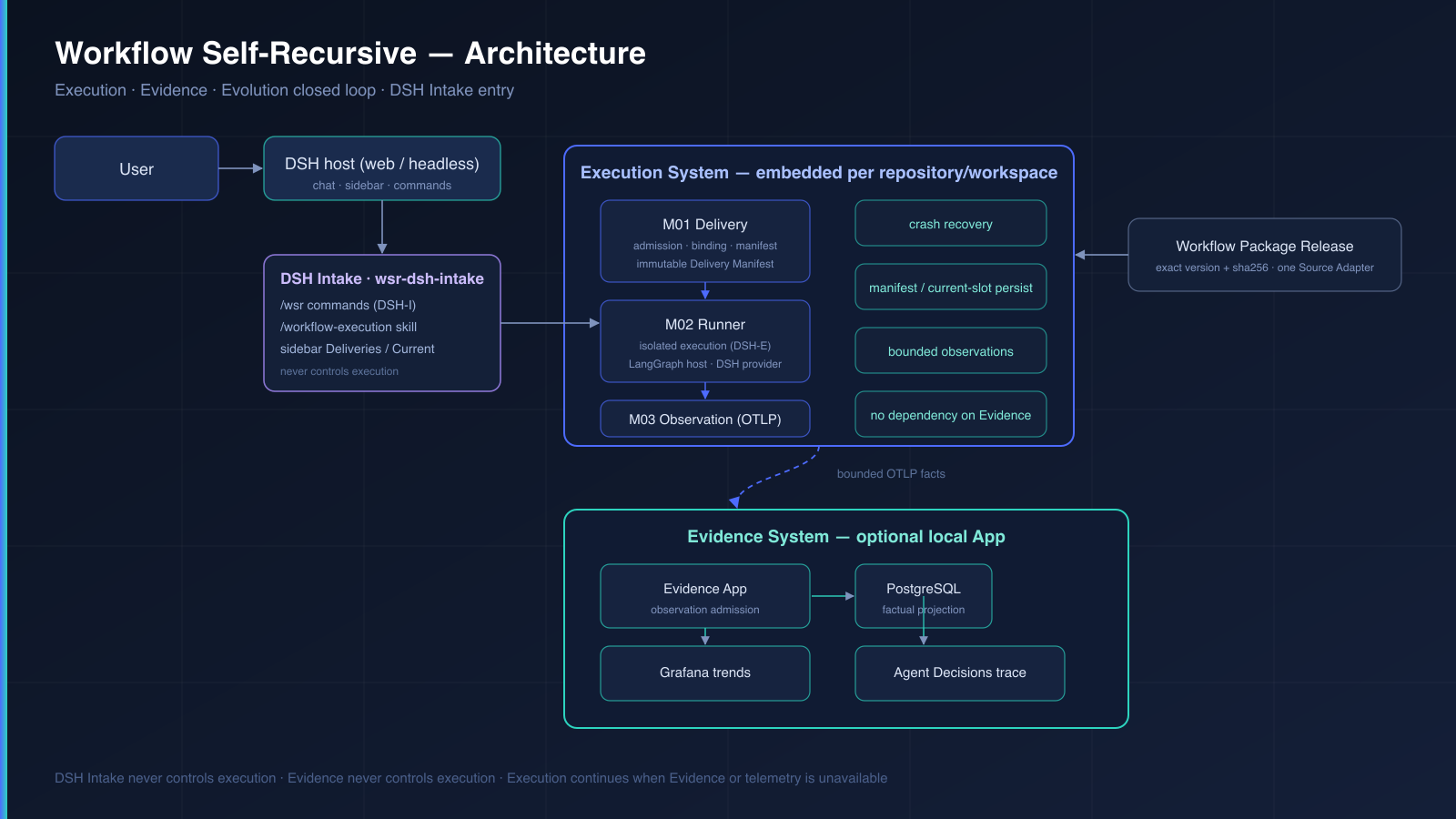
The only public DSH plugin is dsh-crystra, owned and registered by firestige/crystra-dsh. Its release pins this core as an ordinary, exact GitHub Release tarball dependency. Follow that repository for plugin installation and setup; no separate Execution plugin or installer is distributed.
Crystra RC artifacts are available for isolated qualification. packages/dsh-intake is a private regression fixture pending consolidation into that plugin.
/crystra list                         # privacy-safe Delivery and worktree state
/crystra create <name|name@latest|name@version>
/crystra recover [delivery-id]
/crystra status [delivery-id]
/crystra action finish
/crystra abandon [delivery-id]
The explicit first-party skill /workflow-execution performs exactly one closed operation through the DSH-I-only workflow_execution_intake tool.
| Dimension | Requirement |
|---|---|
| Node.js | >=24.12.0 <25 |
| DeepSeek Harness | 0.1.5-rc.2 (@deepseek-ai/dsh) |
| Workflow Package contract | agentops.workflow-dsl@2.0.0 |
| Observation contract | agentops.observation@1.0.0 |
| Checkpoint store | better-sqlite3 (native build, approved via allowBuilds) |
0.1.x is intended for trusted local use by individuals and small teams; compatibility-breaking changes are possible.observation.enabled: true with a loopback OTLP base endpoint to enable the non-controlling exporter.web profile is the reference assembly; a custom profile contains only dsh-base and is not an interactive Intake surface.For host-neutral embedding, import ExecutionApplicationFactory, DefaultExecutionApplicationFactory, ExecutionRequest, TaskPrompt, and the configuration types from the package root. Calling the default factory's create(configFile, dependencies) is the single production bootstrap path. The exact DSH runtime is an optional peer: package-root import/type consumers need not install it, while executing the current dsh Provider requires the embedding profile to provide @deepseek-ai/dsh@0.1.5-rc.2. The release includes config/schema/execution.config.schema.json, versioned defaults/examples, compiled TypeScript declarations, and execution-config init|copy|validate|dump-effective.
execution.config@2.0.0 is the production multi-Provider path and contains no installation-wide Provider or model default. DefaultExecutionApplicationFactory registers the exact bundled DSH, Copilot SDK and Codex CLI Provider factories unless an embedding supplies an explicit registry. Each Agent-action Role must be present in <canonical-worktree>/.crystra/role-provider-bindings.json with an exact Provider identity/version and Provider-owned model coordinate. Admission validates required Workflow capabilities, freezes the factory descriptor digest into execution.delivery-manifest@2.0.0, and never performs priority selection or fallback. Recovery accepts only the same descriptor and starts realms only for Providers actually used by the persisted Delivery. See config/schema/execution.config.v2.schema.json.
The default Copilot factory registers provider.copilot@1.0.78 and reuses the local logged-in user through the exact bundled SDK. The default Codex factory registers provider.codex@0.144.5 and reuses Codex CLI's local login state. Neither path asks the embedding host for token material. Every Delivery realm admits only model coordinates frozen for its Roles and fails closed on runtime, login, model, recovery, or binding drift.
Unpublished Workflows do not require a GitHub release. Pack a compiled package containing definition/package.json and its declared resources:
workflow-local-source pack /absolute/path/my-workflow /absolute/path/private-workflows/source.json
For a source checkout, use node dist/configuration/local-source-cli.js pack ... after building. The command prints the exact selector and the workflowSource configuration to put in the Execution installation configuration:
{
  "kind": "adapter",
  "adapterKey": "workflow.local.v1",
  "adapterConfigFile": "/absolute/path/private-workflows/source.json"
}
This source accepts only exact selectors such as my-workflow@1.2.3-rc.1. Bare names, latest, and version ranges cannot select a local package. The default public GitHub source excludes prereleases, including explicit RC selectors. There is no network fallback from the local source.
The catalog records the name, exact version, relative archive path, and SHA-256. Execution checks the archive bytes and uses the same schema/snapshot/resource validator. Local packages use a separate cache; a cached entry does not bypass current local-source validation. After changing a Workflow, regenerate valid digests/snapshot and use a new exact version (for example 1.2.3-rc.2); packing different bytes over an existing coordinate is rejected. Recovery of an admitted Delivery keeps its frozen binding.
This repository is normally consumed as a submodule of crystra:
git clone --recurse-submodules https://github.com/firestige/crystra.git
To clone it standalone:
git clone https://github.com/firestige/crystra-execution.git
Exact Workflow Package resolution can consume one qualified aggregate Crystra Workflow RC when no package-scoped release exists. It verifies the candidate receipt, metadata digest, all four asset digests, and source/contract bindings before admitting the archive. Multiple matching candidates fail closed; a package-scoped release takes precedence. This enables RC combination qualification without publishing GA.
The latest selector continues to exclude aggregate RCs; request an exact name@version for candidate integration.
See runtime migration and qualification scope for the rc.2 alignment.
The default production registry includes provider.dsh@0.1.5-rc.2 (dsh-headless), with structured completion and Action interaction. It runs the pinned DSH headless runtime inside an isolated Delivery realm; it does not attach to a running DSH UI session or load its ambient plugins. The optional @deepseek-ai/dsh@0.1.5-rc.2 peer must be installed when using this Provider; other Providers do not start or load DSH.
Set each applicable Role in .crystra/role-provider-bindings.json (replace role.reviewer with the actual Workflow Role):
{
  "schemaVersion": "execution.repository-role-provider-bindings@1.0.0",
  "bindings": {
    "role.reviewer": {
      "agentProvider": { "identity": "provider.dsh", "version": "0.1.5-rc.2" },
      "model": { "provider": "deepseek", "model": "deepseek-chat" }
    }
  }
}
The development lockfile pins the DSH component closure to rc.2 as well; the upstream CLI package uses ranges that can otherwise select a later RC. The adapter reads the public Session.ownEvents() API. Existing Deliveries retain their original provider descriptor and cannot silently resume under this new version; use the matching old runtime for those Deliveries or admit a new Delivery with the updated binding.
Authentication stays inside the Provider. It reads DEEPSEEK_API_KEY from the process environment first, then the same reference in $DSH_HOME/.credentials.yaml (default ~/.dsh/.credentials.yaml, DSH version: 1 / refs format). Missing credentials fail when opening a session. It does not copy keys into bindings, manifests, or recovery records. Existing strict file-only legacy adapters retain their previous behavior.
DEEPSEEK_BASE_URL selects a local/proxy OpenAI-compatible DeepSeek endpoint; the default is https://api.deepseek.com. A local endpoint must accept DSH's DeepSeek chat/tool-call protocol and the explicit model coordinate. deepseek and deepseek-official are supported model-provider coordinates. Planning queries the same endpoint’s GET /models API and returns its exact model IDs under the deepseek provider coordinate. An empty catalog stays empty; missing credentials, endpoint failures, malformed results and timeouts report unavailable, without hard-coded model fallbacks. Discovery uses a bounded read-only request and does not create a Delivery, Session or state directory. modelQueryTimeoutMs defaults to 10 seconds (the production composition uses startupTimeoutMs). DSH profile patch settings and .env files are not automatically imported.
Embeddings can instead register createDshAgentProviderFactory({ stateDirectory, credentialPath, credentialRef, baseURL, turnTimeoutMs }) from crystra-execution. Only stateDirectory is required. Connection settings select transport/authentication, never a fallback model. The production factory uses executionTimeoutMs as the turn deadline.
Session persistence is isolated by Delivery, manifest and canonical worktree. Restoring requires the persisted opaque identity and matching session/Role/model/connection binding. Cancellation, timeout and provider errors become explicit failed dispositions; a timed-out session cannot run again. The Provider disposes its sessions and runtime with the Delivery realm.
DeepSeek Harness(DSH)Web 插件聚合生态包 · 一切皆插件,创意工坊分发(dsh-market.com)
把回答做成一页可视化 HTML:模型只写简短的 Markdown 草稿,随包附带的 `am` 命令行生成页面,支持流程图、时序图、树、时间线、ER 图、表格和提示框。
在 dsh 里装上这个插件即可,无需登录、注册或填 API Key,就能使用包括 Muse Spark 1.3、MiMo V2.6 在内的前沿模型——完全免费,不限量。 All you do is install this plugin in dsh: no login, no sign-up, no API key — the frontier models are just there, Muse Spark 1.3 and MiMo V2.6 among them. Completely free, with no usage cap.

