

dsh-web
zhu1090093659/dsh-webDeepSeek Harness(DSH)Web 插件聚合生态包 · 一切皆插件,创意工坊分发(dsh-market.com)

Use your VPS inside DeepSeek Harness as seamlessly as over SSH: curated zero-token commands, plus the AI in the conversation can operate the server.
在 DSH 中和 SSH 一样无感地使用 VPS,除了精选的部分常用命令之外,使用时还能让对话中的大模型对 VPS 进行操作。
English · 简体中文
Install: search for dsh-vps-manager in the DSH plugin market and click install; or quit DSH completely and run the line below in a terminal (for command-line dsh web, replace desktop with web; see Install). Then open DSH and add a machine under Settings → VPS Manager.
dsh plugin --profile desktop add dsh-vps-manager
Manage your VPS from DeepSeek Harness (DSH): check server status with commands that skip the model and cost no tokens, tell the AI what to do and let it work on the server, see how the server is doing on one page, open a real terminal or move files in the conversation when you want to do it yourself, and handle common installs and maintenance with recipes.
It works with DSH on Windows, macOS and Linux, in both DSH Desktop and command-line dsh web, and several computers (home, office) can manage the same server at the same time.
You enter the password once when adding a machine; from then on everything uses SSH key login and shares one execution mechanism: operations that change things run as remote tasks and keep going if the connection drops; changes on the same machine run one at a time; config files are backed up before they are edited; an automatic restore is set up on the server before firewall or SSH changes; and every run is written to an audit log.
Want DSH itself running on your VPS? See the sister project dsh-vps: one command on the VPS installs stock DSH behind a login page with automatic HTTPS, reachable from any browser, with settings, API keys and the plugin market all working, and new DSH releases upgraded with one click in the page. The two work together: install this plugin in the DSH on your VPS and manage that server right from the conversation.
| Capability | What it does |
|---|---|
| Zero-token commands | 22 /vps- commands: check status, install software, reboot and wait for the machine to come back, without touching the model |
| VPS mode | One click in the conversation header and that conversation operates the server; each conversation has its own binding, so one window can work on the server while another keeps working on local code |
| Real connection state | Header squares: grey not selected · yellow connecting · green connected · red unreachable, with the reason and a retry button |
| Terminal in the conversation | A real terminal (xterm.js over ssh -tt) where menu scripts, top and vim work; red / yellow / green buttons to end, minimize and maximize; nothing lost when you minimize or switch conversations, and it reconnects after a drop |
| Status in the conversation | One page for how the server is doing: rule-judged "needs attention" items first (failed services, full disks, expiring certificates, pending security updates), then ring meters, disks, services, containers, ports, firewall and more; click Interpret for a few sentences from DSH's default model. Expand it into DSH's right sidebar to keep it open beside the chat, refreshing every minute while visible, and pick any of your machines to look at |
| Files in the conversation | A file browser for the server: drag in to upload, right-click to download, double-click to edit, deletes go to a trash you can restore from; backups before overwriting or editing; right-click "let the AI look at this file" |
| AI on the server | 5 tools with risk-tiered confirmation: read-only runs automatically, changes ask you, dangerous commands ask again; levels can be set per machine, group or globally |
| Three safeguards | Files are backed up before editing and restored if validation fails; a connectivity safety net before firewall and SSH changes; long operations run as remote tasks that survive disconnects |
| Commands that fit the system | A health check finds the OS, package manager, init system, privilege, running services and containers, and the model is told to write commands for that machine |
| Recipe library | 29 repeatable recipes (7 install · 6 configure · 16 query); anything the AI gets working can be saved as a recipe in one sentence |
| Settings page | Add a machine with one form (enter the password once, the key is put in place for you, the password is not stored), import from ~/.ssh/config, baseline configuration, terminal settings, uninstall |
| Three platforms, both kinds of DSH | Windows, macOS, Linux; DSH Desktop and dsh web. Terminal connections pass DSH's sign-in check, a same-origin check and the plugin token, and open only on the local computer by default |
| Several computers, one server | Each computer has its own key; changes queue on the server and say which computer is making them; trash, backups and task records are shared; uninstalling revokes only that computer's key |
| English / 中文 | The interface follows the language set in DSH and switches instantly, without a reload; server messages, /vps- command output and recipe names follow too |
| Light install | No native modules (no node-pty to compile); the only runtime dependencies are ws and yaml |
Three screenshots take turns here (1 → 2 → 3); click to step through them on the project page. Full size: 1 · 2 · 3
1 Settings → VPS Manager: the numbered machines · 2 Files below the conversation, VPS status kept in the right sidebar · 3 Where the main controls are
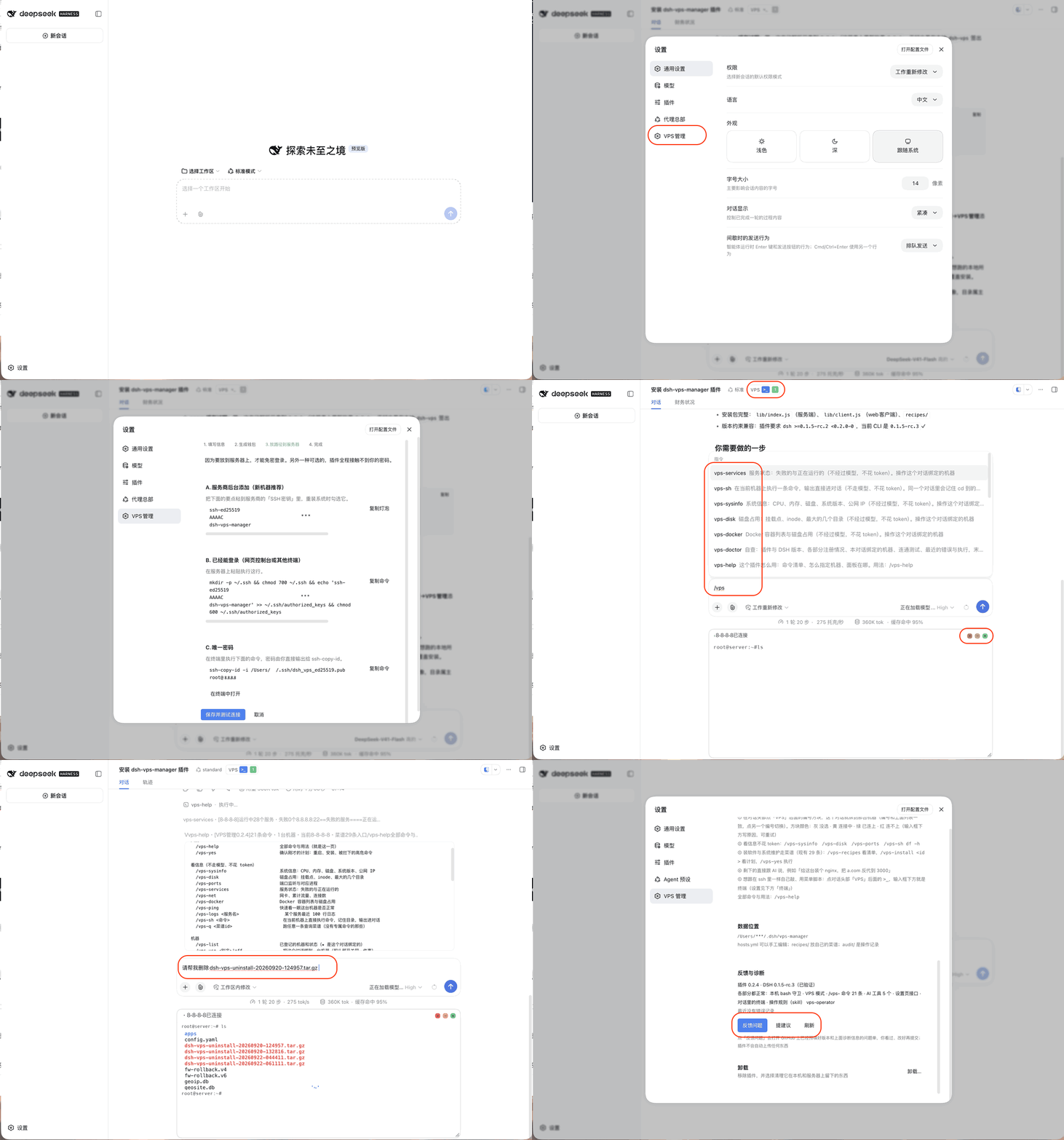
From installing the plugin to reaching the first machine (the address and user name in the recording are blacked out)
| Look things up | Talk to the AI | Install and maintain with recipes | |
|---|---|---|---|
| How | Commands like /vps-sysinfo | "Install nginx on this machine and reverse-proxy a.com to port 3000" | /vps-install <recipe id> shows the plan, /vps-yes runs it |
| Uses the model | No | Yes | No |
| Cost | Zero tokens | Normal token use | Zero tokens |
| Scope | Fixed read-only queries | Anything SSH can do, with confirmations by risk level | 29 recipes that are safe to run again |
dsh websudo that asks for a password is not supportedroot or to have passwordless sudo; read-only queries do not| Windows | macOS | Linux | |
|---|---|---|---|
| SSH client | The built-in "OpenSSH Client". Usually already installed on Windows 10 / 11; otherwise add it under Settings → System → Optional features | Built in | Built in; otherwise install openssh-client |
| Speed | The Windows build of OpenSSH has no connection sharing, so each command opens its own connection, a fraction of a second more | One shared connection, tens of milliseconds | One shared connection, tens of milliseconds |
| Copying in the terminal | Select text, then Ctrl+C (with nothing selected, Ctrl+C interrupts) | ⌘C | Select text, then Ctrl+C |
~ in data locations | Your user folder, C:\Users\yourname | Home directory | Home directory |
| How it is verified | On every push, GitHub's Windows 2022 and 2025 machines go through the full flow against a real server | The author's daily machine | On every push, the full flow against a real server; every 6 hours, a compatibility check against the latest DSH |
Everything works the same on all three: commands, the AI, the terminal, the Files page, recipes, the settings page and uninstall.
Interface language follows DSH: pick English or 中文 under DSH Settings → General → Language, and the plugin's settings page, conversation header, terminal and Files panel switch at once; server errors and hints, /vps- command output, and recipe names and plans use the same language. Those are the two languages DSH ships today; with another language pack installed, the plugin shows English or Chinese according to the pack's declared fallback.
Plugin market: search for dsh-vps-manager in DSH's plugin market (dshmarket) and click install. Works in both DSH Desktop and dsh web.
Command line: quit DSH completely first, then run the line for your DSH:
# Official DeepSeek Harness desktop app
dsh plugin --profile desktop add dsh-vps-manager
# Command-line dsh web
dsh plugin --profile web add dsh-vps-manager
dsh command: install it from the app menu, "Manage dsh command…". A dsh installed from npm cannot change the desktop app's plugins.--profile must come before add. Since DSH 0.2.0, leaving it out fails with required option '--profile <name>' not specified.For the latest code on GitHub (possibly newer than the release on npm), use github:AIcivilization/dsh-vps-manager as the package name instead.
Open DSH afterwards. Plugins are loaded when DSH starts. What changed in each version is listed under Releases.
To uninstall, open DSH Settings → VPS Manager, scroll to the bottom and click "Uninstall…" (see Settings page). You can also quit DSH completely, run dsh plugin --profile desktop remove dsh-vps-manager in a terminal (--profile web for dsh web) and reopen DSH; that removes only the plugin and keeps the machine list, keys, SSH configuration and audit log.
Open DSH Settings → VPS Manager → "+ Add machine". It is one form:
Click Save and connect:
~/.ssh/dsh_vps_ed25519 (your existing keys are left alone)~/.ssh/authorized_keys on the server (skipped if it is already there)~/.ssh/config.d/dsh-vps.conf, one Include line is added at the very top of ~/.ssh/config (backed up first to ~/.ssh/config.dsh-bak), and the machine is reached with the key and gets a health checkThe password is used once and never stored: it goes only into the environment of that single ssh process and reaches ssh through SSH_ASKPASS. It is not written to any file, log or audit record, and every later connection uses the key. Adding with a password only works on the computer running DSH, so the password never crosses the network.
A wrong password, a server that refuses password logins, or a changed fingerprint is explained right in the form. For a key-only server, expand "No password?" under the form: paste the public key into your provider's "SSH keys" page, or run a one-line command on a server you can already log in to, then click "The public key is in place, connect".
Machines already defined in ~/.ssh/config can be taken over with "Import from ~/.ssh/config". The plugin never rewrites what you wrote in ~/.ssh/config.
On Windows the paths are the same, with ~ meaning your user folder (for example C:\Users\yourname).
DSH on Windows, a Mac and Linux can each have the plugin installed and manage the same server at the same time:
authorized_keys gets one line per computer, commented dsh-vps-manager@computer-name, so you can tell them apartThe conversation header has a VPS switch: the word VPS, then the terminal button >_, then one small square per machine. Each square shows its number (1 for the first machine, 2 for the second, and so on), matching the numbers on the settings page.
A square's colour is the real connection state, not just whether it is selected:
A live check runs when you turn the switch on, open the conversation, or come back to the DSH window (tens of milliseconds over the shared connection, a fraction of a second on Windows). Every command, AI tool call and terminal connection also records whether it reached the server, and the square follows
Click a square: this conversation enters VPS mode. From then on /vps- commands act on that machine, and the plugin tells the model which machine this conversation operates on, what system it runs (package manager, init system, privilege), which program holds ports 80/443, which services and containers are running, plus a few rules it must follow (never guess names, handle systemd services only through systemctl, never turn a failed lookup into a restart or reinstall). The model writes commands for that system, and knows what you mean by "this machine" or "the server"
In VPS mode the model cannot use local bash: a call is refused with a pointer to the VPS tools, so the model does not investigate server problems on your own computer. Reading files, searching and similar tools are unaffected
Click it again: VPS mode ends, the square turns grey, and local bash is available again. With nothing bound there is no default machine at all: commands do not run, and the AI must name the machine it operates on
Each conversation can be bound to one machine at a time. A binding only applies to its own conversation: one window can operate the server in VPS mode while another keeps working on local code, without affecting each other
The same from the keyboard: /vps-use <alias> binds, /vps-use off unbinds
A machine that has never had a health check gets one in the background when the switch is turned on, so the model receives its system details
Nothing is shown below the input box, except a single line in three cases: a task is running on the machine, the machine is unreachable, or its disk is at least 85% full.
The >_ button right after VPS in the conversation header is the terminal. Once a machine is bound, click it and a real terminal opens below the input box, working just like an SSH session (with only one machine you can click it before binding, and it binds that machine for you):
top, htop, vim, docker exec -it, mysql and other programs that need keystrokes all work, as do Ctrl+C, arrow keys and CJK text. To copy: ⌘C on a Mac; on Windows and Linux, select text and press Ctrl+C (with nothing selected, Ctrl+C interrupts as usual)>_ button in the header is still a switch: not open → open; open → minimize; minimized → restore. While minimized it shows a small green dot/vps-sh when you want the AI to see its outputSettings (DSH Settings → VPS Manager → 界面 / Interface): colour scheme (follow system / dark / light, where follow system matches DSH's appearance), font size (11–20), how long to keep the terminal after a disconnect (5 minutes / 10 minutes / 30 minutes / 1 hour), and whether other devices may open it.
It works in both DSH Desktop and dsh web: the connection follows the page address (an https page automatically uses an encrypted connection). Every connection must pass three checks: DSH's own sign-in check, an origin that is the DSH page itself, and the plugin token embedded in that page. On top of that, by default the terminal only opens on the computer running DSH: when you reach dsh web through a LAN address or a reverse proxy, first tick "允许从其他设备打开 VPS 终端" (allow opening the VPS terminal from other devices) under DSH Settings → VPS Manager → Interface. The terminal is full control of the server, so only turn this on for access paths you trust.
No native module has to be compiled on your machine: the pseudo-terminal on the server is requested with ssh -tt, and window-size changes are applied over a second SSH connection. The terminal display is xterm.js (MIT licensed, bundled with the plugin and loaded the first time you open a terminal).
The terminal panel's title bar has a Terminal | Files | Status switch. Files is a file browser for the server this conversation is bound to:
/etc, /var/log, root, trash) and a clickable path on top; click the empty part of the path to type one (~ means home). Columns sort, and files starting with . are hidden until you turn on "show hidden files"~/.cache/dsh-vps/backups/ on the server, and keeps its mode and owner. New files get 644 and new folders 755, so web servers can read them. An upload that breaks off halfway leaves the original untouched.tar.gz as it downloads. Download managers installed on your computer (IDM, Folx and the like) do not get in the waysshd_config, firewall rules) are flagged at the top~/.cache/dsh-vps/trash) you can restore from; deleting permanently or emptying the trash asks again. Top-level system directories (/etc, /usrDeepSeek Harness(DSH)Web 插件聚合生态包 · 一切皆插件,创意工坊分发(dsh-market.com)
把回答做成一页可视化 HTML:模型只写简短的 Markdown 草稿,随包附带的 `am` 命令行生成页面,支持流程图、时序图、树、时间线、ER 图、表格和提示框。
在 dsh 里装上这个插件即可,无需登录、注册或填 API Key,就能使用包括 Muse Spark 1.3、MiMo V2.6 在内的前沿模型——完全免费,不限量。 All you do is install this plugin in dsh: no login, no sign-up, no API key — the frontier models are just there, Muse Spark 1.3 and MiMo V2.6 among them. Completely free, with no usage cap.

