
dsh-web
zhu1090093659/dsh-webDeepSeek Harness(DSH)Web 插件聚合生态包 · 一切皆插件,创意工坊分发(dsh-market.com)

读取当前 DSH 路由背后的 API 余额或订阅余量——包括经控制面读取 OpenDesign(AMR)的钱包与 Design Plan 窗口——绝不猜数字:查不到时如实说明原因(仅解析失败时附原始响应);OpenDesign 需先 `vela login` 或在桌面端写入 `~/.amr/config.json` 的 controlKey。
中文 | English
A small plugin for DeepSeek Harness: it tells you how much credit or quota is left for the model you're actually using.
No control panels to open, no mental arithmetic, and no being fooled by a stale number — if it genuinely can't read your balance, it says why.
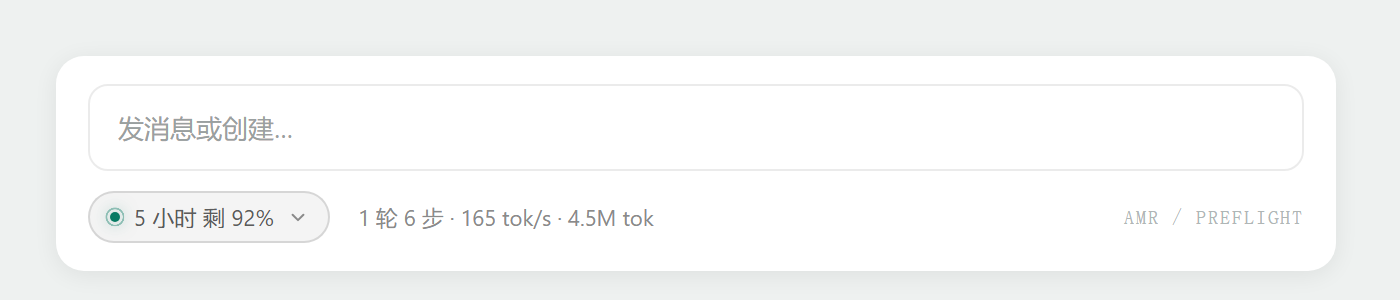
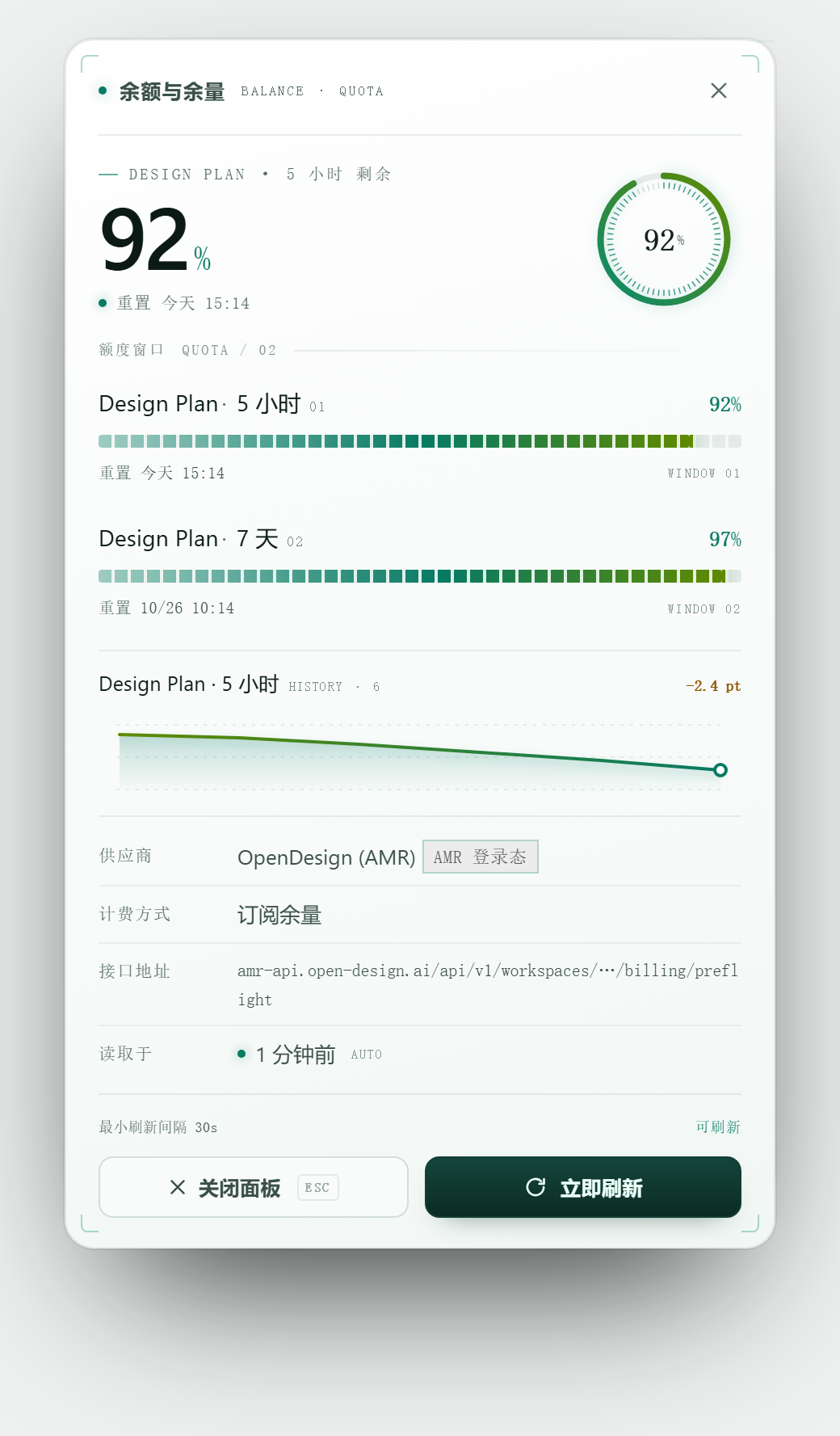
Click it to open the full panel:
Running an agent on API credit or a subscription, two things bite:
This plugin gathers it into one place: whichever provider your current session is using, it reads that provider's balance and shows it the same way every time.
Balances are per provider, not per model — every model under one provider shares the same pool.
| Provider | What it reads | Shown as |
|---|---|---|
| DeepSeek | account balance | money (¥12.34) |
| OpenRouter | key credit | money |
| Moonshot / Kimi | account balance | money |
| SiliconFlow | account balance | money |
| 智谱 GLM / Z.AI | subscription quota | window percentages |
| Kimi Coding | subscription quota | window percentages |
| MiniMax | plan quota | window percentages |
| OpenCode Go | subscription quota | window percentages |
| OpenDesign (AMR) | wallet + Design Plan windows | money + percentages |
"Window percentages" means the plugin lists each quota period separately — rolling / weekly / monthly — with its own bar and reset time. So you can tell whether the 5-hour window is nearly spent or the monthly total is running out.
If you use a self-hosted relay (New-API, Sub2API, CloseAI, claude-code-hub and similar), the plugin tries a set of conventional endpoints in order:
/api/usage/token/  →  /v1/dashboard/billing/subscription  →  /v1/usage
→  /api/v1/me/quota  →  /dashboard/billing/credit_grants
→  /api/v1/credits  →  /api/user/self
Whichever returns a readable figure first wins. An endpoint you configure yourself is tried before all of them.
The mechanism (ordering, short-circuiting, unit calibration) is covered by tests, but each preset's response shape was transcribed from public panel documentation and the author cannot verify them all against live servers. So an unrecognised shape is reported as "reachable but unparseable" with the raw response attached — never guessed at.
| Situation | What happens |
|---|---|
| The vendor has no public balance endpoint | Says so plainly; invents nothing |
| Route isn't in the catalog and no preset matched | Reports "not catalogued" plus the last raw response |
| No credential configured | Names the variable you need to set |
| Endpoint answered but the shape is unknown | Reports "unparseable" with an excerpt (secrets masked) |
"Not catalogued" means this plugin doesn't recognise that provider yet — it does not mean the vendor has no balance endpoint. Setting a custom endpoint via balance_set_endpoint usually fixes it.
dsh plugin --profile desktop add @zhujiuyi/dsh-balance
Then restart DSH. The readout appears on the stats row under the composer.
Don't install
dsh-balance-meter(no scope). That name belongs to an unrelated package on npm.
Prefer not to use npm? Install the tarball from a release instead — /latest/ follows the newest one, so this command needs no editing:
dsh plugin --profile desktop add https://github.com/zhujiuyi/dsh-balance-meter/releases/latest/download/zhujiuyi-dsh-balance-0.2.5.tgz
Installing from the repository works too:
dsh plugin --profile desktop add github:zhujiuyi/dsh-balance-meter
Uninstall:
dsh plugin --profile desktop remove @zhujiuyi/dsh-balance
Mostly you don't do anything. Three ways in:
balance_check tool.This is what the plugin cares about most. Three rules:
1. It never guesses. If it can't read a figure it says so and explains why. "Unavailable" beats a plausible-looking wrong number.
2. Stale figures are labelled. If a refresh fails after a previous success, the readout keeps showing the last known value marked "possibly stale", with the failure reason in the details. An old number is never passed off as current.
3. The trend chart uses real readings only. That curve comes from reads that actually happened, not a hardcoded sample series. With fewer than two readings it says it's still collecting rather than drawing a fake history.
Two limits keep it polite: a minimum interval (30s by default) and a failure cooldown. Nothing polls while the page is hidden.
OpenDesign is the only provider whose billing is not on the API gateway host, and it needs a login first:
vela login # or sign in through the OpenDesign desktop app
That writes a credential to ~/.amr/config.json, which the plugin reads.
Why this is required: the sk-amr-… API key you configure in DSH is a runtime key for inference, and the vendor explicitly rejects it for billing reads. Balance can only be read with the control key that signing in produces.
Signed out, the plugin tells you to run vela login — it never treats that gateway as an uncatalogued relay and starts probing it.
Plugins page → the @zhujiuyi/dsh-balance card: preferred route, auto-refresh on/off, minimum interval, and the refresh-after ceiling.
To pin a custom endpoint or credential variable for one route, edit the balance-meter row in your profile's cordis.patch.yml:
- id: balance-meter
  name: "@zhujiuyi/dsh-balance"
  config:
    primary: deepseek
    routes:
      - id: my-provider
        baseURL: https://api.example.com/v1
        apiKeyEnv: MY_PROVIDER_API_KEY
        endpoint: '{origin}/v1/balance'
Templates support {origin} (scheme + host) and {base} (the full baseURL). Prefer {origin} — it doesn't care whether your baseURL carries a path segment.
exec permission, no subprocesses — no shell, no curl.npm run verify # static contract check + all tests
npm test # 305 tests, no DSH install required
npm run check # contract check only
Four layers, none needing DSH: pure logic (parsers, preset chain, cache/throttle), host integration (stubs for @deepseek-ai/*, running the real apply()), a static contract check, and browser-half render tests (real client.js loaded with a minimal React stub and rendered across its states).
That last layer earns its keep: a useMemo referencing a const declared below it is a runtime scope error — invisible to node --check and to the contract check, but it crashes the component and makes the readout disappear. That happened once.
Of the 9 providers, only OpenCode Go and OpenDesign have been checked against real responses and had their parsers corrected. The rest report "reachable but unparseable" with an excerpt if their shape differs from the docs — send that excerpt and it gets fixed.
This is the DSH port of ccgui-plugin-balance-meter (a CC GUI plugin). Because DSH provides credentials and outbound HTTP natively, this version needs no exec permission:
| CC GUI version | This plugin | |
|---|---|---|
| Reading credentials | Parses each engine's config, needs exec:curl | ctx.credentials directly |
| Networking | Host requires pre-declared domains, hence exec:curl | Plain fetch in-process |
| Route detection | Sniffs gateway hostnames | ctx.llm.listProviders() + profile |
Also: the readout sits on the composer stats row (conversation.composer.dock) rather than a status bar, and it reports the shortest period first (5-hour → weekly → monthly) — the window most likely to stop you first.
Design spec: docs/superpowers/specs/2026-10-14-dsh-balance-meter-design.md.
MIT
DeepSeek Harness(DSH)Web 插件聚合生态包 · 一切皆插件,创意工坊分发(dsh-market.com)
把回答做成一页可视化 HTML:模型只写简短的 Markdown 草稿,随包附带的 `am` 命令行生成页面,支持流程图、时序图、树、时间线、ER 图、表格和提示框。
在 dsh 里装上这个插件即可,无需登录、注册或填 API Key,就能使用包括 Muse Spark 1.3、MiMo V2.6 在内的前沿模型——完全免费,不限量。 All you do is install this plugin in dsh: no login, no sign-up, no API key — the frontier models are just there, Muse Spark 1.3 and MiMo V2.6 among them. Completely free, with no usage cap.

