

dsh-web
zhu1090093659/dsh-webDeepSeek Harness(DSH)Web 插件聚合生态包 · 一切皆插件,创意工坊分发(dsh-market.com)
New in v2.0.0: native DSH 0.2.x settings with live policy updates and validated mode choices.
Compatibility: v2 requires DSH 0.2.1-rc.3 or later within 0.2.x. DSH 0.1.2-rc.1 users should retain v1.2.0. Native schema-generated settings replace the legacy custom client card; profile configuration updates apply immediately.
Understand what your Windows agent is about to change—and why a call was blocked.
| Your problem | Ask the agent |
|---|---|
| A command looks risky | “Check this command without executing it.” |
| Protection seems incomplete after an upgrade | “Run windows_workspace_guard_doctor and explain uncovered tools.” |
| Too many blocks, no clear explanation | “Run windows_workspace_guard_audit_summary and show the most frequent rule IDs.” |
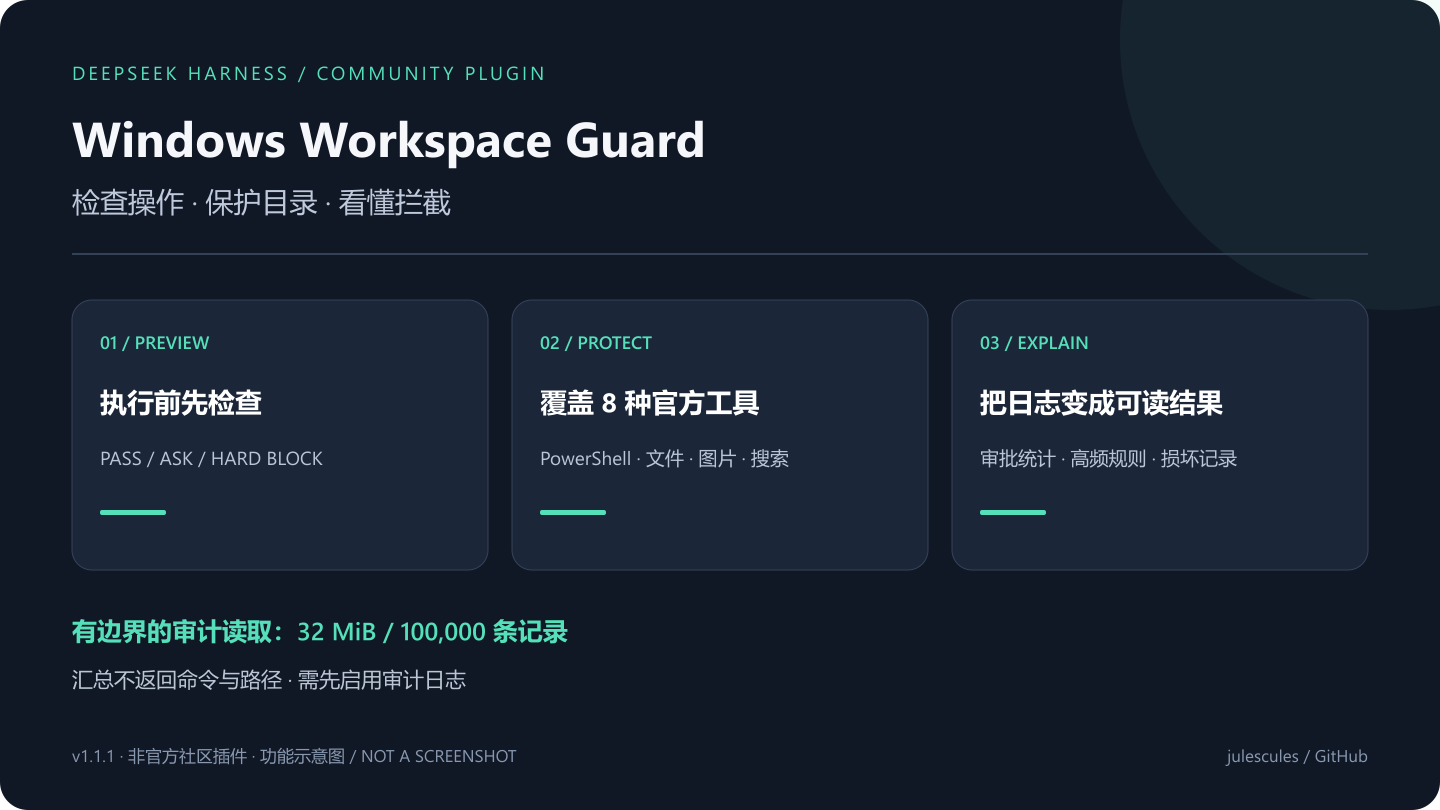
The new windows_workspace_guard_audit_summary tool reads the configured audit log and returns decision totals and frequent rule IDs. It excludes commands, working directories, and target paths. Malformed rows and the 100,000-record limit are reported explicitly so partial evidence is visible.
Set auditPath to a project-owned JSONL path in the plugin settings to collect future decisions. Logging is opt-in; the tool cannot reconstruct old activity. You can also run node audit-summary.js D:\project\logs\guard.jsonl from the package directory without a model or API key.
Use the summary to identify a rule, then inspect that specific case with the dry-run tool before changing policy.
node audit-summary.js D:\project\logs\guard.jsonl --since 2026-10-18T00:00:00Z --until 2026-10-18T23:59:59Z --decision blocked-hard
The agent tool accepts the same since, until, and decision parameters. Timestamps require an explicit timezone; both bounds are inclusive. records counts valid scanned rows; matched counts selected rows. Time filtering excludes missing or invalid timestamps and counts them in invalidTimestamps. The 32 MiB / 100,000-record bounds still apply to scanned input, including excluded rows. Calls without filters retain the original aggregate behavior.
中文 | English
[!IMPORTANT] Unofficial community plugin. Independently developed and maintained; not reviewed or endorsed by DeepSeek.
Stop a Windows agent before it deletes originals, escapes the workspace, destroys Git recovery paths, reads credentials, or changes system state. PowerShell and both official filesystem suites receive a clear PASS, ASK, or HARD BLOCK before dispatch.
dsh plugin --profile web add github:julescules/dsh-windows-workspace-guard#v2.0.0
dsh --profile web --dump-config
dsh --profile web
Restart DSH, then ask:
Run windows_workspace_guard_doctor, then use windows_workspace_guard_check
to inspect this command without executing it:
Get-Content -LiteralPath $env:DSH_HOME\.credentials.yaml
The default protected set follows the official rc.1 Windows/file surface: pwsh, read, extensionless-capable read_image, write, edit, glob, grep, and Minimal's str_replace_editor. Each adapter reads only the official path and operation fields, omits file content, search text, and replacement strings from policy previews, and applies the same workspace, immutable-path, existing-link, and sensitive-path rules.
Configured tools without a verified argument adapter fail closed. Doctor reports every configured tool as covered or unsupported; the plugin never treats an unknown schema as PowerShell and calls it protected.
Profile configuration remains authoritative. Copy any legacy settings-section overrides into the profile before upgrading. If toolNames is a shorter list, add read_image, glob, and grep in the native form; Doctor shows the effective coverage.
Official grep searches hidden and ignored files. With guardSensitiveData enabled, v1.2.0 requires a narrow include glob such as *.js or *.ks; an unbounded search fails closed before a hidden .env can be returned. Explicit credential-like paths and glob patterns are blocked too.
Workspace escapes and unverifiable mutation paths are hard blocks. allowExact remains available for explicit review-level commands, but it cannot authorize a write outside the configured workspace or bypass any non-overridable policy.
Static non-overridable rules are also registered through the official synchronous ctx.tools.guard() seam. They remain denials even if another reorderable tools/pre-execute listener short-circuits its waterfall. Older Harness builds without that API keep the pre-execute fallback.
Live junction/symlink inspection remains asynchronous in tools/pre-execute; it cannot be moved into a synchronous guard and is reported honestly as a separate layer.
With guardSensitiveData: true (default), guarded pwsh, read, and editor calls block explicit reads or copies of:
$DSH_HOME\.credentials.yaml and .env files;sensitivePaths;Env: enumeration;This is a conservative tool boundary, not a general DLP system. It does not inspect arbitrary native-process memory, already-running processes, or tools outside toolNames.
windows_workspace_guard_doctor reports facts without changing ACLs or configuration:
ctx.tools.guard() availability;| Result | Meaning |
|---|---|
| PASS | No matched risk under the active policy. |
| ASK | A reviewable operation needs one host approval in mode: ask. |
| HARD BLOCK | Disk/system mutation, policy bypass, immutable path, link traversal, or sensitive-data access cannot be approved away. |
Use windows_workspace_guard_check for a dry run. Select pwsh with command; select read, write, or edit with path; or select str_replace_editor with an operation plus absolute path. It returns machine-readable findings and never executes the call.
The native DSH plugin settings form updates these values live:
enabled: true
mode: block               # block | ask | report
toolNames: [pwsh, read, read_image, write, edit, glob, grep, str_replace_editor]
workspaceRoots: []        # empty = current session cwd
protectedPaths: []
guardExistingLinks: true
guardSensitiveData: true
sensitivePaths: []
auditPath: ''             # optional append-only JSONL
auditIncludeCommand: false
auditFailClosed: false
With an audit path, dispatch writes occur after host approval and monotonic guards. Denied calls are observed after their final result. Commands are hashed and redacted by default.
The package stays outside Harness core and uses the official dsh.bundle.patch, tools/pre-execute, ctx.tools.guard(), tools/execute, tools/result, settings, and typed-tool seams.
dsh plugin --profile web add github:julescules/dsh-windows-workspace-guard#v2.0.0
dsh plugin --profile web list
dsh plugin --help
Use the disable/remove command shown by dsh plugin --help for your Harness build, then restart DSH. Profile command names are still changing during developer preview.
dsh --profile web --dump-config, confirm windows-workspace-guard, then restart Web.auditPath is configured.workspaceRoots and sensitivePaths absolute and narrow.npm run check
npm pack --dry-run
node scripts/build-release-metadata.mjs .\dsh-windows-workspace-guard-2.0.0.tgz .\builds\v2.0.0
.\scripts\verify-release.ps1 -PackagePath .\dsh-windows-workspace-guard-2.0.0.tgz -ChecksumsPath .\builds\v2.0.0\SHA256SUMS
Each release ships a SHA-256 checksum and CycloneDX SBOM. The verifier reads files literally and makes no network request.
toolNames are not covered; configured names with unknown argument schemas fail closed and appear as Doctor warnings.For missed cases, reply in the official community plugin thread with Windows, PowerShell and DSH versions, a redacted command, expected PASS/ASK/BLOCK, and redacted doctor output.
See CONTRIBUTING.md and SECURITY.md.
Compatibility: v2 requires DSH 0.2.1-rc.3 or later within 0.2.x. DSH 0.1.2-rc.1 users should retain v1.2.0. Native schema-generated settings replace the legacy custom client card; profile configuration updates apply immediately.
Host contract regression: install the pinned dependencies shown in .github/workflows/ci.yml, then run npm run test:host. Verified against actual rc.3 Loader/Settings/Tools with an in-memory profile editor: live policy updates, unchanged plugin fiber, stale revision and invalid-mode rejection. Browser rendering and model execution are not covered. Legacy settings-section overrides must be copied into profile configuration when upgrading; v2 does not import old settings files.
DeepSeek Harness(DSH)Web 插件聚合生态包 · 一切皆插件,创意工坊分发(dsh-market.com)
把回答做成一页可视化 HTML:模型只写简短的 Markdown 草稿,随包附带的 `am` 命令行生成页面,支持流程图、时序图、树、时间线、ER 图、表格和提示框。
在 dsh 里装上这个插件即可,无需登录、注册或填 API Key,就能使用包括 Muse Spark 1.3、MiMo V2.6 在内的前沿模型——完全免费,不限量。 All you do is install this plugin in dsh: no login, no sign-up, no API key — the frontier models are just there, Muse Spark 1.3 and MiMo V2.6 among them. Completely free, with no usage cap.

