

dsh-web
zhu1090093659/dsh-webDeepSeek Harness(DSH)Web 插件聚合生态包 · 一切皆插件,创意工坊分发(dsh-market.com)
English | 中文
Scope change. DeepSeek Harness now owns the provider side:
@deepseek-ai/dsh-llm-pi-airegisters the OpenAI Codex OAuth flow, credential storage, refresh, and model routing through@deepseek-ai/dsh-authorization. What the product still lacks is a browser surface for that seam. This package is that surface, and nothing else.
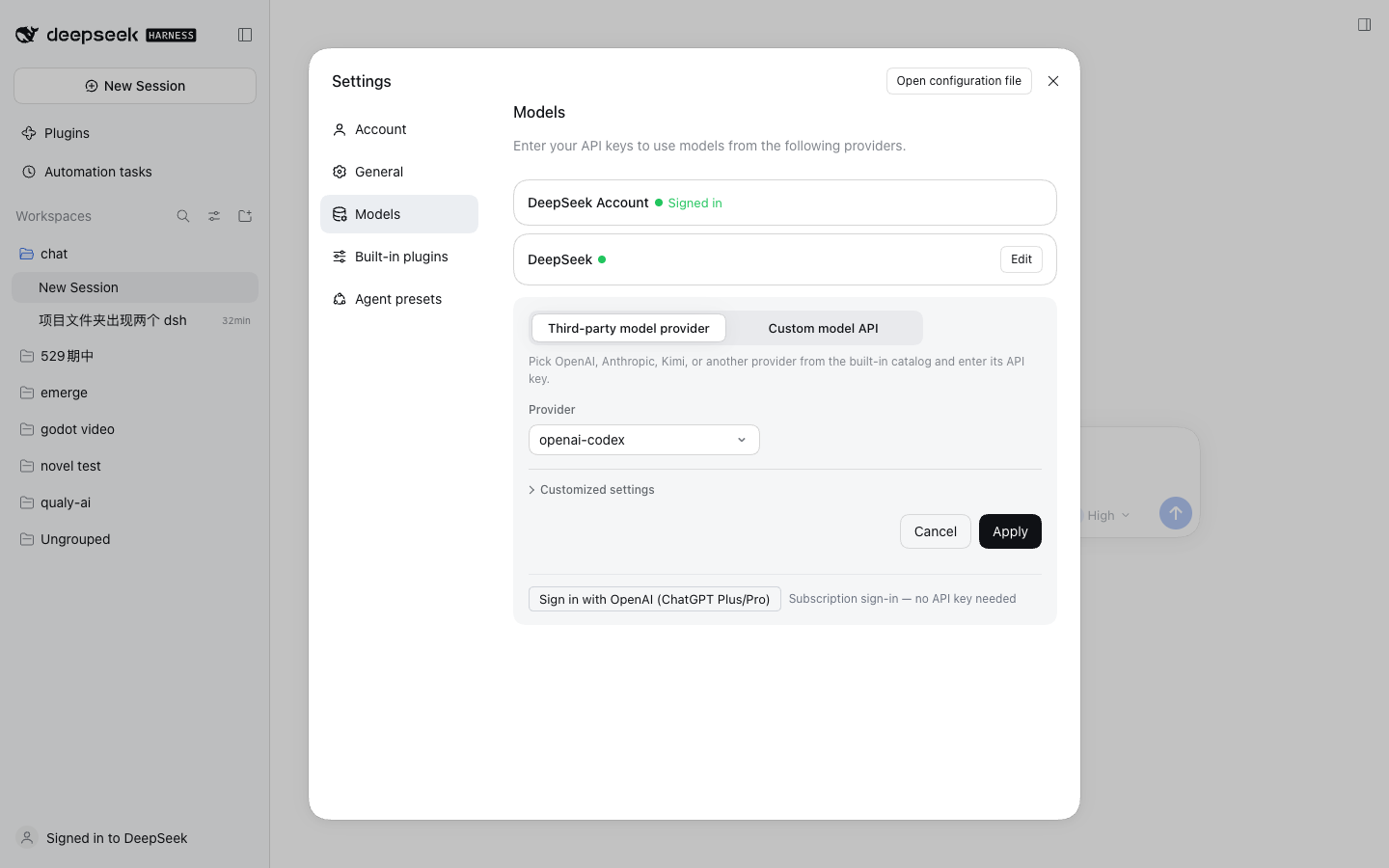
A provider card extension for the Models settings page: it lets a person sign in with a provider subscription (ChatGPT Plus/Pro, and any other flow the Host exposes for a provider) instead of pasting an API key.
codexAuth) that drives ctx.authorization for one
browser surface: start an attempt, read its notices and prompts, answer, cancel.settings.models.provider-card seat for the
llm-pi-ai family. Cards whose provider reports nativeAuth.oauth get a
"Sign in with …" button; every other card renders nothing.It does not ship an OAuth driver, a model adapter, or credential storage. Those belong to the provider plugin, and installing both would mean two owners for one credential.
0.2.1-rc.2 or newer.@deepseek-ai/dsh-llm-pi-ai.dsh plugin --profile <profile> add dsh-oauth-openai
For a checkout:
dsh plugin --profile <profile> add /path/to/dsh-oauth-openai
Restart the profile, open Settings → Models, and add or edit a provider that offers a subscription login.
Settings → Models card (Client)
  └─ remote.codexAuth.start / state / answer / cancel
       └─ Host ProviderSignInController
            └─ ctx.authorization.begin({ key, method, signal, interaction })
                 └─ provider flow (dsh-llm-pi-ai)
The Host keeps one attempt per credential key, projects the seam's notices and prompts
into plain views, and retains a finished attempt for five minutes so a late poll still
sees its outcome. The Client polls state while an attempt runs; the stream is
deliberately not used, so the plugin needs no uplink support.
Secrets never cross the wire. The seam reports authorized only after the credential
is stored, and the views carry a message, a URL, a short code, and prompt text — never a
token or a credential record. Failures keep the seam's own sentence when the error is an
AuthorizationError, and collapse everything else to authorization failed.
pnpm install
pnpm run check   # build the client bundle, run the controller tests, verify the package
src/controller.js is Host logic and runs under node:test with a fake seam.
src/client.jsx is bundled by scripts/build.mjs into dist/client.js in the
window.__ModuleLoader__ wrapper the Web client expects.
llm-pi-ai/<provider>.MIT
DeepSeek Harness(DSH)Web 插件聚合生态包 · 一切皆插件,创意工坊分发(dsh-market.com)
把回答做成一页可视化 HTML:模型只写简短的 Markdown 草稿,随包附带的 `am` 命令行生成页面,支持流程图、时序图、树、时间线、ER 图、表格和提示框。
在 dsh 里装上这个插件即可,无需登录、注册或填 API Key,就能使用包括 Muse Spark 1.3、MiMo V2.6 在内的前沿模型——完全免费,不限量。 All you do is install this plugin in dsh: no login, no sign-up, no API key — the frontier models are just there, Muse Spark 1.3 and MiMo V2.6 among them. Completely free, with no usage cap.

