

dsh-web
zhu1090093659/dsh-webDeepSeek Harness(DSH)Web 插件聚合生态包 · 一切皆插件,创意工坊分发(dsh-market.com)
中文 | English
An Electron shell for DeepSeek Harness that runs the official, unmodified dsh Web UI — on Windows, Linux and macOS. Also the reference implementation if you want to build your own shell.
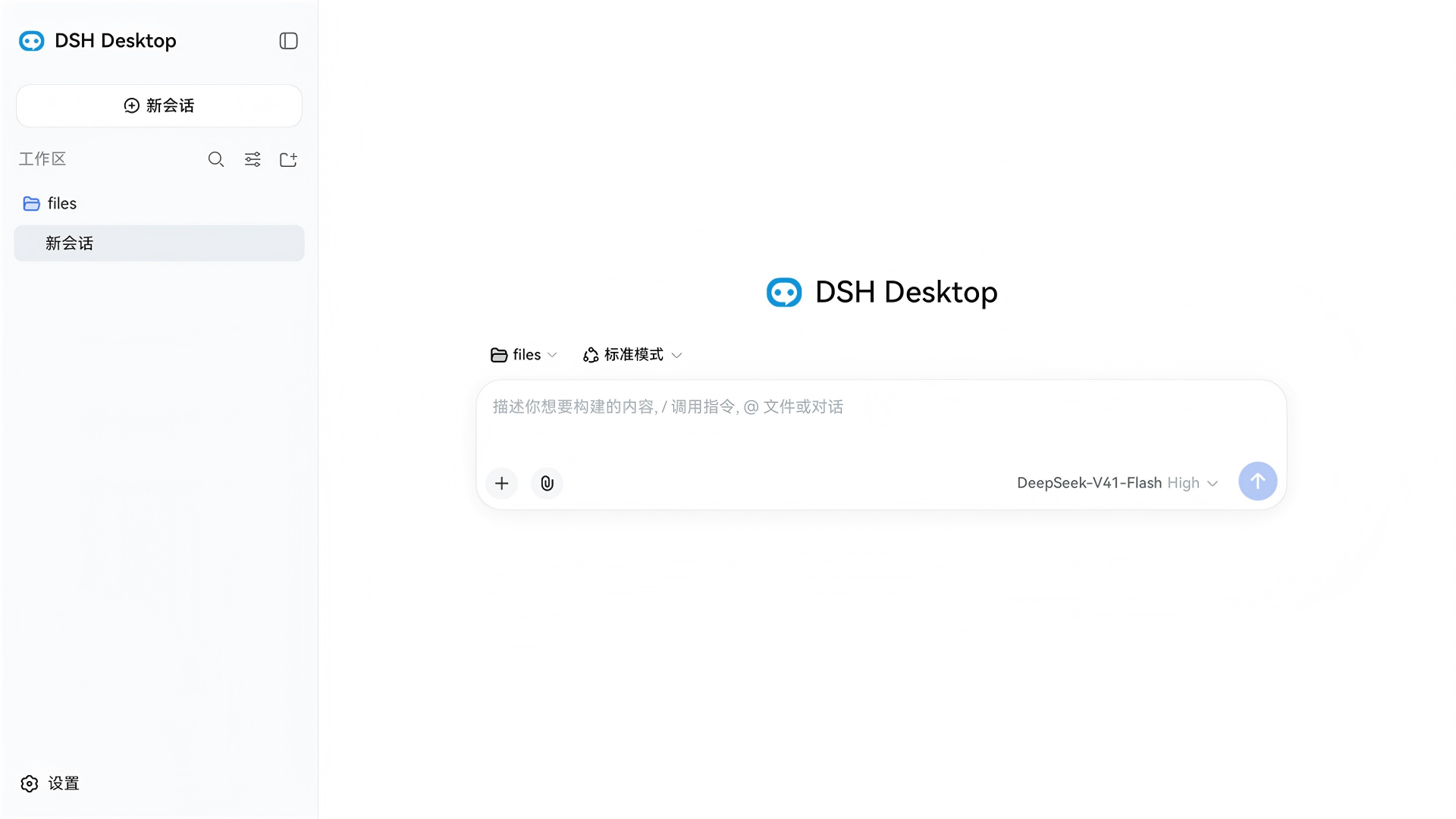
Real capture — no mockup. The official dsh Web UI inside the shell. This frame comes from the Electron on HarmonyOS Edition (same shell, same Web UI, same data plane), because it is the edition with a ready device shot; the desktop build loads the identical, unmodified UI.
Status 0.2.1 — packaging works on all three platforms; tray, native notifications, native window frame, clipboard image paste, window-state persistence and F11 are in. No auto-update, no code signing, no store distribution yet.
Three decisions, and they are the whole design:
| Decision | What it means |
|---|---|
| Zero upstream changes | The renderer loads dsh web's own SPA same-origin. Only three idempotent patches are applied, all of them Electron-compatibility toggles (HMR off, native directory picker off, onboarding steps off) — no fork, no re-implementation of the UI. |
| No CORS, no auth dance, no custom protocol, no IPC carrier | The dsh Host starts inside the Electron main process, and its webserver serves both dist/ and /api on one bound port. The window is a browser pointed at http://127.0.0.1:<port>/. |
| Linux is a first-class target | .deb and .rpm ship next to the Windows installer and the macOS DMG. Most dsh desktop shells stop at Windows/macOS. |
| Capability | State |
|---|---|
| System tray (quit / restore) | ✅ |
| Native notifications, subscribed to dsh session events | ✅ |
| Native window frame (system min / max / close) | ✅ |
| Clipboard image paste | ✅ |
| Window state persistence (maximized / bounds restored) | ✅ |
| F11 fullscreen | ✅ |
| Global shortcut · launch at login · multiple windows | ⏸ deferred |
The native file picker reuses dsh's standard in-app directory browser (one of the three patches), so no OS dialog is involved.
| Platform | Artifact | Notes |
|---|---|---|
| Windows x64 | Setup.exe · portable ZIP | Squirrel installer, unsigned |
| Linux x64 | .deb · .rpm · ZIP | Debian/Ubuntu and Fedora/RHEL |
| macOS arm64 | .dmg · ZIP | Unsigned — Gatekeeper needs a manual allow |
HarmonyOS editions (2in1 / tablet) live in separate repos. dsh-desktop-hos — Electron on HarmonyOS Edition — shares this shell architecture and the same unmodified Web UI, with the Electron runtime swapped for the Electron-on-HarmonyOS one; there is no consumer installer yet (AppGallery track). dsh-desktop-ark — HarmonyOS Edition — keeps the same in-process Host but drops Electron: the system ArkWeb renders the UI while an embedded Node runtime (ohos-node-bridge) runs dsh; it is a v0.1.0 scaffold.
Everything here is local npm run make output: no signing, no notarization, no auto-update. If that matters to you, build it yourself — see Development.
| Shell | dsh (upstream tag) | Electron | Platforms | Verified |
|---|---|---|---|---|
0.2.1 | dsh-v0.2.1-rc.2 | 43.0.0 | Windows x64 · Linux x64 · macOS arm64 | artifacts produced by npm run make; runtime exercised via npm start |
Upstream dsh is a developer preview and ships breaking changes. This shell pins one tag at a time: bumping it means adding patches/<new-tag>/ and updating the pin in scripts/build-dsh.mjs.
Most dsh desktop shells are products. This one is deliberately documented like a specimen, so the working parts can be copied into your own shell:
specs/ — as-built specs: host, window, tray, notifications, lifecycle, preload, app entry, desktop profile, plugin marketpatches/dsh-v0.2.1-rc.2/ — the three patches, each with its reasonAGENTS.md, docs/000-产品概念设计.md — architecture and working conventionsscripts/build-dsh.mjs · collect-dsh.mjs · fetch-runtime.mjs — reproducible build, artifact collection, bundled-runtime channelElectron main process (Node.js, also hosts the dsh Host)
runProfile('desktop', ['--port','0']) → { ctx, port, shutdown }
├─ webserver 127.0.0.1:<free port> — serves dist + /api
├─ apiProxy RPC gateway
└─ connection /api + WebSocket
renderer: loadURL('http://127.0.0.1:<port>/') ← same-origin
No preload bridge, no window-control channel: the renderer uses dsh's existing WebApiClient (HTTP uplink + WebSocket downlink) against the same origin. Tray and notifications are produced in the main process by subscribing to ctx session events.
dsh, a sibling directory of this project, not a submodule, referenced as ../deepseek-harness; consumed via local source reference) — current build is based on dsh-v0.2.1-rc.2; its patches live in patches/dsh-v0.2.1-rc.2/../dsh-market; the built-in visual plugin marketplace — npm package dshmarket)../deepseek-harness, not a submodule); we consume its build artifacts. The plugin marketplace dsh-market likewise lives in a sibling directory (../dsh-market, npm package dshmarket); its build output is materialized into dsh's node_modules/dshmarket and bundled as a built-in plugin. Both siblings are required for a build.src/main/host.ts dynamically imports dsh's runProfile (apps/cli build artifact), hosting the dsh Host in the main process (webserver bound to 127.0.0.1:<free port>), returning a { ctx, shutdown, port, url } handle.loadURL(http://127.0.0.1:<port>/) to load the dsh Web UI same-origin, reusing WebApiClient (HTTP uplink + WebSocket downlink) — zero CORS, zero auth, zero new carrier.profiles/desktop/ (dsh.profile.bundles = [dsh-base, dsh-web-app], with cordis.patch.yml overriding web-runtime.printUrl: false), copied to $DSH_HOME/profiles/desktop at runtime.dsh depends on Node internal APIs (HMR, native directory dialog) that are unavailable under Electron, so three patches must be applied before building. One command does it all (idempotent — --reverse --check detects already-applied and skips). It also builds the sibling ../dsh-market plugin marketplace:
npm run build:dsh # ① git apply both patches under patches/ → ② pnpm install (if node_modules missing) → ③ build:lib:host + build:lib:client + build:web → ④ build ../dsh-market (npm install if needed + npm run build)
Prerequisite — sibling source checkouts. This project consumes both deepseek-harness and dsh-market as sibling directories (not submodules). Before building, clone them next to this project:
# dsh: pinned tag = dsh-v0.2.1-rc.2 (also set in .github/workflows; matches patches/dsh-v0.2.1-rc.2/)
git clone --branch dsh-v0.2.1-rc.2 https://github.com/deepseek-ai/deepseek-harness.git ../deepseek-harness
git clone --branch v1.26.0             https://github.com/dsh-market/dsh-market.git         ../dsh-market
collect-dsh.mjs hard-fails if ../dsh-market is missing (the packaged app bundles it as dsh-dist/node_modules/dshmarket); build:dsh warns and skips only the marketplace build if it is absent.
dsh version pin. This project builds against deepseek-harness tag
dsh-v0.2.1-rc.2. Patches are organized per dsh version (patches/<dsh-tag>/) andscripts/build-dsh.mjspinspatches/dsh-v0.2.1-rc.2/— when bumping to a new dsh tag, add a matchingpatches/<new-tag>/directory and update that pin.
| Patch | Purpose |
|---|---|
patches/dsh-v0.2.1-rc.2/dsh-disable-hmr.patch | Adds a DSH_DISABLE_HMR switch to runProfile, skipping watch-only HMR (HMR depends on --expose-internals) |
patches/dsh-v0.2.1-rc.2/dsh-disable-native-picker.patch | Forces directory-picker to use browse under Electron (the native dialog worker fails because it spawns electron.exe) |
patches/dsh-v0.2.1-rc.2/dsh-disable-welcome-notice.patch | Drops the client's two settings.onboarding steps (the versioned internal-testing notice and the official-DeepSeek API-key prompt) so a first launch opens straight into the app, and updates apply.client.spec.ts to the shipped registration set |
Electron compatibility root cause: dsh's loader obtains the Node internal ESM loader via the
node-addon-require-builtinnative module, which fails under Electron because Electron's V8 lacks theGetAlignedPointerFromEmbedderDatasymbol; in development the loader falls back to default ESM import, resolved byhost.ts'sensureWorkspaceLinkslinking workspace packages into dsh's root node_modules.
# This project's deps (npm: Electron / Forge / Vite)
npm install

# dsh deps (run inside ../deepseek-harness; pnpm workspace)
cd ../deepseek-harness && pnpm i

# Development: Vite build + launch Electron, main process hosts dsh Host and loads its Web UI
npm start

# Package: prepackage auto-collects (pnpm deploy materializes dsh artifacts into dsh-dist/, extraResource copies into resources/)
npm run package

# Distribution artifacts: Windows Squirrel installer / portable ZIP (makers in forge.config.ts)
npm run make
The packaged output
out/DSH Desktop-win32-x64/already includes dsh (lib + node_modules + web dist + profile); the exe runs dsh directly.
On Windows with a restricted network (GitHub unreachable / Corepack limited), npm run package can hit three known pitfalls. Verified fixes:
1. pnpm version mismatch (pnpm --filter resolves an old version)
deepseek-harness/package.json pins packageManager: pnpm@11.7.0, but corepack pnpm --filter <pkg> run ... resolves a different version (e.g. 11.5.2) inside the sub-workspace and fails with This project is configured to use 11.7.0 of pnpm. corepack enable fails with EPERM under an nvm-managed Node (no write access to the node dir), so no pnpm shim is created; pm-on-fail=ignore in .npmrc also has no effect (the version check runs before config is read).
Fix — hand-roll a pnpm.cmd shim that calls corepack, place it in a user-writable dir and put it at the front of PATH:
$shimDir = "C:\Users\$env:USERNAME\AppData\Local\pnpm-shim"
New-Item -ItemType Directory -Path $shimDir -Force | Out-Null
$corepackCmd = (Get-Command corepack.cmd).Source   # e.g. C:\Program Files\nodejs\corepack.cmd
Set-Content -Path (Join-Path $shimDir "pnpm.cmd") -Value @"
@ECHO off
GOTO start
:find_dp0
SET dp0=%~dp0
EXIT /b
:start
SETLOCAL
call "$corepackCmd" pnpm %*
"@ -Encoding ASCII
$env:PATH = "$shimDir;$env:PATH"    # prepend before every build
2. fetch-runtime re-downloads (missing .versions.json stamp)
scripts/fetch-runtime.mjs is idempotent via runtime/.versions.json. If the first download is interrupted (e.g. shell timeout), runtime/node/ and runtime/pnpm/ may be in place while the stamp is unwritten, so the next npm run package re-downloads Node + pnpm.
Fix — once runtime/node/node.exe and runtime/pnpm/pnpm.exe exist, hand-write the stamp to skip the download:
# Must exactly match the `wanted` string the script builds (node / pnpm / platform / arch)
'{"node":"24.11.1","pnpm":"9.15.9","platform":"win32","arch":"x64"}' |
  Set-Content -Path .\runtime\.versions.json -Encoding ASCII -NoNewline
3. Electron binary download ETIMEDOUT (GitHub blocked)
The electron-forge package stage downloads the matching Electron binary from github.com; a restricted network yields connect ETIMEDOUT.
Fix — use the npmmirror China mirror (env vars apply to the current build process):
$env:ELECTRON_MIRROR = "https://registry.npmmirror.com/-/binary/electron/"
$env:ELECTRON_CUSTOM_DIR = "v{{ version }}"
npm run package
Combining all three (pnpm shim on PATH + stamp in place + Electron mirror) makes
npm run package/npm run makerun reliably on a restricted Windows box.
This project, deepseek-harness (dsh), and dsh-market live in sibling directories (not submodules), integrated via source reference:
(sibling directories)
├── dsh-desktop/      # This project (Electron desktop shell)
│   ├── docs/                      # Product concept design
│   ├── specs/                     # Spec documents (as-built; see specs/README.md for index)
│   ├── patches/                   # dsh upstream patches (git apply, auto-applied by build:dsh)
│   │   ├── dsh-disable-hmr.patch
│   │   ├── dsh-disable-native-picker.patch
│   │   └── dsh-disable-welcome-notice.patch
│   ├── scripts/                   # Build scripts
│   │   ├── build-dsh.mjs          # apply patches + install deps + build dsh + dsh-market artifacts
│   │   ├── collect-dsh.mjs        # collect dsh artifacts into dsh-dist/ (pnpm deploy + materialize dshmarket)
│   │   └── fetch-runtime.mjs      # fetch portable Node + pnpm into runtime/ (packaged install channel)
│   ├── profiles/desktop/          # Custom desktop profile (dsh.profile.bundles + cordis.patch.yml)
│   ├── src/
│   │   ├── main/                  # Electron main process (= dsh Host host)
│   │   │   ├── index.ts           # single-instance lock → start host → create window → tray/notification/lifecycle
│   │   │   ├── host.ts            # runProfile('desktop') → { ctx, shutdown }; plugin link/resolve
│   │   │   ├── runtime.ts         # bundled Node/pnpm/dsh shim + PATH injection (market install channel)
│   │   │   ├── windows.ts         # BrowserWindow, loadURL(localhost), native frame/security
│   │   │   ├── window-state.ts     # persist maximized/bounds; restore on start; F11 fullscreen
│   │   │   ├── tray.ts            # system tray (quit/restore)
│   │   │   ├── notifications.ts   # subscribe to ctx session/event → native notifications
│   │   │   └── lifecycle.ts       # NO_PROXY/CA, crash handling
│   │   ├── preload/index.ts       # preload entry (no window-control bridge)
│   │   └── renderer/renderer.ts   # minimal renderer entry (fallback loading page)
│   ├── forge.config.ts            # Electron Forge config (extraResource copies dsh-dist + runtime)
│   ├── vite.*.config.ts           # Vite configs (main/preload/renderer)
│   ├── index.html                 # renderer entry (Forge Vite convention: at project root)
│   └── resources/                 # app icon, tray icon
│
├── deepseek-harness/              # The wrapped host (dsh, source reference, not a submodule)
│   ├── apps/                      # cli (dsh bin, profile-boot), web (Web frontend, build:web produces dist)
│   ├── packages/                  # host / client / core / session workspace packages
│   ├── vendor/                    # vendored cordis framework packages (cordis / loader / hmr / ...)
│   └── native/                    # landlock-run native module (Linux sandbox, cut in MVP)
│
└── dsh-market/                    # Plugin marketplace (source reference, not a submodule; npm pkg "dshmarket")
    ├── src/                       # host half (mounts /dsh-market/* routes, spawns `dsh plugin`)
    ├── client/                    # browser half (settings-page UI; built to client/client.js)
    ├── lib/                       # compiled host output (materialized into dsh-dist/node_modules/dshmarket)
    └── cordis.patch.yml           # loader insert declaration ({ id: dsh-market, name: dshmarket })
CI note: GitHub Actions clones both siblings during the workflow (see
.github/workflows/ci.ymlandrelease.yml—Checkout dsh (sibling)andCheckout dsh-market (sibling)), becauseactions/checkoutcannot place a second repository inside$GITHUB_WORKSPACE.
../deepseek-harness) — the wrapped host; its docs/ directory contains full architecture docs../dsh-market) — the built-in visual plugin marketplace (npm package dshmarket), bundled via collect-dsh.mjspackages/desktop/) — a similar "wrap an agent harness with Electron" use caseMIT © 2026 fellow99
DeepSeek Harness(DSH)Web 插件聚合生态包 · 一切皆插件,创意工坊分发(dsh-market.com)
把回答做成一页可视化 HTML:模型只写简短的 Markdown 草稿,随包附带的 `am` 命令行生成页面,支持流程图、时序图、树、时间线、ER 图、表格和提示框。
在 dsh 里装上这个插件即可,无需登录、注册或填 API Key,就能使用包括 Muse Spark 1.3、MiMo V2.6 在内的前沿模型——完全免费,不限量。 All you do is install this plugin in dsh: no login, no sign-up, no API key — the frontier models are just there, Muse Spark 1.3 and MiMo V2.6 among them. Completely free, with no usage cap.

