
dsh-web
zhu1090093659/dsh-webDeepSeek Harness(DSH)Web 插件聚合生态包 · 一切皆插件,创意工坊分发(dsh-market.com)

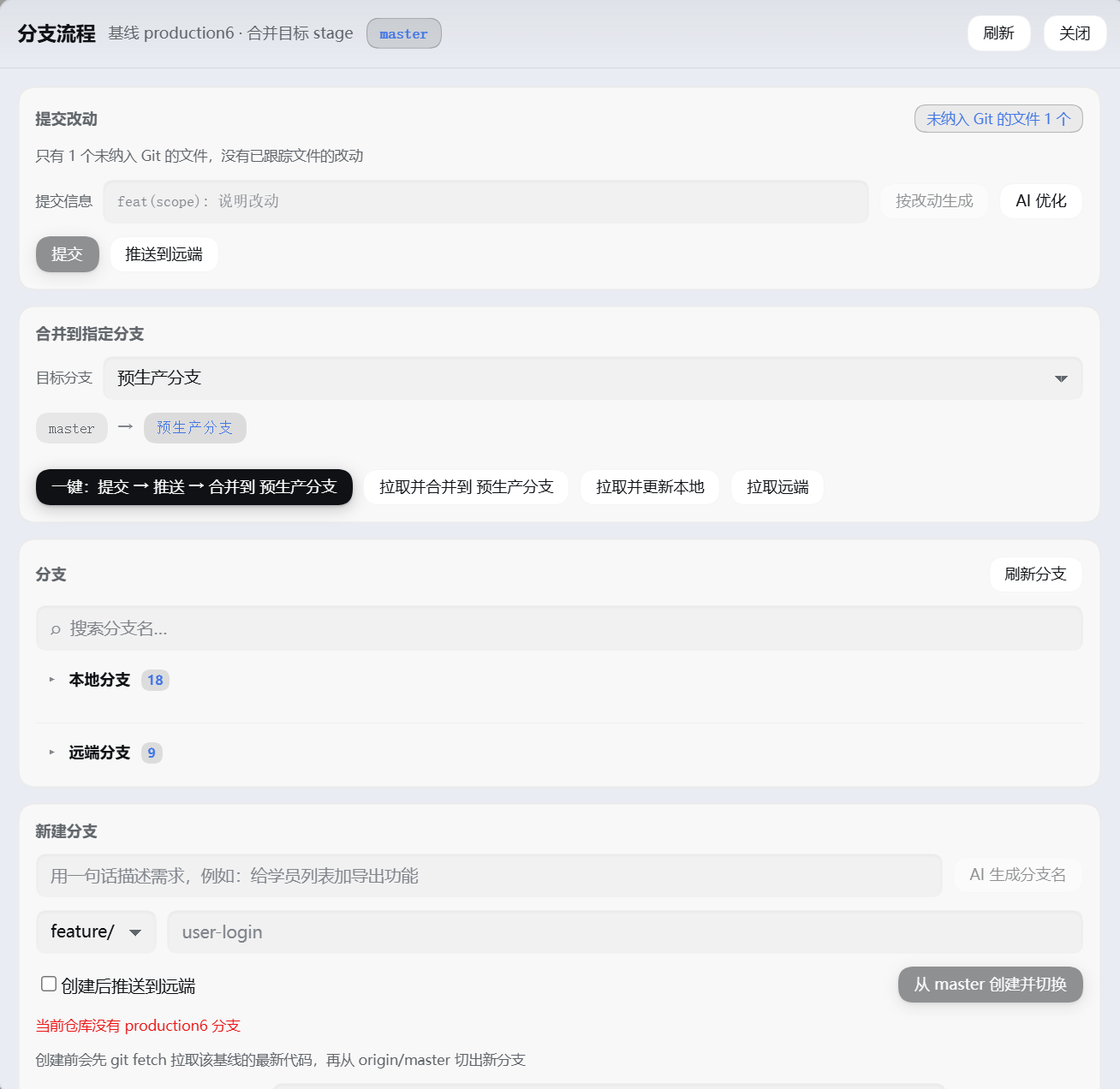
输入框内的分支面板:按规范从 production6 切分支,按 type(scope) 约定校验提交信息,一键提交、推送并合并到 stage。
English | 简体中文
A branch-flow panel for the DSH Web GUI. A status chip sits inside the composer; click it to open the full branch / commit / merge panel.
It removes the mechanical loop after editing code — staging, writing a commit message, switching branches, pulling, merging, pushing — and validates branch names and commit messages against your team's conventions as you type.
The branch chip in the composer. Click it to open the panel:

The full panel — commit changes, merge into a target branch, branch list, create branch:
While a merge is conflicted the chip turns red and shows the conflict count:

This is a DSH profile bundle. Replace <profile> below with your profile name (usually desktop) and pick any of the four methods:
# 1) From GitHub (recommended, version-pinnable)
dsh plugin --profile <profile> add github:crystal-hang/dsh-branch-flow#v0.1.0

# 2) From GitHub, latest main
dsh plugin --profile <profile> add github:crystal-hang/dsh-branch-flow

# 3) From a local directory (development / personal use)
dsh plugin --profile <profile> add link:/path/to/dsh-branch-flow

# 4) From npm (if published)
dsh plugin --profile <profile> add dsh-branch-flow
You can also hand the whole directory to plugin_manager's install_bundle (pass the absolute path as target).
Installing with a tag such as
#v0.1.0makesnpm installcheck out that tag's commit, so the version is reproducible. Omitting the tag follows the latest commit onmain, which suits tracking development.
Reload the page after installing. The chip appears inside the composer, immediately left of the model selector.
The current version is in the version field of package.json and in Releases. To upgrade, replace the tag above with the new version number.
>=0.2.1-rc.2 (dsh.engines.dsh)webServer, subprocess, and workspaceRegistry servicesllm and agentDefaultModel; when either is missing the panel reports an explicit error instead of failing silently↑/↓ ahead/behind. Click it to open the panel. The row above the composer stays free.origin/*, absent from refs/heads). An active repository may carry hundreds, hence collapsed; clicking "switch" creates the local tracking branch (git switch -c <name> --track origin/<name>).git fetch --prune and re-reads, so a branch a colleague just pushed appears immediately.AGENTS.md, __pycache__/*.pyc, and build output that never entered Git. The card's top-right corner shows "N files not in Git"; click it to expand when you do want to commit a new file.The chip mounts at conversation.input.right, which the host renders before conversation.input.model, so it sits left of the model selector at the same row's button height (28px).
The chip width adapts to its content (flex: 0 1 auto, no fixed width), capped at min(45vw, 420px) — 420px fits the 50-character branch names the rules allow, and 45vw keeps it inside narrow windows. It truncates only when it genuinely does not fit, and hovering reveals the full branch name.
Styles reference only host theme variables (--dsw-*), so light and dark themes follow automatically.
Controls share one grammar: pill geometry + tinted brand fill + deeper fill on hover (no longer just a border colour change).
appearance:none), replaced with a filled, borderless surface — neutral fill at 6%, 10px radius, subtle inner shadow. On focus the fill becomes solid and a 4px translucent brand ring grows outward instead of a thicker border. Selects use a CSS-drawn chevron (native arrow removed) with 30px of reserved space.The font stack is the system stack throughout (-apple-system, BlinkMacSystemFont, ui-sans-serif, system-ui) — half of the iOS feel comes from pairing this geometry with system type rather than looking like a web control.
Every colour is derived from theme tokens via color-mix() (for example color-mix(in srgb, var(--dsw-alias-brand-primary) 8%, var(--dsw-alias-bg-layer-2))); no light or dark palette is hard-coded, so each theme computes its own suitable ramp. Under prefers-reduced-motion, all animation and offset is disabled.
-; no underscores, camelCase, or spaces.-, and /; no Chinese characters or special symbols.production6 and stage (prod, test, uat, release2, dev2, … are refused).test1, aaa, tmp, new and the like are rejected.feature/, bugfix/, hotfix/, release/, followed by a short English description.Unified baseline: new branches are cut from the latest production6 only, and the panel refuses to cut from stage (error.stage-baseline). It runs fetch --prune first, then branches from origin/production6.
If a repository has no
production6at all (say a legacy repository usingmaster), the panel does not pretend it can create a branch: it states plainly that this repository lacks production6 and offers a searchable list of every branch in the repository (with a "showing N / M" count). Your chosen baseline is remembered per repository (localStorage). A baseline is an existing ref, so the new-branch naming rules do not apply to it — historical names like预生产分支work as a baseline.
Creating a branch pulls the latest code first: it runs git fetch --prune, then cuts and checks out from origin/<baseline> (preferring the remote when it exists, otherwise the local baseline), so a new branch is never behind.
AI branch names: in the create card, describe the work in one line (for example "add export to the student list") and press "AI suggest name" or simply Enter. The plugin calls your default model to translate it into a conforming branch name such as feature/student-list-export. The result fills the prefix and description fields and remains editable; you confirm before anything is created.
Every suggestion passes the rule check:
git switch -c prefix, uppercase, and underscores are all cleaned up;feat/ or perf/) is rewritten to feature/, with the notice "prefix corrected to the convention";feature/test are rejected with a reason.Push after creating: the create card carries a "Push to remote after creating" checkbox (on by default). When checked it runs git switch -c <name> <baseline> followed by git push --set-upstream origin <name>, so the branch is immediately available on the remote. A failed push does not undo the local branch; the reason is reported separately.
<type>(<scope>): <subject>, where type is limited to
feat fix refactor perf docs style test build ci chore revert.
The panel validates input live and auto-corrects fixable deviations:
(): become half-width;type(scope): prefix is filled in from the branch prefix (feature/→feat, bugfix/→fix, hotfix/→fix, release/→chore);_ . -; when empty it is inferred from the changed files' directories;Messages come from two sources, and both must conform before committing:
llm service) to rewrite it, then runs the result through the same rule check and shows both the raw output and the corrected result.The panel no longer lists step-by-step copy (the button label already says "commit → push → merge"). The behaviour is:
Underneath: git add → git commit -m <conforming message> → git push [--set-upstream] → git fetch --prune → git switch <target> → git merge --ff-only origin/<target> → git merge <source> → git push <target> → git switch <original>.
The merge fast-forwards when it can, otherwise it creates a merge commit (no forced --no-ff).
production6 serves as a baseline only: selecting it as a target is refused (error.production-protected), and the panel offers no way to delete it.
These two buttons are not the same thing, and the panel keeps them separate:
git fetch --prune): updates only the remote-tracking refs under origin/* and touches neither your local branches nor your working files. It therefore often looks like it "did nothing" — the code really is still old. The panel surfaces the result: "the remote has new commits: xxx is N behind and M ahead, click 'Pull and update local' to bring the code down".git merge --ff-only): fast-forwards your local branch onto the remote, which is what actually changes your code. It refuses when the branches have diverged (error.diverged) rather than quietly rewriting history, and refuses when tracked files carry uncommitted changes.Untracked files block nothing. Files that never entered Git — AGENTS.md, __pycache__/*.pyc, build output — are carried across a branch switch by git as-is. Refusing on them as "uncommitted changes" would leave a workspace holding only caches and scratch notes permanently unable to switch or merge.
Switching branches imposes no "clean worktree" gate, leaving the decision to git:
tracked-changes-would-be-overwritten, listing the blocking paths.Merging requires tracked files to have no uncommitted changes (a merge moves HEAD, and merging with half-finished work is error-prone); the error names the file count. Existing conflicts or an in-progress Git operation are blocked first.
A merge conflict is not rolled back; the repository stays mid-merge, the panel lists the conflicting files and offers three actions:
inputActions.insertText); press Enter to let the model edit;git add -A + git commit --no-edit completes the merge (refused while conflict markers remain);git merge --abort.It collects and uploads nothing. The only remote access is git fetch / git push against the origin you configured. There is no telemetry, no usage reporting, and no external HTTP request (the only fetch is the browser calling back to the local host at the relative path branch-flow/*).
What it can do (the permission surface a code audit should look at):
| Capability | Scope |
|---|---|
| Spawning processes | Runs git only, passing an argv array to spawn — no shell, so there is no command injection |
| Reading files | Only existsSync to test whether an operation marker in the git directory (MERGE_HEAD and friends) exists |
| Writing files | None. The plugin writes no files; git writes the repository itself |
| Network | git fetch/push against origin only; no third-party services |
| Runtime dependencies | Zero npm dependencies: the host half uses only node:fs/node:path, the browser half only require('react') (host-provided) |
Access fences (all covered by regression tests):
/branch-flow/* accepts only paths of registered workspaces (exact realpath comparison); the browser cannot make the host run git against arbitrary directories;X-Forwarded-For / CF-Connecting-IP are refused outright; content-type: application/json is required (which blocks cross-site forms);- or containing control characters are refused (invalid-ref-name), ruling out parameter injection such as -D or --upload-pack=…;About your repository contents: the plugin neither knows nor reads your source. It runs git commands and sends the panel result summaries (branch names, file paths, commit messages, relative times). The one case that sends content to a model is "AI polish" for a commit message, which sends a fragment of the staged diff (truncated to 12 KB) — it does not happen unless you press that button.
Worth knowing before you use it:
It runs with your privileges. Installing a plugin means allowing that code to execute git commands on your machine. This plugin confines itself to running git against registered workspaces, with regression tests covering that, but it is still a program holding your account's permissions — as with any DSH plugin, trust the source before installing.
git push really changes the remote. Both "one-click" and "push" push to your configured origin, and "merge" pushes the target branch on success. Verify in a test repository first, confirming the branch name, merge direction, and push target behave as expected before using it on a real repository. production6 is protected as a baseline (it cannot be a merge target and cannot be deleted), but pushes to targets such as stage are real.
AI features send content to your model provider. "AI polish" (commit message) sends a staged diff fragment (up to 12 KB) to your configured default model; "AI suggest name" sends only the requirement description you typed, no code. If a diff contains secrets, tokens, or internal addresses, use "From the diff" (pure local assembly) or write the message by hand.
The licence is MIT. You may use, modify, and redistribute it freely, including commercially; the author provides no warranty for the consequences of use. If you redistribute it, keep the copyright notice in the LICENSE file.
Override in the profile's cordis.patch.yml (every field is optional; defaults shown):
- id: branch-flow
  name: dsh-branch-flow
  config:
    baseline: production6   # unified baseline
    target: stage           # default merge target (changeable in the panel)
    remote: origin
    pushAfterMerge: true    # push the target branch after a successful merge
index.js                 Host entry: reads config, wires routes
lib/rules.js             Branch-name / commit-message rules (authoritative host implementation)
lib/git.js               Real git semantics: view / commit / push / merge / conflicts / create branch
lib/routes.js            /branch-flow/* routes + workspace trust fence
lib/message.js           AI commit messages (host llm service)
lib/branch-name.js       AI branch names (host llm service) + reply normalisation
lib/loopback.js          Loopback + same-origin fence
client.js                Browser half: chip and panel (single-file bundle)
locale/{zh,en}.json      Title and description for the plugin manager
icon.svg                 Plugin icon
scripts/verify-git.mjs   Exercises every git verb in a real temporary repository
scripts/verify-client.mjs Renders the chip and panel with a minimal React driver
scripts/verify-css.mjs   Checks stylesheet balance and control geometry
scripts/verify-hooks.mjs Checks components for hook-order mistakes
scripts/verify-branch-name.mjs Checks AI branch-name normalisation and rejection rules
scripts/probe-view.mjs   Read-only dump of one repository's panel view
node scripts/verify-git.mjs         # create repo, commit, push, merge, conflict, protected branch, untracked files, create+push
node scripts/verify-client.mjs      # render chip / panel, conflict state, missing-baseline fallback, alignment variables
node scripts/verify-css.mjs         # CSS rule balance, button/input/select style contract
node scripts/verify-hooks.mjs       # no hook invoked after an early return inside a component
node scripts/verify-branch-name.mjs # AI branch-name cleanup, prefix correction, rejection rules
All five scripts report their result through the exit code.
DeepSeek Harness(DSH)Web 插件聚合生态包 · 一切皆插件,创意工坊分发(dsh-market.com)
把回答做成一页可视化 HTML:模型只写简短的 Markdown 草稿,随包附带的 `am` 命令行生成页面,支持流程图、时序图、树、时间线、ER 图、表格和提示框。
在 dsh 里装上这个插件即可,无需登录、注册或填 API Key,就能使用包括 Muse Spark 1.3、MiMo V2.6 在内的前沿模型——完全免费,不限量。 All you do is install this plugin in dsh: no login, no sign-up, no API key — the frontier models are just there, Muse Spark 1.3 and MiMo V2.6 among them. Completely free, with no usage cap.

