
dsh-web
zhu1090093659/dsh-webDeepSeek Harness(DSH)Web 插件聚合生态包 · 一切皆插件,创意工坊分发(dsh-market.com)

Unofficial DeepSeek Harness (DSH) plugin for FreeCodeGo: managed gateway and free-model catalogs, per-provider accounts, media generation, and the engineering graph + memory toolchain. AGPL-3.0-only.
FreeCodeGo for DeepSeek Harness — a Cordis bundle that adds the FreeCodeGo engine inventory, a managed free-model gateway, per-provider accounts, media generation, and the engineering (code-graph + memory) toolchain to DeepSeek Harness (dsh).
English | 中文
FreeCodeGo is not a DeepSeek product, and this is not an official DeepSeek distribution: it is a plugin that mounts into a Harness you install yourself. See TRADEMARK.md for the naming policy that applies to forks of this repository.
The five views below are the plugin as it looks mounted: the plugin market card shows the same set, and the first one is what that card previews.
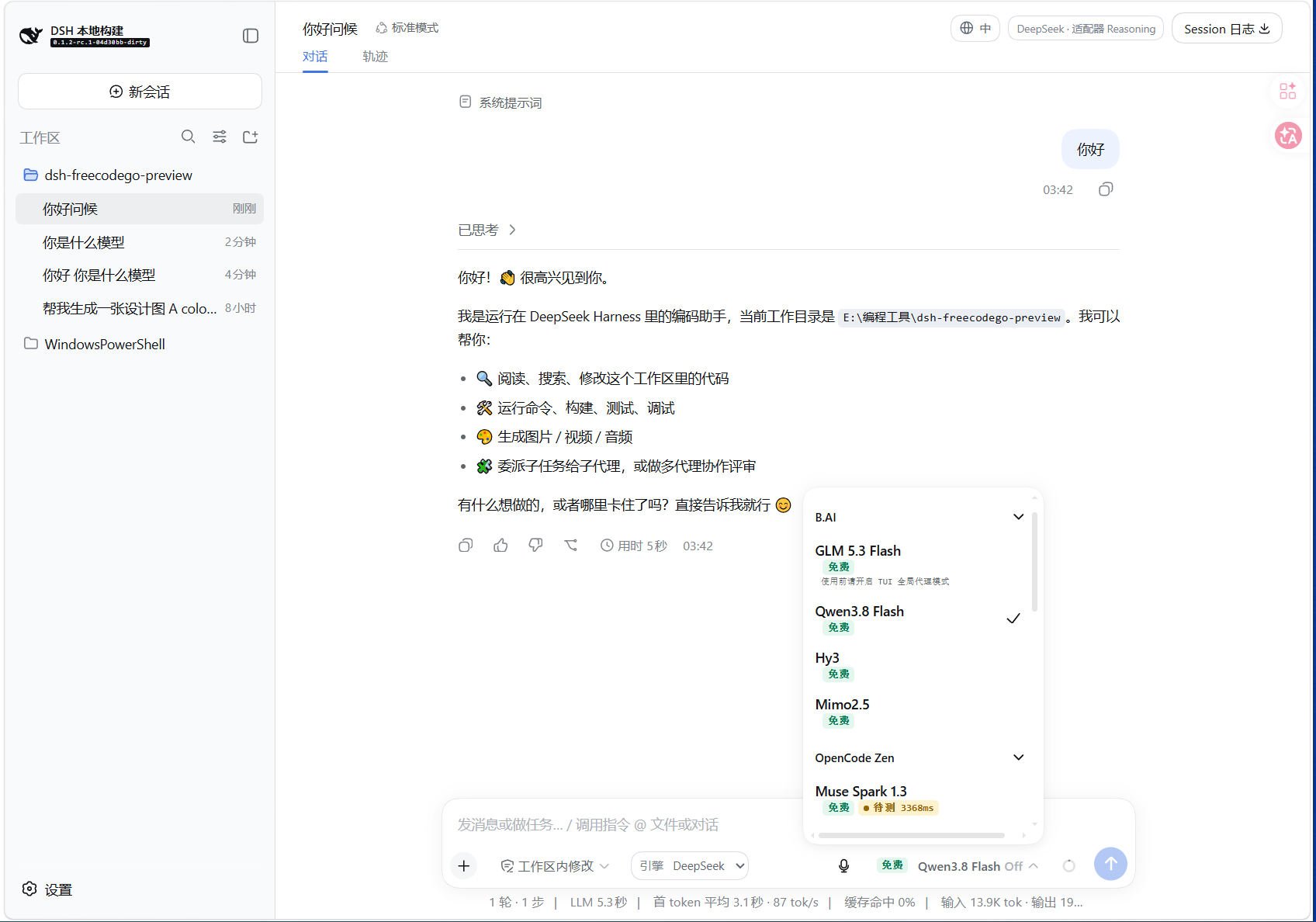
Model picker — the managed catalog and the free providers it reads, grouped by provider, each row carrying its own free and latency label; the composer's engine selector sits beside it.
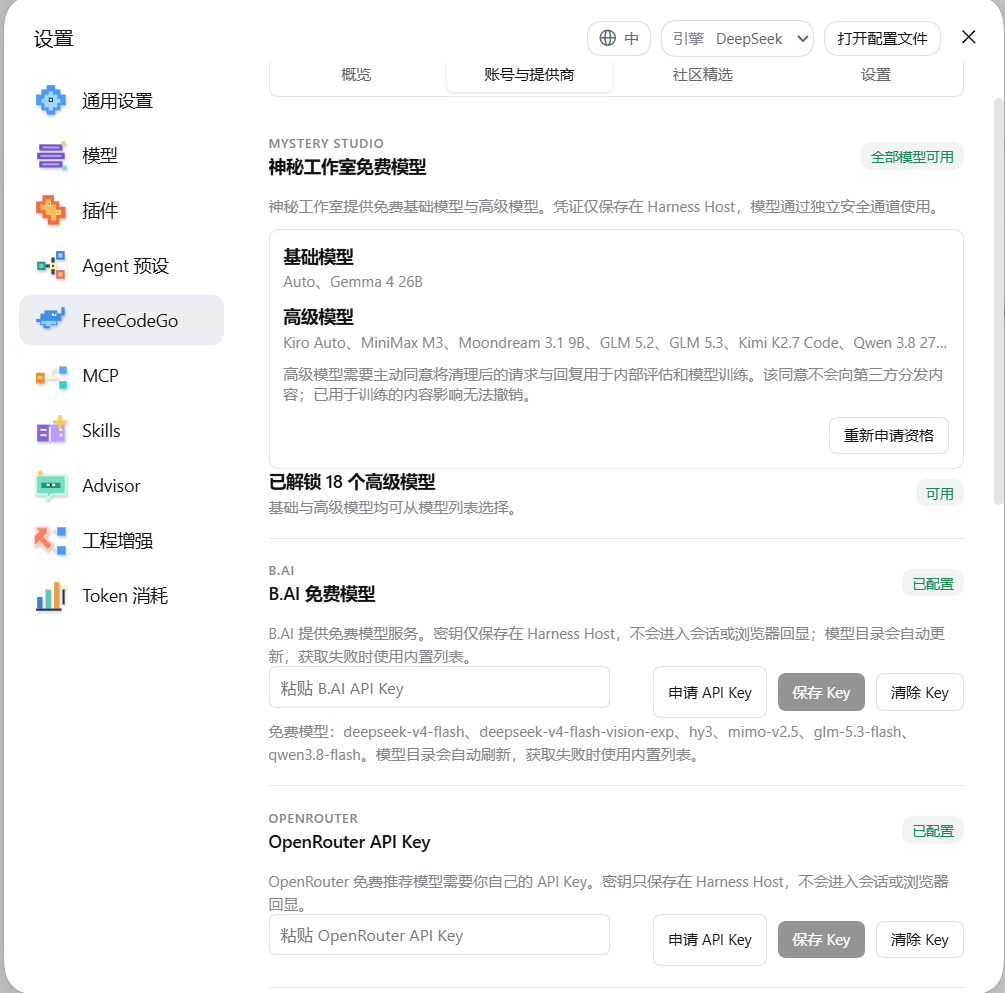
Accounts and providers — Settings → FreeCodeGo → Accounts & providers: each provider's key stays in the Harness host, and that provider's free-model roster is listed under it.
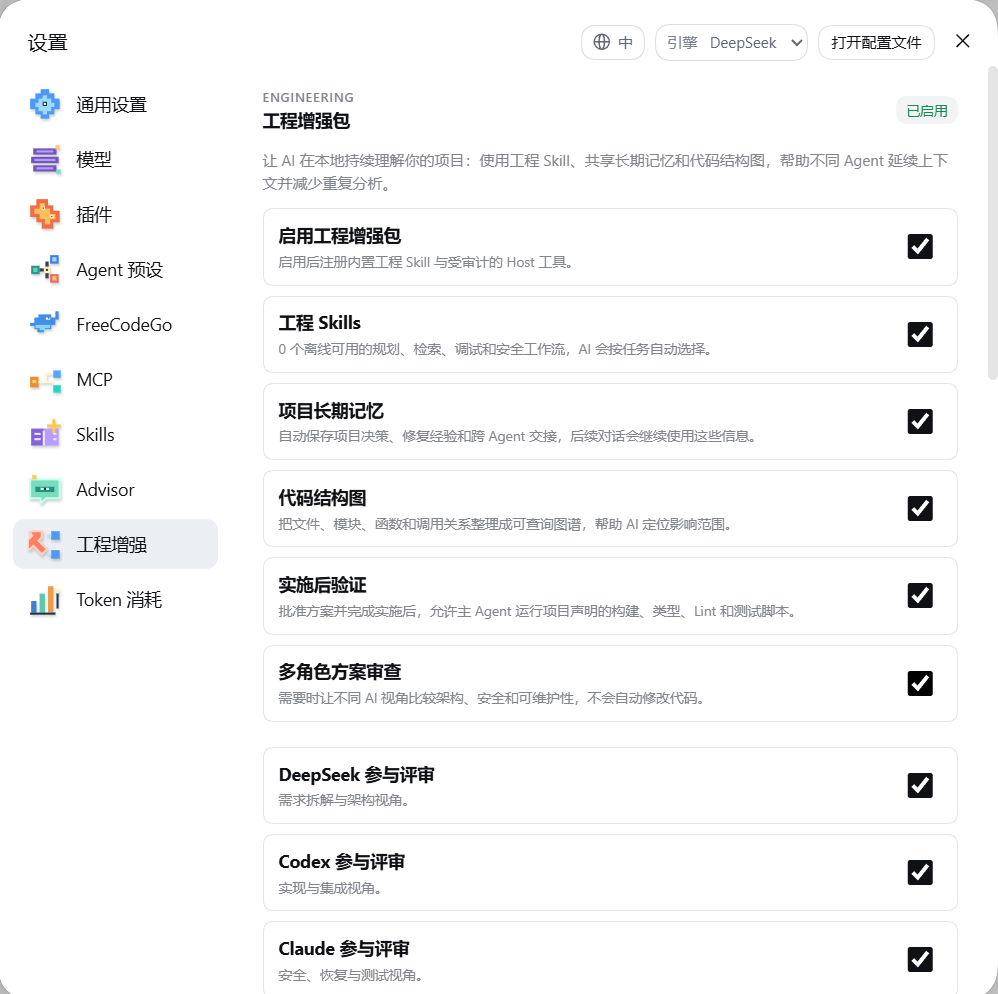
Engineering enhancement — the master switch and what sits behind it: engineering skills, project-long-term memory, the code graph, post-implementation verification, and multi-role review.
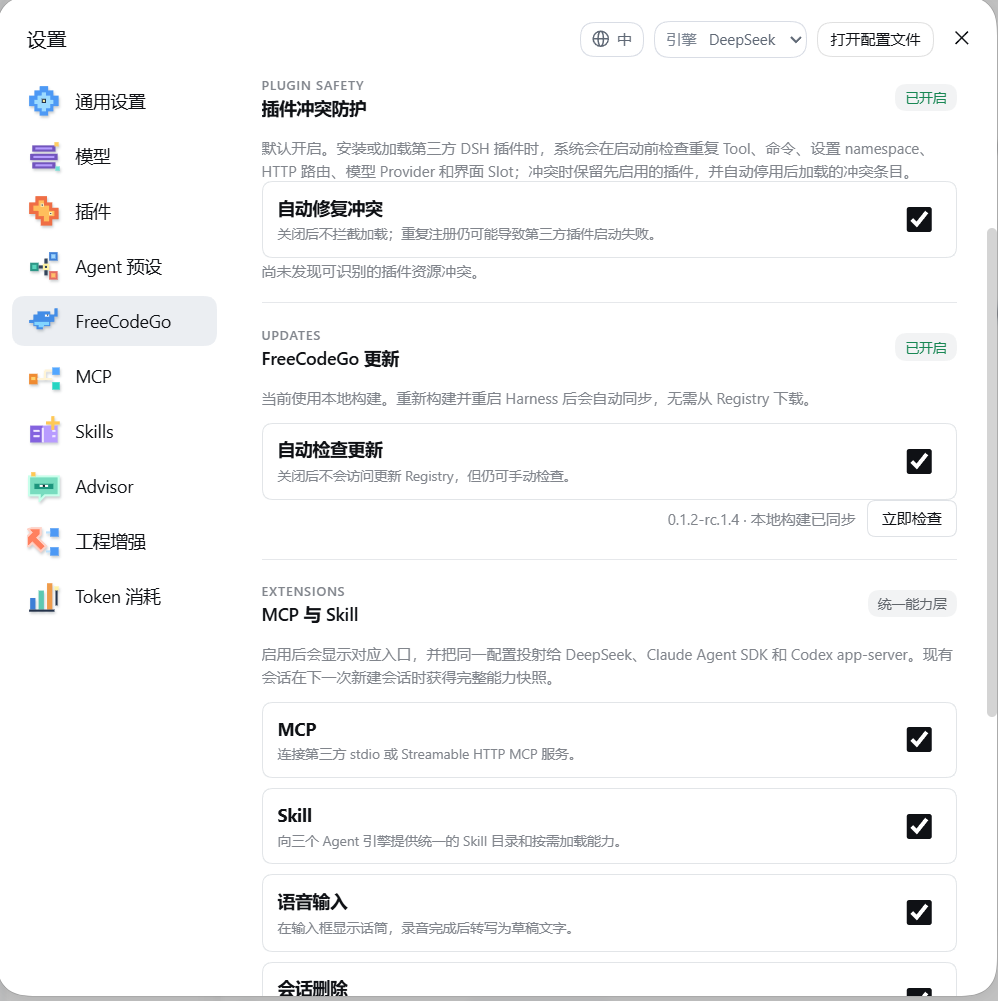
Plugin safety and updates — conflict protection at load time, the release update check, and the unified MCP / Skill capability layer.
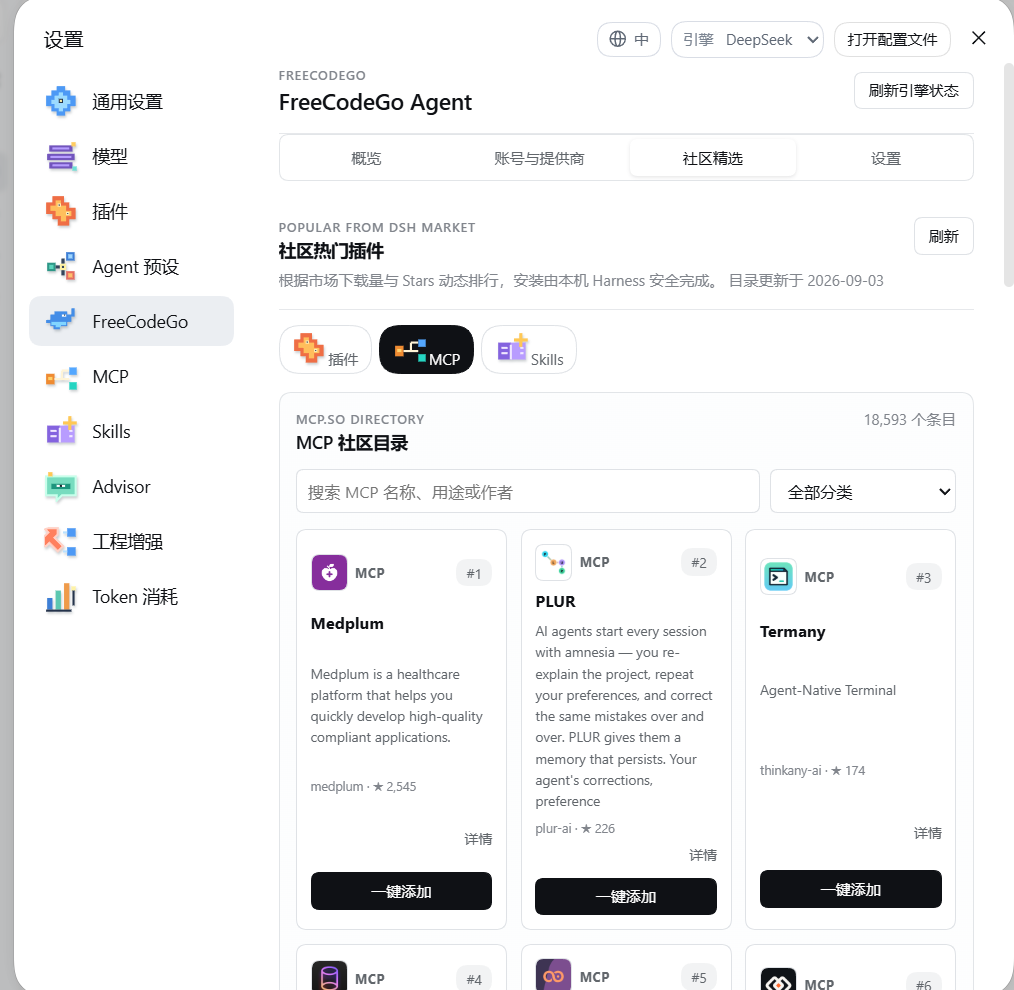
Community picks — the DSH market ranking and the MCP.SO directory, installed into the local Harness with one click.
AgentFactory.tool_search, cache-cold clearing with spill recall, a model-visible context budget, and cache-miss attribution.freecodego_companion_face request the model may make, and a short sad face when a tool call comes back a failure. One character in two seats, and the two always agree.Every feature below states the setting that gates it, and where something is off by default it says so. The decision behind each one is written up in plugin/packages/freecodego/harness-plugin/README.md, the top-level feature document.
Every free row below comes from the provider's own directory, read when you open the picker, so this is what those directories returned on 2026-10-19 (sorted, where the picker keeps directory order) — and the picker is the count that is true when you look.
| Provider | Free models | Directory |
|---|---|---|
| Private Key Gateway | the free routes in the picker, read live | no sign-up and no API key |
| OpenCode | beam-free, big-pickle, deepseek-v4.1-flash-free, glm-5.3-flash-free, jev-1.13-free, longcat-2.5-preview-free, mimo-v2.6-flash-free, minimax-m3.1-flash-free, muse-spark-1.2, muse-spark-1.3, nemotron-3.5-lightning-free, nemotron-3.5-super-vl-free | 12 of 85 rows; public, no sign-in |
| Kilo | cohere/north-mini-code:free, dots-studio/dots-3-note-preview:free, kilo-auto/free, liquid/lfm-2.5-2.6b:free, minimax/minimax-m3.1-flash:free, nvidia/nemotron-3-nano-omni-30b-a3b-reasoning:free, nvidia/nemotron-3-super-120b-a12b:free, nvidia/nemotron-3-ultra-550b-a55b:free, nvidia/nemotron-3.5-content-safety:free, nvidia/nemotron-3.5-lightning:free, nvidia/nemotron-3.5-super-vl:free, openrouter/free, poolside/laguna-s-2.1:free, poolside/laguna-xs-2.1:free, reflection/beam-free, stealth/glyph-cluster, thinkingmachines/inkling-small:free, xingchen-agi/xing4.0-29b-a4b:free | 18 of 400 rows; public, 200 requests/hour per egress IP |
| Logfare | chat claude-haiku-5-5, deepseek-v4-pro-0813, deepseek-v4.1-flash, gemma-4-26b, glm-5.3, glm-5.3-flash, kimi-k2.6, logfare/auto, minimax-m3.1-flash, qwen-3.8-27b; images flux-1-schnell, flux-2-dev, flux-2-klein-4b, flux-2-klein-9b, sdxl-lightning; audio whisper-large-v3-turbo; other routes 8ball, aura-2-en, clef, clef-flash, lucid-origin, nova-3, phoenix-1.0 | 23 rows; 14 need a training-data opt-in, the other 9 do not |
| Qoder | Qwen 3.8 Flash (route qmodel_38flash) | the free flash route, plus daily check-in campaigns |
| NVIDIA | google/gemma-4-31b-it, z-ai/glm-5.3, z-ai/glm-5.3-flash — the roster also names deepseek-ai/deepseek-v4-flash-0731, deepseek-ai/deepseek-v4-pro-0813 and moonshotai/kimi-k3, which are gone from NVIDIA's live catalogue of 81 rows | an API key is required to call them; cross-checked 2026-10-19 |
| SenseNova | deepseek-v4-flash, deepseek-v4-pro, glm-5.2, kimi-k3, sensenova-6.8-flash-lite | roster ships in the bundle; an API key is required |
| TRAE | the rows its directory lists | free credits reset daily, per account |
| Cline | the rows the directory marks ×0 · 官方免费模型, deepseek-v4.1-flash among them | an account pool |
| WorkBuddy International | the rows a credit package marks x0, deepseek-v4.1-flash among them while its promotion window is open | device login, several accounts |
| Agnes | chat and image/video rows | a control-plane account |
| VyceAI | no free roster | the daily check-in credit pays its metered rows |
| Groq | whisper-large-v3-turbo | transcription, not a chat route |
These lists follow their directories: a route upstream retires leaves the table on the next read, which is why it is generated by scripts/generate-free-model-tables.ts rather than remembered.
TRAE, Cline, WorkBuddy International, Agnes publish no stable roster, so their rows are counted when they arrive rather than listed here.
14 Logfare rows sit behind a training-data opt-in, which the picker labels rather than hides.
deepseek-v4.1-flash is also free here through two of the account pools above: Cline keeps it in its free half, and WorkBuddy International covers it for as long as its promotion runs.
AgentFactory, so a session asked for a native engine never silently falls back to DeepSeek.setDefaultEngine and setDefaultModel set what new sessions start on and persist in the settings document of this plugin's own composition entry (freecodego-harness-plugin); existing sessions keep their durable plan.autoSubagentModelSelection, on). Every live text-model route is synchronized into Harness's subagent-model-selection, so new top-level sessions receive provider / model / reasoning_effort plus an on-demand list_subagent_models discovery tool. Children inherit the parent's execution engine and may override the exact LLM route per delegation; a temporarily failing provider keeps its last authorized routes.dsh-llm-pi-ai plugin and the shared Models settings editor; API keys are stored through the Harness credential service and never reach the browser.glm-5.3-flash only when the active Z.AI account holds a Coding Plan credential, and the limited-free window (Asia/Shanghai, 23:00–09:00, before the 20th of each month) is computed Host-side — no client clock or account claim can grant the entitlement.~/.antseed, and the key is handed to the browser only on an explicit export click — and a session-scoped gateway switch starts the runtime and publishes its catalog at http://127.0.0.1:8390/v1. While the gateway is open, its free text models join the picker under antseed, and its free image models become selectable as the image model under Overview, generated through the runtime's own image endpoint on the same loopback address. Only free routes are wired up: no deposit, no payment channel. The switch is never persisted, so a restart asks again, and the per-provider model-list controls cover it like any other provider.WORKBUDDY_AUTH; multiple accounts can be added and removed independently. Agnes registers or logs in through its control-plane endpoints and creates a default API key, stored under AGNES_AUTH / AGNES_API_KEY. Cline and Logfare credentials likewise live as credential references.freecodego:// handler, so sign-in drives the backend's own /auth/oauth/{provider}/start with redirect=/oauth/desktop?state=<ours>&plugin=1, polls GET /auth/oauth/desktop/poll until the issued pair arrives, and adopts that pair into the Host credential vault — the backend stores it under the state it was handed and shows a plain confirmation page instead of a deep link. The same card completes MFA, binds or creates the account, and sends the verification code, all through Host Remotes.selectModel resolves with the Remote failure rather than throwing, so the echo checks the result instead of only watching for a throw — otherwise a refusal would clear the reason it had just written. A separate retry layer absorbs a short-lived Host reconnect (1m, 10m, 30m backoff) without clearing the last directory, so a menu that was open when the carrier dropped recovers instead of going empty.fetch rejection, a status code on a custom error, a DOMException from an abort signal, an adapter's machine code, a provider's own wording — and reacting to the message at each call site is how a rate limit gets retried forever while a context overflow is retried until the budget is gone. Every failure is classified once, and each kind maps to one decision: retry, cool the account down, or fail the turn.gateway.baseUrl configured (default https://freecodego.com, HTTPS required) the settings surface shows account, quota, and usage details, selects payment methods and plans, opens checkout links, polls orders, and renders the live model pricing table, reusing the FreeCodeGo v1 routes for mobile authentication, bootstrap/model state, quota, runtime health, pricing, plans, checkout, and order polling. Payment verification/cancellation and receipt-email delivery are wired; provider-specific payment confirmation, binary receipt download, complete runtime artifact coverage, clean-profile installation, and assembled Web E2E remain release gates.mediaDefaults). freecodego_generate_image, freecodego_generate_video, freecodego_generate_audio, and freecodego_transcribe_audio read the live default at execution time; the model-facing schema deliberately has no model override. Gateway media requests reuse the Host-vault account token, base64 images are admitted to Harness attachment storage and returned as image content blocks, and generated audio is saved under the workspace's .freecodego/generated-media.mediaGenerationEnabled, on by default). It governs freecodego_generate_image, freecodego_generate_video, and the legacy agnes_generate_image / agnes_generate_video names, and switching it off unregisters them so they leave the model's tool list instead of failing at call time. freecodego_generate_audio and freecodego_transcribe_audio are outside it: one writes into the active workspace and the other reads out of it./images/generations, /images/edits when sources are attached), Seedream's image: [...] fusion body, Gemini's :generateContent, Imagen's :predict, and DashScope's multimodal-generation. Video generation speaks nine: Kling (text2video / image2video / multi-image2video), Ark (/contents/generations/tasks), DashScope's async video-synthesis, MiniMax Hailuo, Vidu, Gemini's Veo :predictLongRunning, xAI's /videos/generations including edits and extensions, OpenAI's /videos, and the gateway's portable shape for everything unrecognized. The model roster is read live from the Harness model directory, the managed catalog, Logfare, and Agnes rather than pinned, and the package README carries the full table.freecodego/hy3 route, reads durable turn events with a separate model context and holds only bounded, read-only workspace tools (read, glob, grep). Credentials, hidden reasoning, and unrestricted primary-Agent tools are never copied into the review context.advisor_status, advisor_review, and advisor_notes, so the active Agent can inspect the reviewer, ask for a second opinion at a checkpoint, and consume prior findings without a separate UI action.record events only.Engineering Enhancement sits behind one master switch (engineeringEnabled, on by default). It mounts audited bundled engineering Skills, static asset Doctor checks, bounded declared-script verification, and Host-owned tools shared by DeepSeek, Claude, and Codex. Switching it off stands the whole pack down. The settings page holds the master switch; the detailed controls live in the dynamic Engineering sidebar entry.
engineering_team_start keeps the current root Agent on its selected engine while starting isolated DeepSeek, Codex, and Claude child Agents for a bounded, read-only review of an objective and a draft plan, with an optional cross-examination round. Children cannot edit files, execute shell commands, create another team, or change permissions. Participants may be toggled independently, and the settings panel reports whether the Codex/Claude runtime is installed before allowing one to be enabled.council_* id for polling with engineering_team_status, engineering_team_cancel stops all children, and completed reports stay available through engineering_team_report after the parent session is restored. engineeringCouncilAutoRun (off) can run a review automatically after an approved plan, so users keep explicit control by default.queued, running, awaiting_approval, implementing, verifying, terminal states) persisted as session events, so an interrupted active job is restored as stale rather than silently lost. Approval records carry a plan digest, workspace fingerprint, policy digest, and expiry; a change to any of them fails closed and requires a fresh review.engineering_team_mark_implemented with a bounded summary before engineering_team_verify is accepted.skipped, `unavailabDeepSeek Harness(DSH)Web 插件聚合生态包 · 一切皆插件,创意工坊分发(dsh-market.com)
把回答做成一页可视化 HTML:模型只写简短的 Markdown 草稿,随包附带的 `am` 命令行生成页面,支持流程图、时序图、树、时间线、ER 图、表格和提示框。
在 dsh 里装上这个插件即可,无需登录、注册或填 API Key,就能使用包括 Muse Spark 1.3、MiMo V2.6 在内的前沿模型——完全免费,不限量。 All you do is install this plugin in dsh: no login, no sign-up, no API key — the frontier models are just there, Muse Spark 1.3 and MiMo V2.6 among them. Completely free, with no usage cap.

