

dsh-web
zhu1090093659/dsh-webDeepSeek Harness(DSH)Web 插件聚合生态包 · 一切皆插件,创意工坊分发(dsh-market.com)
Track your AI usage. See how you rank.
English | 简体中文
MADRank is an AI Usage & Ranking plugin for DeepSeek Harness (DSH). It turns your DSH activity into a private local dashboard — Today / 7-Day history / Top models / Streak — and, if you explicitly opt in, an anonymous global 7-Day Token Race based on real usage.
The core principle is simple: local tracking runs by default, global ranking is an explicit opt-in, uploads only happen for finished UTC days, and only aggregated usage is ever sent.
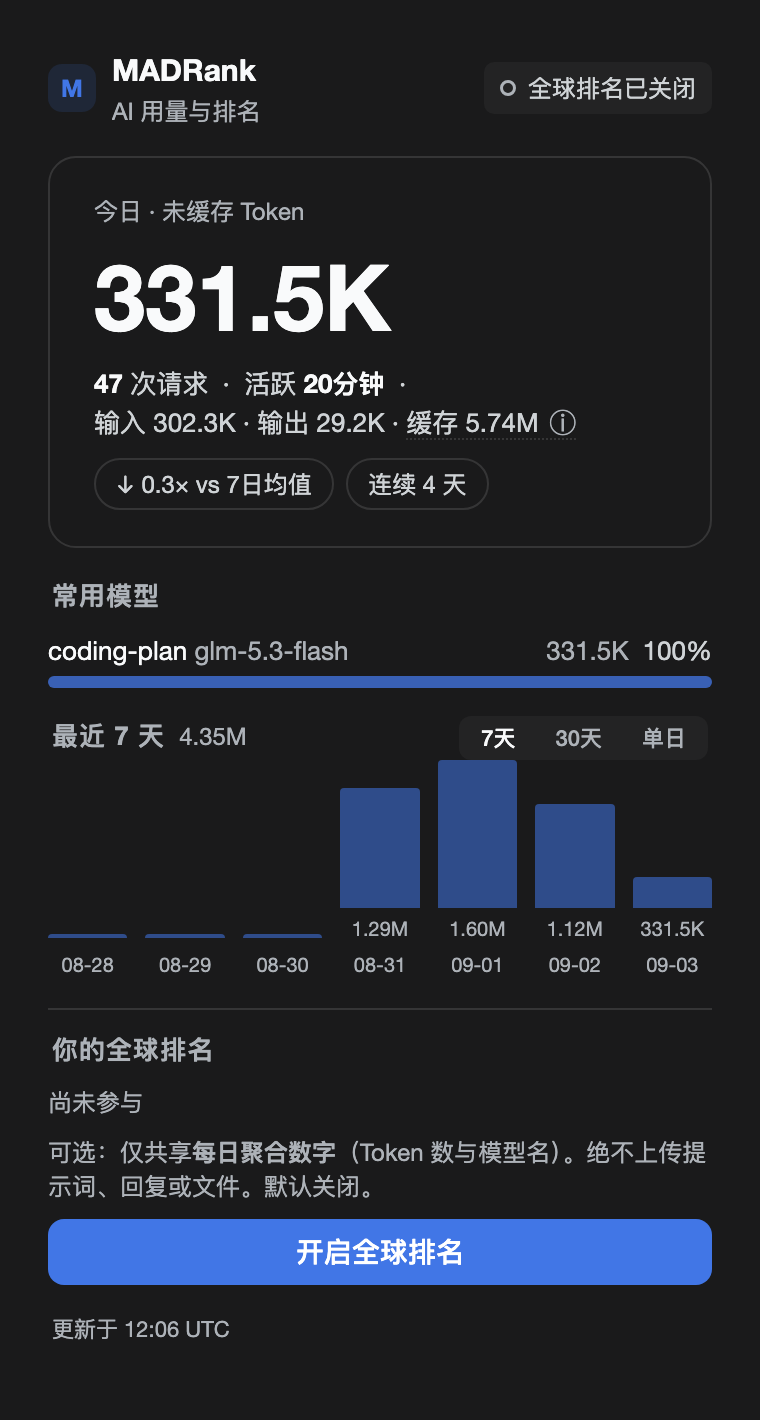
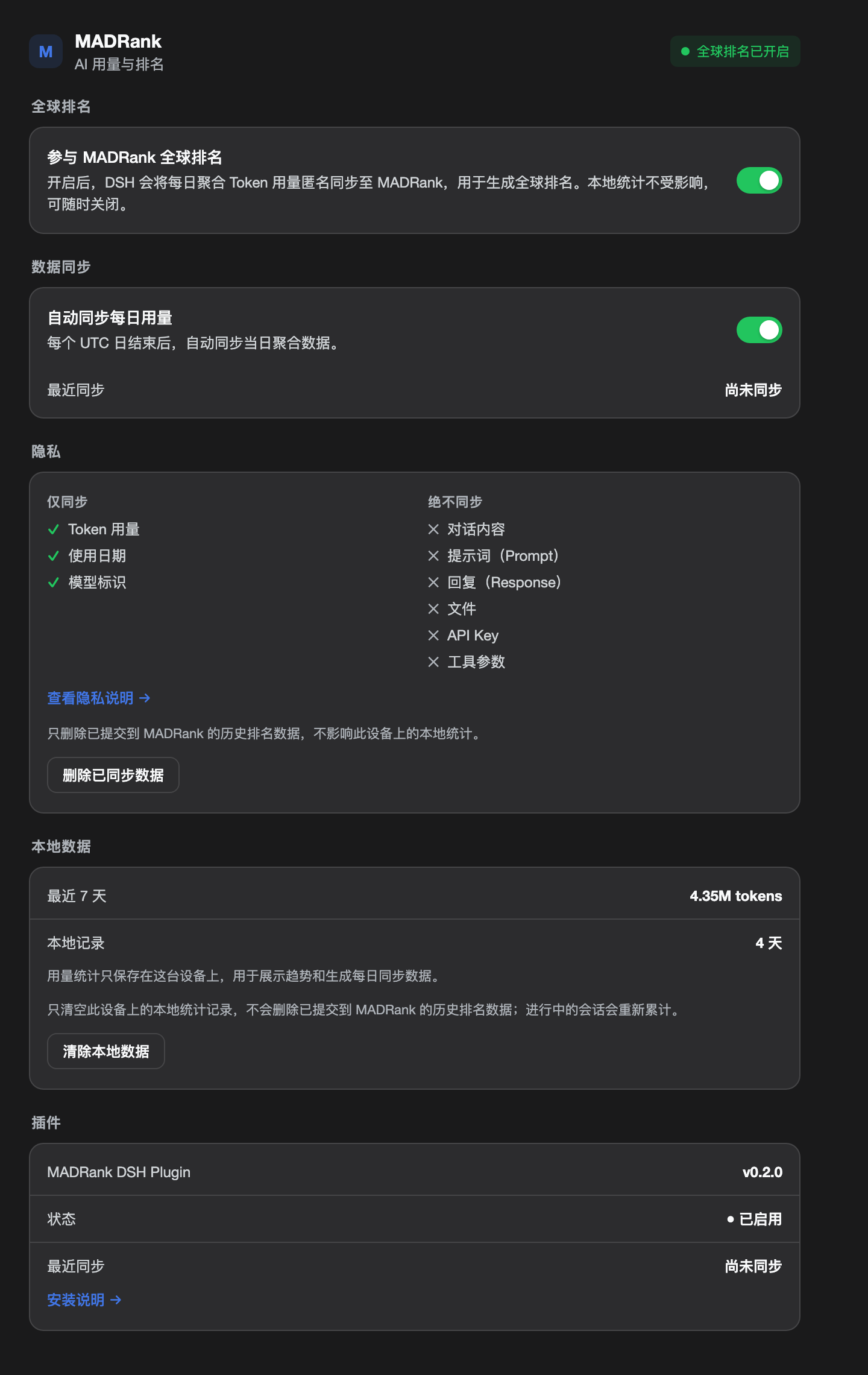
Left: sidebar Quick View (real local data) · Right: Settings → MADRank panel
1. Local AI Usage Dashboard (works fully offline, no ranking required)
Data comes from the DSH session projection feed — the plugin never reads DSH's internal database directly.
2. 7-Day Token Race (the core competitive metric)
7-Day Total — your primary tokens over the last 7 UTC days.
Primary Tokens = uncached input tokens + output tokens
Cached Tokens  = cache read + cache write
A note on honesty: the race figure is the full input+output as uploaded (uncached input + cache write + output); cache reads are reported separately and never counted toward the race. "Uncached" on the local dashboard refers to your local primary (uncached input + output) — the two numbers answer different questions, and the card labels both: local figures are marked LOCAL · LIVE, race figures carry the server sync time. This keeps read-cache differences from distorting comparisons while staying truthful about what is counted.
3. Opt-in Global Ranking
Nothing is uploaded by default. Sync only starts after you explicitly enable join the global ranking:
4. One-click Share Card
The share button on the Quick View card turns your rank into a postable card:
https://madrank.ai/share/<shareToken>, viewable from any device by anyone/api/usage/me) right before sharing, so stale local caches never leak stale numbers into your postsSharing uploads no new private data: the share token only addresses your anonymous node on a public leaderboard, and the leaderboard itself is public.
Local tracking and global sync are separated at the architecture level.
Default (offline-capable):
DSH → Local Projection → Local Usage Store → Local Dashboard

After joining the race:
Local Usage Store → Finished UTC Day → Aggregated Usage → MADRank Ingest
Never uploaded: prompts, responses, tool arguments, individual request payloads, same-day usage. Uploaded: daily, per-model aggregated usage only.
Deletion is intentionally split: Clear Local Data removes this machine's statistics; Delete Remote Data requests removal of the remote rows tied to your anonymous installation identity.
MADRank does not invent a second token-accounting logic. It uses DSH's session projection as the data source and reconciles aggregation against an independent reference token-meter. A real-session reconciliation run:
input        745,120  =  745,120
output       186,324  =  186,324
cache read 26,352,384 = 26,352,384

MATCH ✓
The suite covers streaming replacement, waterfall tool traffic, cross-midnight bucketing and (turn, step) replacement semantics. Goal: stay consistent with DSH's own token meter.
A DSH plugin is mounted from a profile. Two things must both be true, or the plugin silently does nothing:
- the package is declared/installed in the profile (
package.json+node_modules, viadsh plugin … add);- the profile mounts it — a
cordis.patch.ymlinsert entry.The published package ships the Host half compiled to JavaScript (
dist/host/) and the browser half prebuilt (dist/client.js) — consumers need no build step. (Node refuses to type-strip TypeScript insidenode_modules, which is why installed packages must not pointmainat a.tsfile.)
Open the sidebar Plugins page (the plugin manager; Settings → Plugins is a read-only list) and install from one of:
qomob/dsh-madrank@qomob/dsh-madrankThen fully quit and reopen the app (the profile composition is loaded at startup; reloading the page is not enough). If the manager leaves the plugin un-mounted, add the mount entry below, then restart.
desktop, web, …)# GitHub (always the latest `main`)
dsh plugin --profile desktop add github:qomob/dsh-madrank
# …or the published npm package
dsh plugin --profile desktop add @qomob/dsh-madrank
dsh plugin forwards to pnpm inside ~/.dsh/profiles/<profile>/, which declares the dependency properly (an undeclared package gets pruned on the next pnpm install).
Then add the mount entry to ~/.dsh/profiles/<profile>/cordis.patch.yml:
- insert:
    - id: madrank
      name: '@qomob/dsh-madrank'
And restart DSH.
git clone https://github.com/qomob/dsh-madrank.git
cd dsh-madrank && npm install && npm run build
dsh plugin --profile desktop add 'link:/absolute/path/to/dsh-madrank'
Use link: not file: (file: copies the package and breaks source sync). With link: the profile loads the built dist/ — run npm run build after source edits, then restart. Add the mount entry and restart as above.
madrankUsage projection registered and settings ns registered: madrank-usage.| Symptom | Check |
|---|---|
| No MADRank entry, no log lines | Mount entry missing from cordis.patch.yml |
| Plugin gone after an unrelated install | Dependency not declared in the profile package.json (re-run dsh plugin … add) |
| "settings ns registered" missing | Profile never restarted, or the app was only reloaded |
| Older UI/copy than this README | npm install of an older version — use the GitHub spec, or upgrade (dsh plugin --profile desktop add @qomob/dsh-madrank@latest) |
| Installed, enabled, but runtime says not running (v0.3.6 or earlier) | That release pointed main at src/index.ts; Node cannot type-strip TS under node_modules. Upgrade to v0.4.0+, which ships compiled dist/host/ JS |
Sidebar → Quick View = VIEW
Settings → MADRank   = CONFIGURE
Quick View shows your usage, 7-day trend, model mix and rank; the share button on the card generates your personal share card. Settings controls the join switch, auto-sync, privacy, local/remote deletion and plugin status.
Scan the QR code to join the DSH plugin community — discuss DSH usage, plugin development and best practices:

The WeChat group QR code expires periodically. If it stops working, leave a message in Issues and we will refresh it.
┌──────────────────────┐
│   DSH Session Logs   │
│    Source of Truth   │
└──────────┬───────────┘
           ▼
┌──────────────────────┐
│  sessionProjections  │
│     madrankUsage     │
└──────────┬───────────┘
           ▼
┌──────────────────────┐
│      UsageStore      │
│  local usage cache   │
└──────────┬───────────┘
      ┌────┴─────┐
      ▼          ▼
   Local UI    Daily Sync
                   │
                   ▼
            MADRank Ingest
                   │
                   ▼
           7-Day Token Race
DSH session logs are the source of truth; the plugin reads sessionProjections (never SQLite directly), keeps a rebuildable local cache, and keeps daily sync fully isolated from local statistics. All DSH coupling lives in src/compat.ts — verifiable via npm run verify:dsh.
Integration follows the current official recommendations from the DeepSeek Harness repository (cookbook docs/cookbook/adding-a-settings-card.md and the dsh-session-projection / dsh-settings package references): the projection definition is the official { key, stateSchema, init, apply, wire, stateVersion } shape (zod ZodType), the settings namespace registers a schemastery schema through the official register contract (src/settings-schema.ts), the sync tick and flush debounce use the official timer service when present, and the browser card registers under settings.plugin.item keyed by its namespace so the Plugins section pairs it with the served namespace automatically.
Non-negotiables: never fork DSH · never read internal SQLite directly · never duplicate token-meter semantics · never create an independent session event pipeline · never upload same-day usage · never upload prompts/responses/tool arguments · never let global sync block local statistics.
Default directory ~/.madrank/usage/ (override with MADRANK_USAGE_DIR): installation-id, usage-store.json, card-snapshot.json, global-rank.json, deleted-epoch, cleared-epoch. The anonymous identity is a locally generated installation UUID; a new machine means a new identity by default.
npm install
npm test
npm run typecheck
npm run build:client
npm run reconcile -- <events.jsonl>
npm run reconcile:fixture
npm run verify:dsh
npm run preview
TypeScript · React · Zod · Vitest.
Local usage projection, 7/30-day history, top models, streak, Quick View, Settings and the daily aggregated sync protocol are implemented; golden-case and real-traffic reconciliation and DSH compatibility verification pass.
v0.5.3 targets DSH 0.2.x (the new plugin model: Config + configForms + slot-prop session data). On older DSH builds the browser half waits for activation — upgrade DSH first. The Host syncs daily aggregates to MADRank and publishes the accepted race record through a dedicated client-visible projection (madrankRank), so the live rank card and share card work on the new model without a custom Remote API.
The MADRank ecosystem goes beyond the DSH plugin:
This project is a community-driven, unofficial project and is not affiliated with DeepSeek AI. "DeepSeek", "dsh", "DeepSeek Harness" and related names and trademarks belong to their respective owners.
MIT © 2026 qomob / MADRank
DeepSeek Harness(DSH)Web 插件聚合生态包 · 一切皆插件,创意工坊分发(dsh-market.com)
把回答做成一页可视化 HTML:模型只写简短的 Markdown 草稿,随包附带的 `am` 命令行生成页面,支持流程图、时序图、树、时间线、ER 图、表格和提示框。
在 dsh 里装上这个插件即可,无需登录、注册或填 API Key,就能使用包括 Muse Spark 1.3、MiMo V2.6 在内的前沿模型——完全免费,不限量。 All you do is install this plugin in dsh: no login, no sign-up, no API key — the frontier models are just there, Muse Spark 1.3 and MiMo V2.6 among them. Completely free, with no usage cap.

