

dsh-web
zhu1090093659/dsh-webDeepSeek Harness(DSH)Web 插件聚合生态包 · 一切皆插件,创意工坊分发(dsh-market.com)
Session-scoped checklists for DeepSeek Harness. The agent owns the list, the model always sees it, and a read-only sidebar tab mirrors it.
The problem this solves is not "having a list". It is having to dictate the list again every session. Here the checklist is created once, injected into the model context on every turn, and updated as work progresses — no reminders needed.
checklist_create), optionally from a template.checklist_check).If the agent forgets to mark something, you say so in chat and it fixes it.
| Tool | What it does |
|---|---|
checklist_create | Creates a list, from scratch or from a template (release, feature, debug, review) |
checklist_add | Appends items to an existing list, optionally under a given item |
checklist_check | Sets one or more items to todo · doing · done · blocked |
checklist_next | Returns the next actionable leaf, its path, and how many remain |
checklist_edit | Changes an item's text (not its state) |
checklist_list | Full tree with ids and states, for when the digest is truncated |
checklist_delete | Deletes a list (by id or exact title) |
checklist_remove_item | Removes one item and everything nested under it |
checklist_rename | Renames a list; titles stay unique within the session |
checklist_workspace | Lists checklists from other sessions in the same workspace (read-only) |
checklist_template_save | Saves a list as a reusable template for future sessions |
Items are plain strings. Two leading spaces per level nest them:
["Deploy to staging", " Smoke tests", " Rollback plan"]
dsh plugin --profile web add dsh-checklists
From a local build or tarball:
npm install
npm run build
npm pack
dsh plugin --profile dev add ./dsh-checklists-0.7.0.tgz
dsh --profile dev --dump-config        # the tool-checklist row should appear
Install into a test profile first. web and headless are distinct profiles, and
so is the desktop app's desktop profile.
Override the defaults on the plugin's entry in the profile's cordis.patch.yml:
- id: tool-checklist
  name: dsh-checklists
  config:
    maxDigestLines: 12      # lines of the injected digest
    maxItemsPerList: 200    # per-list item cap
    pruneDays: 14           # prune untouched sessions after N days (0 = never)
    nudge: steer            # steer | observe | off — see "Turn-end gate"
    workspaceView: on-demand   # off | on-demand | always — see "Workspace lens"
    workspaceViewLimit: 10     # sibling checklists returned
    # storageRoot: "D:/data/dsh-checklists"
    # templates:
    #   my-flow: ["Step 1", "  Sub-step", "Step 2"]
$DSH_HOME/storages/dsh-checklist/
├─ sessions/<sessionId>.json    one document per session
└─ templates.json               templates shared across sessions
Writes are atomic (temp file + rename) and serialized per session. A corrupt document degrades to an empty list instead of failing the turn.
The package is
dsh-checklists, but its storage directory keeps thedsh-checklistprefix. That path is data, not identity: renaming it would orphan every checklist already saved.
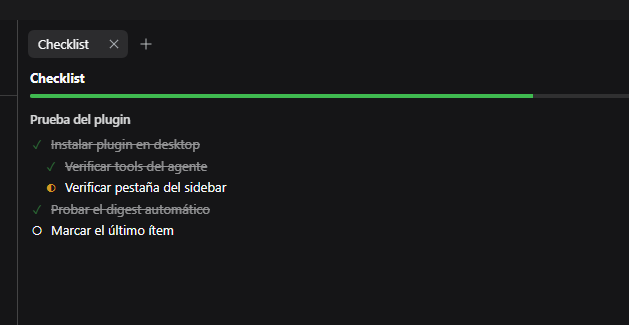
Open the right sidebar, then the guide (+) and pick Checklist.
| Action | How |
|---|---|
| Collapse | Click a list title, or the ▾ on any item with children |
| Auto-collapse | When a new list appears, the others fold and the new one opens |
| Hide completed | The "Hide done" button, shown only when something is done |
| Copy as markdown | "Copy" — paste into a PR or an issue |
| Edit an item's text | Double-click the text; Enter saves, Esc cancels |
Item states remain agent-only: the tab cannot check anything off. The one write
path is text editing, through POST /dsh-checklist/item with expectedText. If the
item changed since the tab read it, the host answers 409 rather than overwriting
the agent's edit.
| Route | Method | Purpose |
|---|---|---|
/dsh-checklist/state | GET | One session's state (read-only, no-store) |
/dsh-checklist/item | POST | Edit an item's text, with a conflict guard |
/dsh-checklist/nudge | GET | Recent turn-end gate decisions |
/dsh-checklist/workspace | GET | Checklists of sibling sessions in the same workspace |
/dsh-checklist/client-probe | GET | Client load diagnostics |
A checklist only helps while it is true. The gate closes the most common gap: a turn does real work, forgets to mark it, and the list is stale by the time you look at it.
When a turn is about to close, the plugin checks exactly three things:
bash, edit, write, …)?doing?If all three hold, the agent gets one short steering message before the turn ends:
Before you finish: N checklist item(s) are still marked "doing". If you completed any of them this turn, update them with checklist_check and say what proves it. If not, leave them as they are — do not mark work you did not do.
It never guesses what was completed — only that the bookkeeping was skipped. At most one nudge per turn, and none when the turn was pure conversation or the checklist already changed.
Inspect recent decisions at GET /dsh-checklist/nudge:
{ "mode": "steer", "entries": [
  { "source": "turn-stopping", "nudge": true, "steered": true,
    "reason": "1 item(s) still doing after workspace changes", "doing": 1 }
] }
nudge: observe records without interrupting; nudge: off disables the gate.
Checklists stay per session. The lens is a read-only way to see the checklists of other sessions in the same project — available on request, and never part of the prompt.
| Mode | Behaviour |
|---|---|
on-demand (default) | The tool works; the sidebar section starts collapsed |
always | The sidebar section starts expanded |
off | No tool, no route |
Clicking an entry expands it into a read-only tree, fetched once from that session's own state route. Nothing there is editable — the lens can look, not touch.
Membership comes from disk: a session belongs to the workspace directory that
contains it under $DSH_HOME/sessions/<workspace>/<sessionId>/. The host's
workspace.json is only used for a friendly title, because it is not always
complete — on the machine this was written on it was missing a workspace.
Nothing here is writable. To change another session's checklist, open that session: two writers on one list would give the list two truths.
The panel follows the harness locale: Spanish when locale starts with es,
English for everything else. If the locale service is unavailable, it falls back
to English instead of breaking.
Text addressed to the model — tool descriptions, rendered results, the digest — is English and is not translated: it is prompt material, not interface copy.
window.__ModuleLoader__ and only require('react').
No bundler needed, but a static inject of a service that never resolves parks
the plugin silently — apply never runs and nothing appears. Tab types must be
registered lazily (ctx.inject([...])).npm run typecheck
npm run test # vitest
npm run smoke # same checks, in-process, no child processes
npm run smoke exists because some sandboxes deny spawn with EPERM, and then
Vitest cannot start its workers. It covers the model, digest, store, public state
and both HTTP routes (23 checks) against the compiled lib/.
version: 1; any change must migrate.MIT
DeepSeek Harness(DSH)Web 插件聚合生态包 · 一切皆插件,创意工坊分发(dsh-market.com)
把回答做成一页可视化 HTML:模型只写简短的 Markdown 草稿,随包附带的 `am` 命令行生成页面,支持流程图、时序图、树、时间线、ER 图、表格和提示框。
在 dsh 里装上这个插件即可,无需登录、注册或填 API Key,就能使用包括 Muse Spark 1.3、MiMo V2.6 在内的前沿模型——完全免费,不限量。 All you do is install this plugin in dsh: no login, no sign-up, no API key — the frontier models are just there, Muse Spark 1.3 and MiMo V2.6 among them. Completely free, with no usage cap.

