

bowenliang123/dsh-context
bowenliang123/dsh-contextDSH 上下文洞察面板:Context 仪表盘 + /context命令 + Context 浏览器,查看 Context的分类组成、内容详情、演进趋势、压缩/注入事件、统计等一站式 Context 全生命周期管理。
v1.13.6 · formerly dsh-usage-stats
Local-first usage center for DeepSeek Harness Web. Tokens, estimated cost, account balances, subscription quotas, trends, forecasts, alerts, and exports — plus coding-subscription OAuth (Grok Build, Codex, Kimi Code, Claude Code), an optional loopback API gateway, and opt-in local auth/usage monitoring. No tokens in chat.
English · 中文版 · 日本語 · 한국어 · Português (BR) · Español · Français · Deutsch · Русский
Upgrade / 升级: Follow the versioned steps in
docs/01-install.md. Hub1.13.6and Subscription0.8.6share the verified DSH0.1.1-rc.2contract and pindsh-coding-oauth-core@0.1.2withundici@7.29.0. Keep profile, configuration, and credential files, update both plugins in the same Web profile, then restart the existing DSH Web process once. Core remains a shared npm dependency, not a separate DSH plugin. Publisheddsh-coding-oauth-core@0.1.2(helpers + subpath exports) is consumed from npm; Hub still keepsvendor/dsh-coding-oauth-coreas the editable publish source.
dsh-coding-oauth-core@0.1.2Published on npm (latest = 0.1.2). Hub and Subscription consume the registry package. vendor/dsh-coding-oauth-core remains the editable source for the next core release; operators publish future versions from that tree (agents must not run npm login / npm publish). See the vendor core README.
First published as dsh-usage-stats. The package and repository are now dsh-hub-oauth-gateway (effective with 1.1.0). Remove any old entry before reinstalling. Local data files and the internal Cordis plugin id stay the same, so historical usage is preserved.
| Use this | Still works / unchanged | |
|---|---|---|
| npm (recommended) | dsh plugin --profile web add dsh-hub-oauth-gateway | Old npm name is no longer updated |
| GitHub / development | dsh-hub-oauth-gateway | — |
| Cordis plugin id | usage-stats | unchanged |
| SQLite database | ${DSH_HOME}/storages/usage-stats-v1.sqlite | unchanged |
| CLI | dsh-hub-oauth | dsh-hub-grok-build (alias). Subscription-owned dsh-coding-oauth / dsh-grok-build are not this package |
Release history lives in CHANGELOG.md.
(session, turn, step); later samples replace, never double-count.oauthDevice.copilotClientId is set; multi-account store (max 8) with optional codingOAuth.pool (off | priority | quota_aware); Claude Code import via Import Claude Code (macOS Keychain Claude Code-credentials or file fallback; preview → commit; overwrite still needs confirm); models appear as (OAuth); one-way CLI credential Pull.coding-opencode-go (separate from DSH-native opencode-go). External tools use coding-opencode-go/<model-id> (legacy opencode-go/<model-id> still accepted) with the matching protocol and a stable conversation header. The local gateway key and upstream credential are separate; missing session IDs are rejected. If an older plugin config still lives under native opencode-go, migrate it from the Accounts card.Product research: docs/research/usage-analytics-landscape.md. Architecture: docs/02-architecture.md.
Captured against DeepSeek Harness Web with this plugin installed (empty local history is normal for a fresh profile).

Floating HUD — today’s metric plus multi-account quota chips
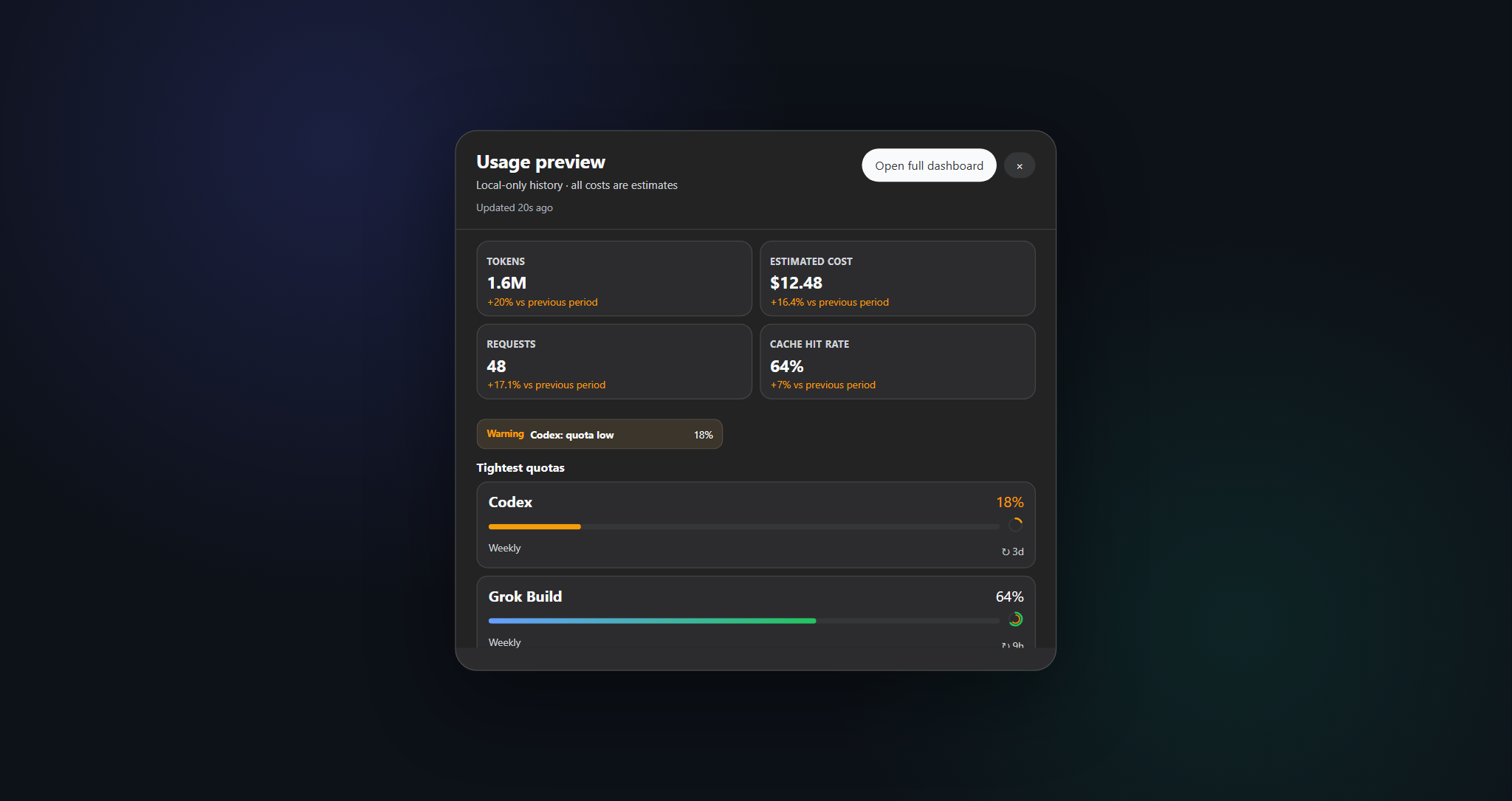
Quick Peek — compact 2×2 KPIs with a one-click jump to the full dashboard
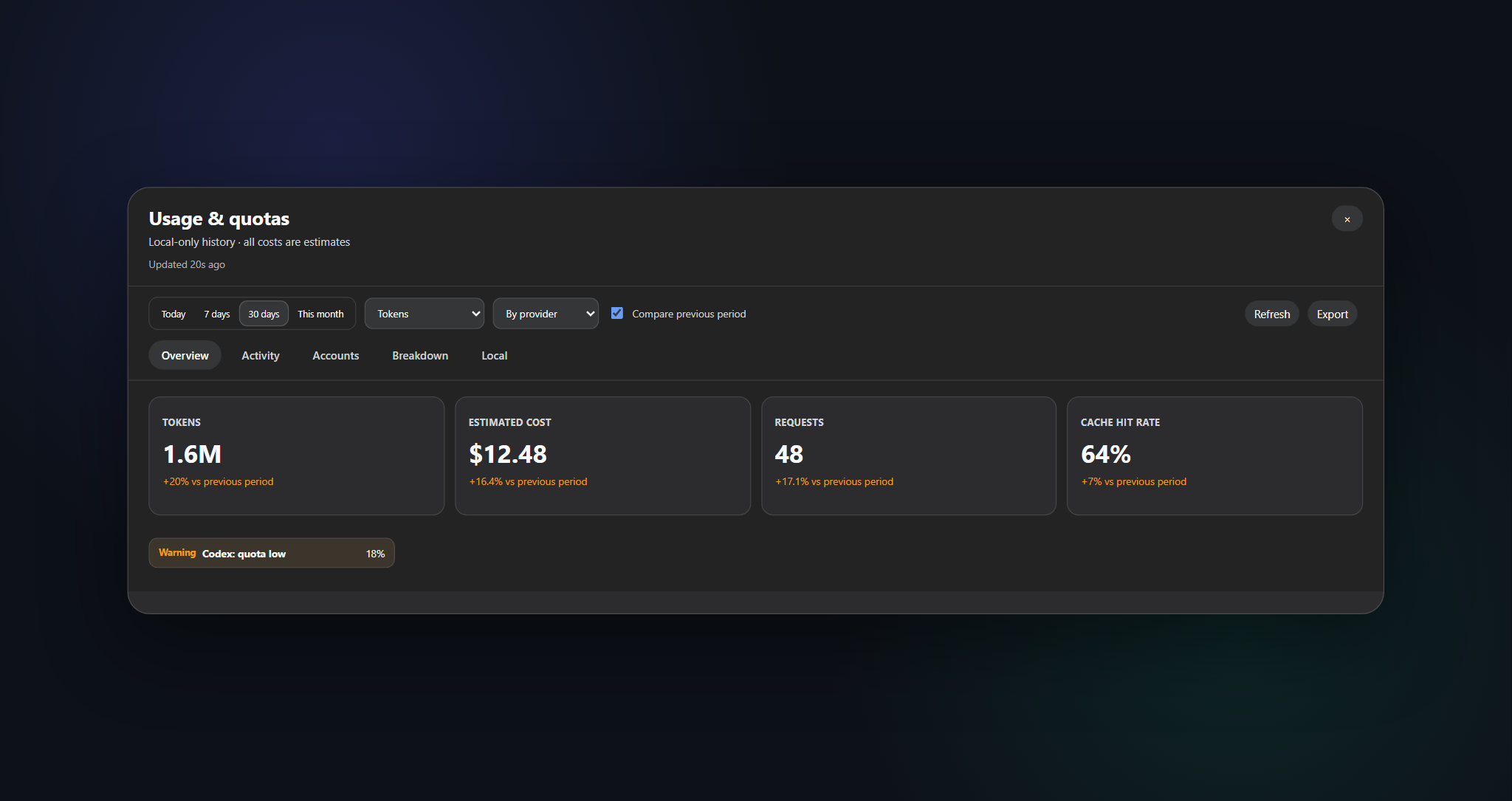
Full dashboard — ranges, tabs, refresh, and CSV / JSON export
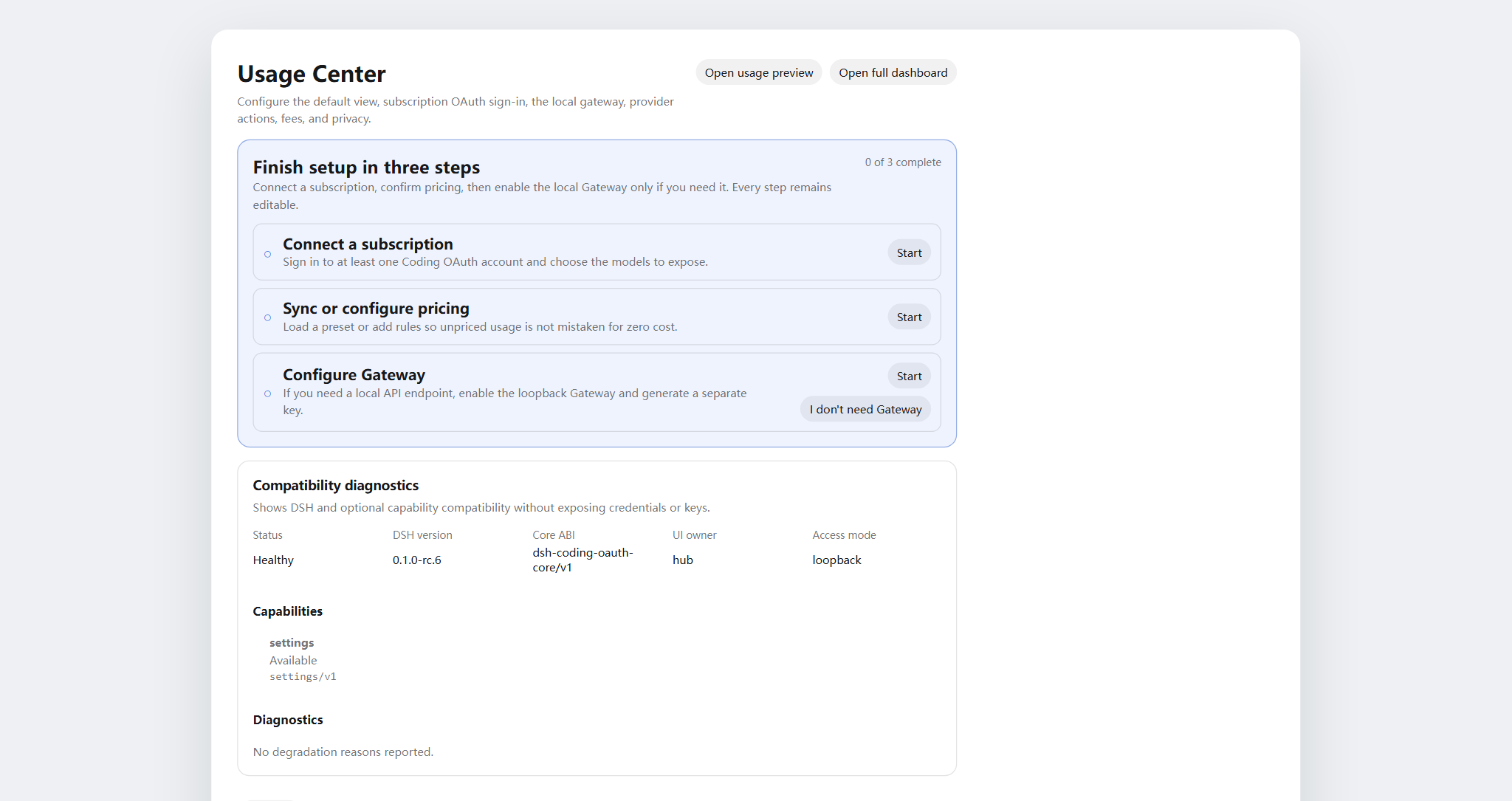
Settings → Usage Center — Display / Accounts / Gateway / Capabilities / Providers / Fees
| You searched / saw | What was actually broken | What this plugin does |
|---|---|---|
| Usage / cost / quota scattered across CLIs and providers | No single local history or coverage-aware cost view | SQLite projection + price rules + account adapters in one Usage Center |
| SuperGrok / ChatGPT Plus / Kimi Code / Claude Pro in DSH without another API bill | Built-in routes are often pay-as-you-go API keys | Local OAuth routes coexist with existing API-key providers |
本轮运行失败 API key is invalid / AUTH mid-turn | GUI maps every AUTH to that banner; OAuth access tokens expire | Proactive refresh and AUTH-aware retry on coding OAuth routes |
| Want OpenAI/Anthropic-compatible tools against subscription sessions | No safe local bridge | Opt-in loopback gateway (not a public relay) |
OpenCode Go: MissingSessionID | Missing stable conversation ID | DSH: use Accounts & Models; external tools: provide x-opencode-session. See migration. |
| Token Monitor-style CLI status without pasting secrets | Manual file digging or chat paste | Opt-in localMonitor / localUsage on hardened allowlisted paths |
# 1. install the current npm release into the web profile
dsh plugin --profile web add dsh-hub-oauth-gateway

# 2. restart the resident DSH Web process (operator chooses when)
# `dsh web` is the official CLI alias for the web profile, not a service-unit name.
# Restart the existing process with the process manager actually configured on this machine.
Then open Settings → Usage Center. For Accounts / Gateway / Capabilities, sign in or enable switches as needed. Full install options (npx installer, GitHub tarball, proxy) are in docs/01-install.md.
@deepseek-ai/dsh 0.1.1-rc.2 (exact BOM). Install range (engines.dsh) covers 0.1.x–0.2.x so hosts such as 0.2.1-rc.2 are not rejected at install; treat 0.2.1-rc.2 / 0.1.5-rc.1 as unverified candidates in compatibility/dsh-bom.json until promoted — see docs/01-install.md.^22.19.0 || >=24.0.0dsh plugin --profile web add dsh-hub-oauth-gateway
dsh plugin --profile web update dsh-hub-oauth-gateway
dsh plugin --profile web remove dsh-hub-oauth-gateway
Compatible installer when the plugin manager is missing: npx --yes dsh-hub-oauth-gateway-install. GitHub /path/to/*.tgz and development path installs are documented in docs/01-install.md. After install, restart the existing DSH Web process through the process manager configured on your machine, then refresh http://127.0.0.1:3080; DSH does not publish a universal service-unit name.
CLI: dsh-hub-oauth login [--pkce] | import | status | logout (dsh-hub-grok-build is an alias).
Settings → Usage Center uses six top tabs: Display, Accounts, Gateway, Capabilities, Providers, and Fees. Signed-in provider cards collapse until expanded. Each Providers card maintains its own auth inline — save/clear API keys, Copilot device auth, per-provider refresh — and OAuth cards link straight to Accounts sign-in / pull.
On the Accounts tab, sign in to Grok Build, Codex, Kimi Code, or Claude Code (device code preferred on remote/headless hosts; browser/PKCE can paste a code or full redirect URL). Authenticated models appear in the selector with (OAuth).
Each provider file can hold multiple AuthDocument v2 accounts (max 8). Use Accounts controls to add accounts, set the default, or remove one. Signed-in cards can show Usage Center cached quota bars (GET-only; hidden when no snapshot exists).
Import Claude Code runs preview → commit (accountMode: add when possible). On macOS it prefers Keychain Claude Code-credentials; elsewhere it uses the allowlisted file path. Overwrite still requires an explicit confirm.
Optional sticky routing: set codingOAuth.pool.mode to priority or quota_aware when two or more accounts exist for a provider. Default is off. Details: docs/03-configuration.md.
GitHub Copilot as an LLM route (github-copilot-oauth) stays fail-closed until you set oauthDevice.copilotClientId.
Allowlisted official CLI OAuth files are discovered read-only. Sync is an explicit one-way Pull (discover → preview → confirm), never auto-import and never writes official CLI files.
Default off. When enabled, an isolated node:http listener (not the DSH web port) serves GET /healthz, GET /v1/models, POST /v1/chat/completions, POST /v1/responses, and POST /v1/messages on loopback, reusing signed-in OAuth sessions. Bind stays YAML-only; non-loopback bind requires a Bearer key. This is not a remote relay. Details: docs/01-install.md.
Connect OpenCode Go in Accounts & Models under coding-opencode-go without enabling Gateway. External tools use coding-opencode-go/<model-id> (legacy opencode-go/<model-id> still accepted) with the matching protocol and a stable conversation header. The local gateway key and upstream credential are separate; missing session IDs are rejected. Migrate any prior plugin takeover of native opencode-go from the Accounts card. Migration / 迁移.
Seven switches default off and apply live: codexSearch, codexImages, codexImageEdits, codexUsage, codexFast, grokImagineImage, grokImagineVideo. Codex Fast / private endpoints and Grok Imagine stay fail-closed until enabled. With codexFast on, the session picker uses the existing codex-oauth-fast route (Standard/Fast hint in Capabilities). That route appears only after a live catalog lists a priority-eligible model. It is not a second Fast stack. See docs/01-install.md and docs/03-configuration.md.
Merge config under the existing Cordis entry — do not add a second entry:
# ~/.dsh/profiles/web/cordis.patch.yml
- insert:
    - id: usage-stats
      name: dsh-hub-oauth-gateway
      config:
        refresh:
          usageSeconds: 30
          accountMinutes: 5
          accountConcurrency: 3
          timeoutMs: 15000
        retention:
          usageDays: 730
          accountSnapshotDays: 180
          preserveDeletedSessions: true
        pricing:
          baseCurrency: USD
        accounts:
          monitors: {}
        oauthDevice:
          copilotClientId: YOUR_PUBLIC_OAUTH_CLIENT_ID
        codingOAuth:
          enabled: true
          pool:
            mode: off
            # switchMargin: 2
        localMonitor:
          enabled: false
        localUsage:
          enabled: false
          intervalMinutes: 30
        statusProbes:
          enabled: false
Full field reference, monitors, proxy, and pricing import: docs/03-configuration.md and docs/01-install.md. Legacy root config.monitors maps to config.accounts.monitors (do not set both).
configured / source / writable metadata — never values.$DSH_HOME/.grok-build-auth.json, .codex-oauth-auth.json, .kimi-code-oauth-auth.json, .claude-code-oauth-auth.json, and .github-copilot-oauth-auth.json when Copilot is configured (0600, atomic write). No HTTP status, log, or UI may return a token.${DSH_HOME:-~/.dsh}/storages/usage-stats-v1.sqlite
Directory 0700, main file 0600, WAL. Default retention: 730 days usage facts, 180 days account snapshots. First-start migration and rollback notes: docs/04-migration-v1.md.
Threat model and reporting: .github/SECURITY.md.
flowchart LR
    subgraph DSH["DSH Harness Web"]
        UI[Settings / Peek / Dashboard] --> API[usage-stats v1 API]
        UI --> OAuthUI[Accounts / Gateway / Capabilities]
    end
    API --> SQLite[(Local SQLite)]
    API --> Adapters[Account adapters]
    OAuthUI --> CodingOAuth[coding-oauth routes]
    CodingOAuth --> Creds["$DSH_HOME/*-oauth-auth.json"]
    CodingOAuth --> LLM[LLM OAuth routes]
    LLM --> Providers[Grok / Codex / Kimi / Claude / Copilot]
Details: docs/02-architecture.md · 中文. OAuth attribution: docs/oauth-provenance.md.
| Doc | Purpose |
|---|---|
docs/01-install.md | Installation, proxy, gateway, capabilities, troubleshooting |
CHANGELOG.md | Release history |
docs/00-project-rules.md | Publication layers, versioning, release loop |
docs/02-architecture.md | Internal architecture · 中文 |
docs/03-configuration.md | Runtime configuration reference |
docs/04-migration-v1.md | 1.0 data migration |
docs/05-dsh-alpha-smoke.md | Isolated smoke on unverified DSH candidates (0.1.2-alpha.*, 0.1.5-rc.1) |
catalog/ | Desktop Market Path A catalog source (catalog-source.json, v1/plugins.json); not shipped in the npm package files whitelist |
.github/CONTRIBUTING.md | Contribution guide |
.github/SECURITY.md | Security policy |
Verify in Cursor Cloud / this repo’s cloud workspace with the declared Node.js and pnpm (Docker sandbox is optional, not required). Use an isolated DSH_HOME for DSH smoke tests. See .github/CONTRIBUTING.md. Keep secrets, prompts, and personal paths out of issues, PRs, screenshots, and logs.
If your language is missing from the switcher, open a PR with a README translation and we will add it.
MIT · see NOTICE. Independent community project; no vendor endorsement is implied. Coding-OAuth portions retain Apache-2.0 attribution where required (LICENSES/Apache-2.0.txt).
DSH 上下文洞察面板:Context 仪表盘 + /context命令 + Context 浏览器,查看 Context的分类组成、内容详情、演进趋势、压缩/注入事件、统计等一站式 Context 全生命周期管理。
会话与当日 API 费用统计、预算图框(已用%)、官方余额、历史看板,支持峰谷计价与官方价格一键同步。
侧边栏计费仪表盘:从会话日志聚合真实用量(按模型/按日统计调用、Token、缓存),按最新多厂商官方价格估算人民币费用,订阅套餐(coding/token/agent)通道豁免计费,并带各厂商健康状态圆点。

