
dsh-web
zhu1090093659/dsh-webDeepSeek Harness(DSH)Web 插件聚合生态包 · 一切皆插件,创意工坊分发(dsh-market.com)

Codex 式的创建工作区对话框:填名称就自动建出目录,或者选文件夹——原生选择窗口会记得你上次在哪(原生选择窗口仅 Windows 可用,其它平台请直接填名称)。
A Create Workspace dialog for DeepSeek Harness: type a name and go, or pick a folder with a chooser that finally remembers where you were.
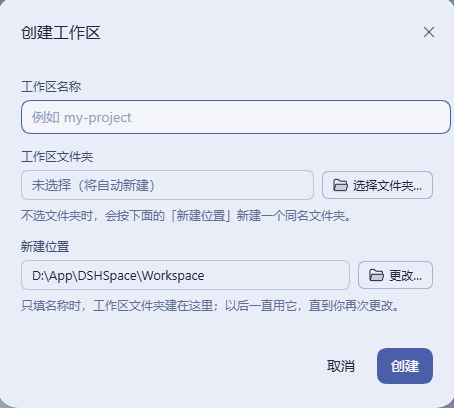
Clicking Add workspace… in DSH today opens the OS folder dialog immediately. This plugin replaces that with a small dialog that asks two independent questions: what is the workspace called, and where does it live. Answer the first only and it creates the folder for you; answer the second and the folder you picked is the workspace.
| You do | You get |
|---|---|
| Type a name, press Create | A new folder with that name is created under New workspace location, registered as a workspace, and a session opens in it |
| Click Choose folder… | The native Windows folder dialog, starting where you left off, not at some default |
| Choose a folder, leave the name empty | The name fills itself in from the folder's own name |
| Choose a folder, having typed a name | Your name wins — the workspace is registered, then renamed to it |
| Click Change… on New workspace location | Pick where name-only workspaces go from now on; the choice is saved and survives restarts |
| Cancel / Esc / click the backdrop | Nothing happens — no folder, no registration |
| Before | After | |
|---|---|---|
Creating my-project | Create the folder in Explorer first, then hunt for it in the picker | Type my-project. Done |
| The folder picker's starting point | The OS default, every single time | The directory you last chose |
| Where new workspaces land | Wherever you navigate to | A location you set once, visible in the dialog, changeable any time |
| Naming a workspace after its folder | Retype the folder name | Auto-filled |
Sidebar → Plugins → Add plugin, paste this address, click Install, then Enable now:
https://github.com/LanFeng97/dsh-workspace-create-dialog
That box takes a package name, a Git address, a tarball or a local absolute path. A repository URL works because this package ships a dsh.bundle patch — DSH checks exactly that before it installs. Restart DeepSeek Harness if the plugin does not come up.
Two things worth knowing: it downloads straight from GitHub, so GitHub has to be reachable (the China-mirror option only covers registry packages, not repository downloads); and DSH does not auto-update third-party plugins yet — upgrading means uninstall + install again.
Already installed with
tools/install.mjsbelow? Runnode tools/install.mjs --uninstallfirst, so the profile does not end up with two loader rows for the same id.
If you would rather not click through it:
Install the DSH plugin at https://github.com/LanFeng97/dsh-workspace-create-dialog into my DSH and tell me when to restart.
Search for dsh-workspace-create-dialog in dshmarket and install it in one click. The listing is pending a PR to awesome-dsh-plugin (their CI requires the repository to be at least one day old); until it lands, use the routes above and below.
git clone https://github.com/LanFeng97/dsh-workspace-create-dialog
cd dsh-workspace-create-dialog
node tools/install.mjs
That copies the package into your DSH profile's node_modules and appends one loader line to the profile's cordis.patch.yml. It resolves your DSH home the same way the harness does — explicit config, then $DSH_HOME, then ~/.dsh.
Then restart DeepSeek Harness (the host half is a Node module, so a config reload alone will not import it). After that, changing lib/client.js only needs a page refresh; changing lib/index.js still needs a restart.
node tools/install.mjs --dry-run prints what it would do without writing anything; --uninstall removes the package and its loader row again.
Publishing to npm is not required: the market installs from GitHub exactly the same way, and listing is unaffected either way.
@deepseek-ai/dsh-client-ui-workspace declares a single slot where the "pick a directory" step is handed to whichever plugin fills it:
sidebar.workspaces.directoryFlow              ← the sidebar's "Add workspace…"
conversation.hero.workspace.directoryFlow     ← the empty-state entry
The owner hands the occupant the whole interaction contract:
interface DirectoryFlowOwnerProps {
  open: boolean                     // a pick is requested
  busy: boolean                     // the owner is adopting the picked path
  onPicked: (path: string) => void  // report the directory; the owner registers it and opens a session
  onCancel: () => void
  onError: (message: string) => void
}
This plugin registers its own occupant into both slots at priority -100. A single slot renders the lowest-priority entry, the shipped native driver sits at 0, so this dialog wins (two entries at the same priority throw, which is the official protection against ambiguity). Removing the loader line from your profile patch restores the stock behaviour exactly.
The desktop app opens its folder dialog from the Electron main process without a starting directory:
// D:\App\DSH\resources\app.asar → lib/main.js
dialog.showOpenDialog(window, { properties: ['openDirectory', 'createDirectory'] })
There is no defaultPath, which is exactly why the chooser always starts in the same place. A plugin cannot reach that call: the DSH host is a child process of Electron. So lib/pick-folder.js opens its own IFileDialog — a small C# COM interop compiled and run by the Windows PowerShell 5.1 that ships with Windows:
IFileDialog::SetFolder — the remembered directory as the starting point;The C# method declaration order must match the COM vtable (Show=3, SetOptions=9, SetFolder=12, SetTitle=17, GetResult=20). Getting it wrong does not error — it just silently does the wrong thing — so a self-test asserts the order.
The New workspace location is resolved in this order (lib/base-dir.js, a pure function):
config.baseDir from your profile patch — the value used at install time;default-workspace (a name the harness fixes, independent of UI language). New workspaces land next to it. This is the default for a fresh install;<Documents>/deepseek-harness, or <home>/deepseek-harness when there is no Documents folder.The resolved value is written to the state file, so "what it was on first run" is decided once and only you change it afterwards. config.baseDir is a seed, not an order.
All four are loopback-guarded (loopback socket + loopback Host + same-origin marker; x-forwarded-for is never trusted) — they create directories and open windows on the host machine, so nothing off-machine may reach them.
| Route | Method | Purpose |
|---|---|---|
/api/dsh-workspace-create/config | GET | Current location + last directory |
/api/dsh-workspace-create/base-dir | POST | {"path":"…"} → validate absolute, create, persist |
/api/dsh-workspace-create/create-folder | POST | {"name":"…"} → create the folder, return its absolute path |
/api/dsh-workspace-create/pick-folder | POST | {"title":"…"} → open the native chooser, return the path (null on cancel) |
The dialog title is supplied by the browser half in the current UI language (<html lang>, maintained by the official client-locale service); the host only sanitizes and truncates it.
Optional, in your profile's cordis.patch.yml:
- insert:
    - id: ui-workspace-create-dialog
      name: 'dsh-workspace-create-dialog'
      config:
        baseDir: 'D:\Work\Workspaces'                 # seed for New workspace location
        stateFile: '<writable path>/state.json'       # defaults to $DSH_HOME/storages/dsh-workspace-create-dialog/state.json
The state file holds two fields: baseDir (the location) and lastDir (where the chooser last was).
node tools/selftest.mjs           # 40 checks, no DSH runtime needed
node tools/pick-probe.mjs         # native picker: compiles the C#, exercises the COM chain, no window
node tools/pick-probe.mjs --real  # same, but actually opens the dialog so you can look at it
node tools/install.mjs --dry-run  # what the installer would do
tools/selftest.mjs covers name validation rules, the location precedence order, the COM vtable order, the slot registration (it runs apply against a fake client context and asserts priority and both slots), the route behaviour (a real mkdir round trip, guard rejections), and the dialog's behaviour itself — it renders the component through a minimal React hook harness and drives it: name-only creation, auto-fill from a picked folder, "your name wins", cancel, and the location change.
| File | Role |
|---|---|
lib/index.js | Host half: location resolution, folder creation, native chooser, routes |
lib/base-dir.js | Location precedence + absolute-path validation (pure) |
lib/name.js | Workspace-name validation and path joining (pure) |
lib/state.js | Atomic state persistence with corrupt-file fallback |
lib/guard.js | Loopback trust fence for the routes |
lib/pick-folder.js | The native picker: embedded C#, PowerShell script, child process |
lib/client.js | Browser half: the dialog, registered into both flow slots |
powershell.exe with a runtime Add-Type. That pair (-EncodedCommand + Add-Type) is exactly what endpoint protection watches for, so a small number of machines may block it. The alternative is shipping a native dependency (koffi); this plugin chose zero dependencies.directoryFlow contract. If a future harness renames or changes it, the plugin goes silently inert — ctx.slots.inject waits for a declaration that never comes, and nothing errors. dsh.engines.dsh states the version requirement; it cannot remove the risk.MIT © 2026 LanFeng97
DeepSeek Harness(DSH)Web 插件聚合生态包 · 一切皆插件,创意工坊分发(dsh-market.com)
把回答做成一页可视化 HTML:模型只写简短的 Markdown 草稿,随包附带的 `am` 命令行生成页面,支持流程图、时序图、树、时间线、ER 图、表格和提示框。
在 dsh 里装上这个插件即可,无需登录、注册或填 API Key,就能使用包括 Muse Spark 1.3、MiMo V2.6 在内的前沿模型——完全免费,不限量。 All you do is install this plugin in dsh: no login, no sign-up, no API key — the frontier models are just there, Muse Spark 1.3 and MiMo V2.6 among them. Completely free, with no usage cap.

