
dsh-web
zhu1090093659/dsh-webDeepSeek Harness(DSH)Web 插件聚合生态包 · 一切皆插件,创意工坊分发(dsh-market.com)

Themes and personalisation for DeepSeek Harness: 17 themes, a theme editor, liquid-glass panels, wallpapers, custom logo/greeting, saved prompts and a Ctrl+K quick switcher
Themes and personalisation for DeepSeek Harness (DSH): 18 themes, a theme editor that builds themes from a mood, one colour, any word or any picture, a theme per workspace, a community gallery of themes and prompt packs, liquid-glass panels, wallpapers (Bing daily, slideshows and video), fonts, saved looks on a schedule that can follow sunrise and sunset, your Windows accent colour, layout controls and a focus mode, AI modes, task-finished alerts, a usage and cost dashboard with spending alerts, chat export to Markdown and PDF, accessibility options, smarter saved prompts, settings sync, a Ctrl+K quick switcher, and 19 languages.
Zero npm dependencies. Your settings stay on your machine unless you turn on sync.
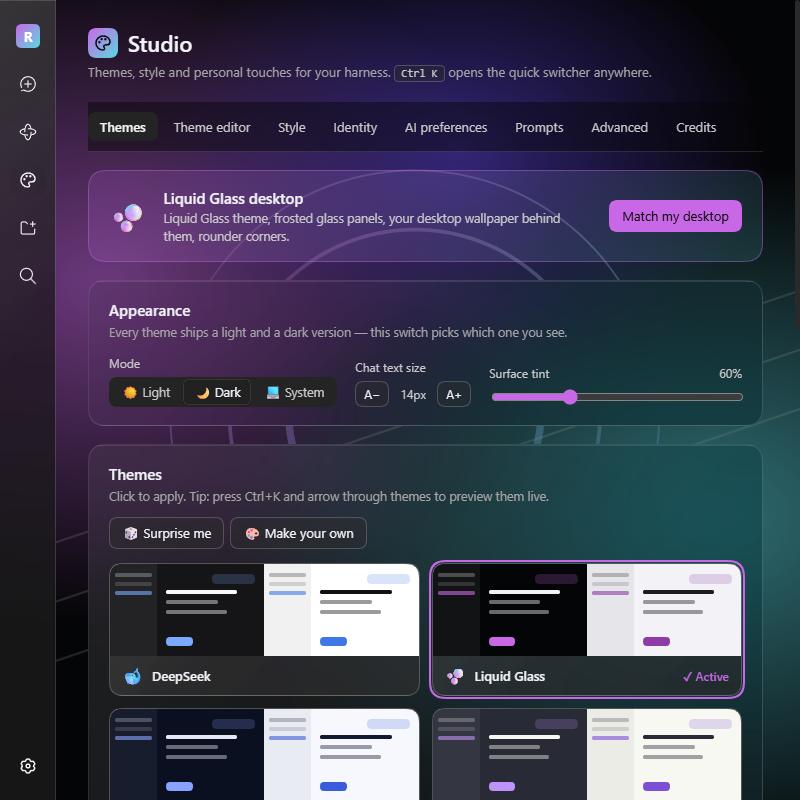
| Liquid glass + personal greeting | Quick switcher (live preview) | Theme editor |
|---|---|---|
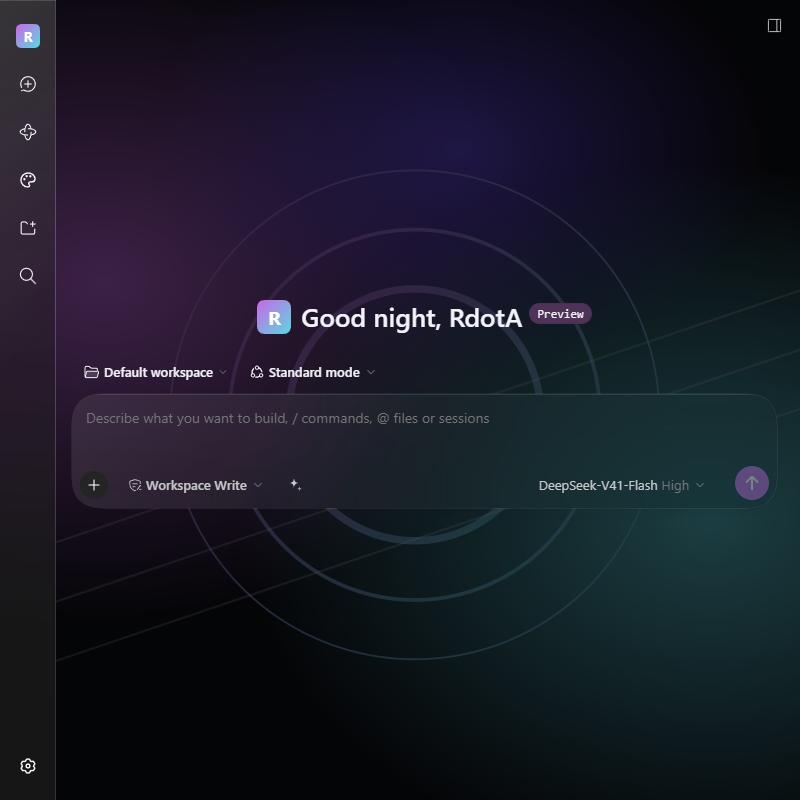 | 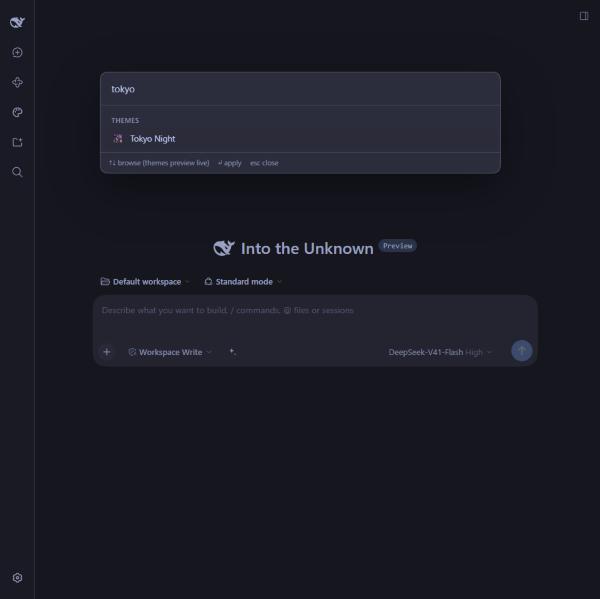 | 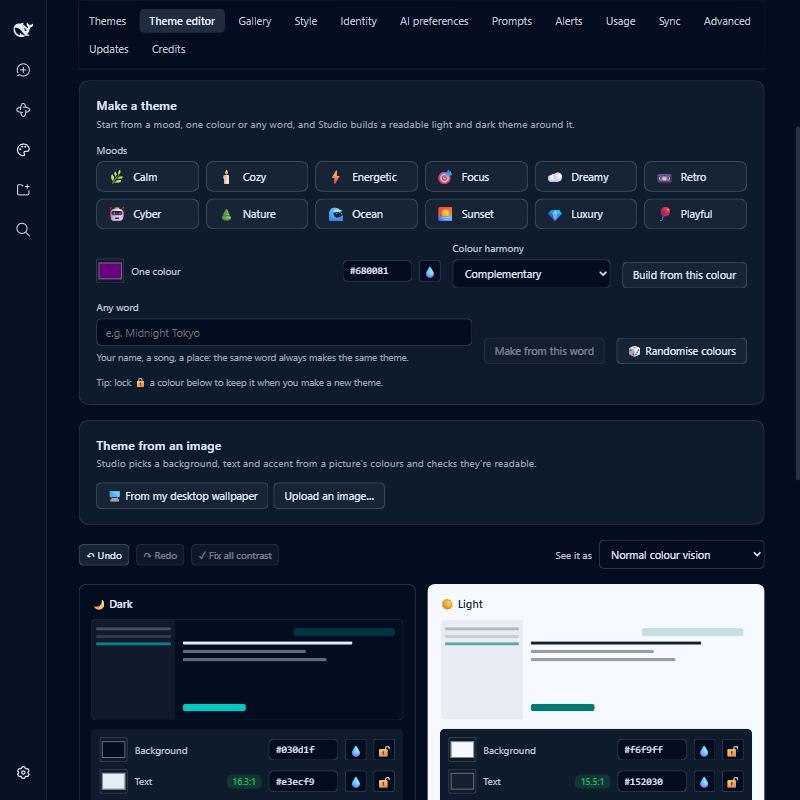 |
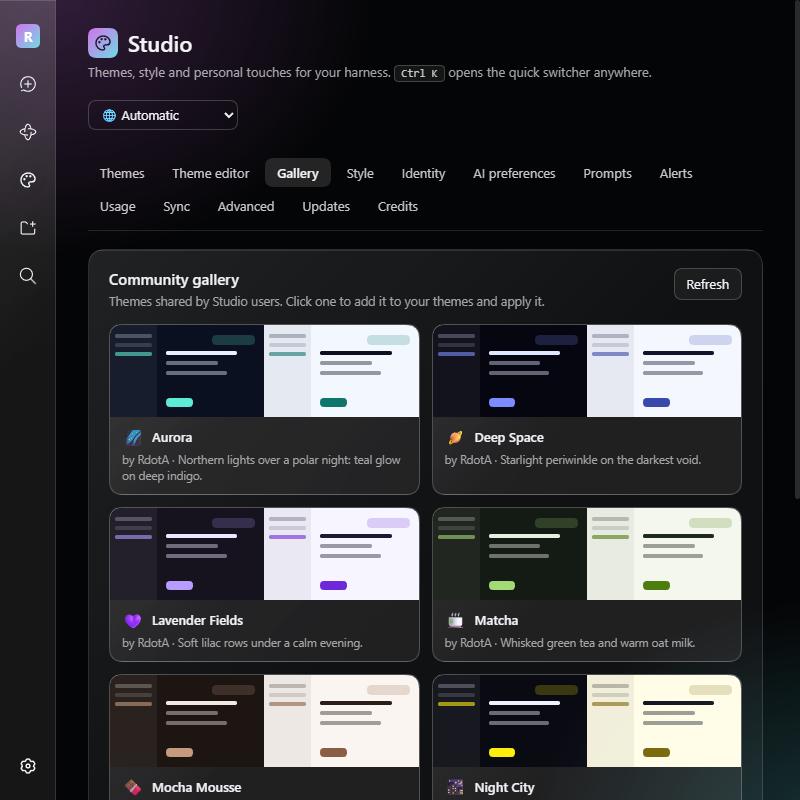
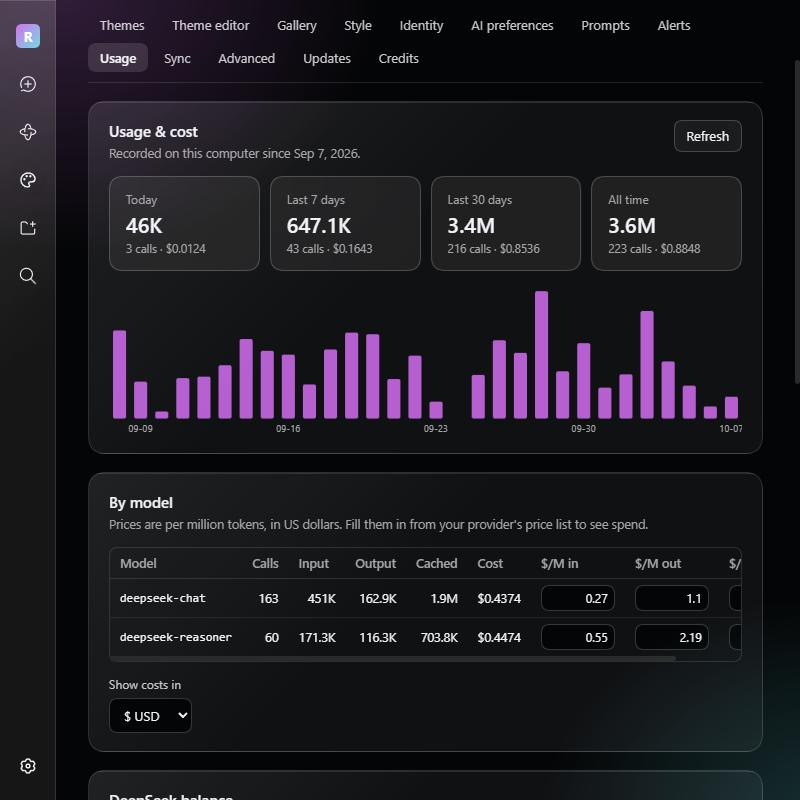
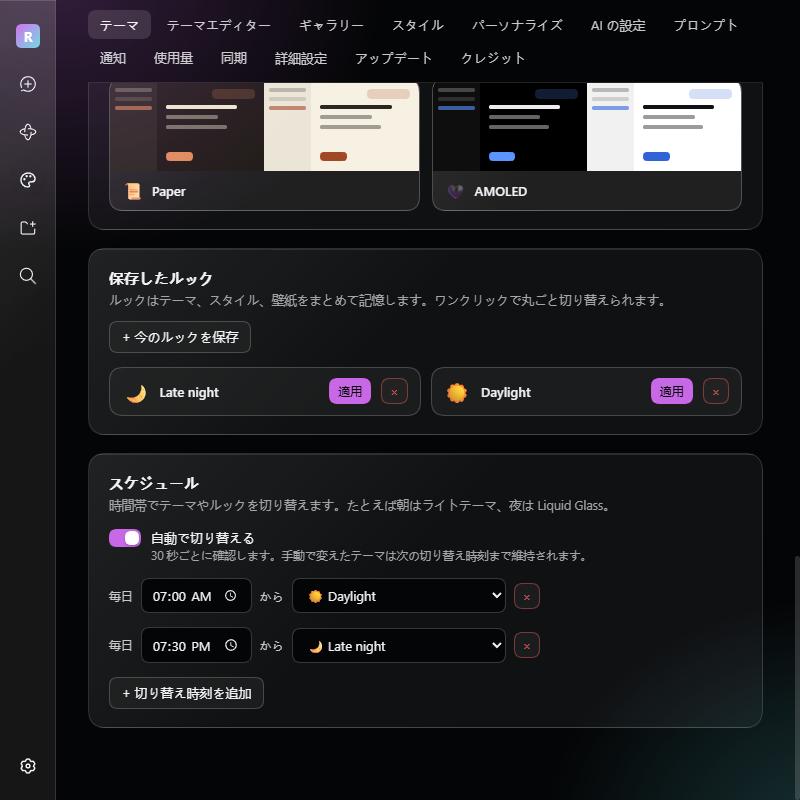
| Community gallery | Usage & cost (sample data) | Looks & schedule, in Japanese |
|---|---|---|
 |  |  |
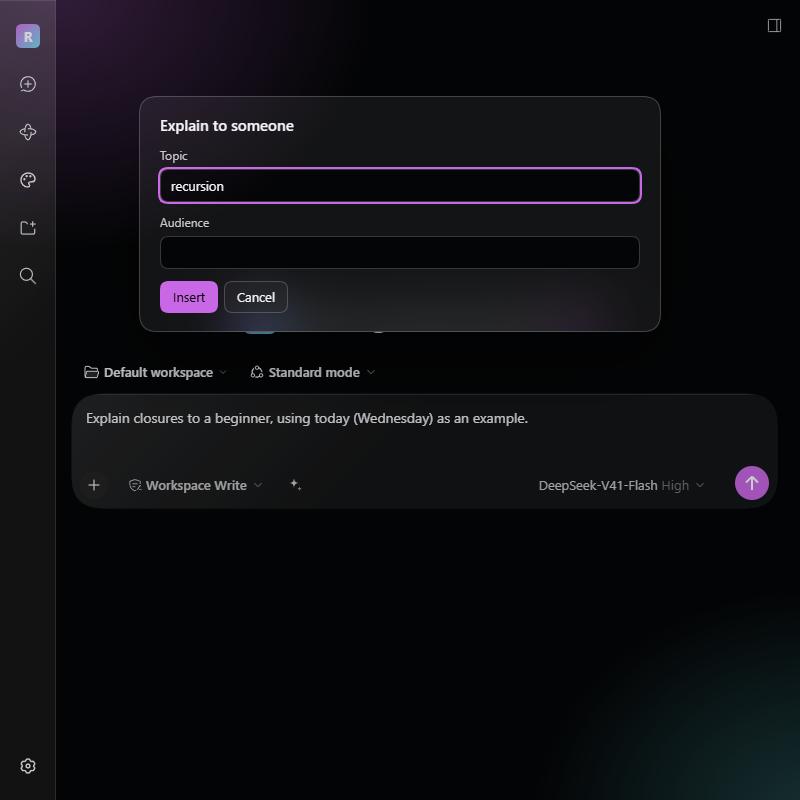
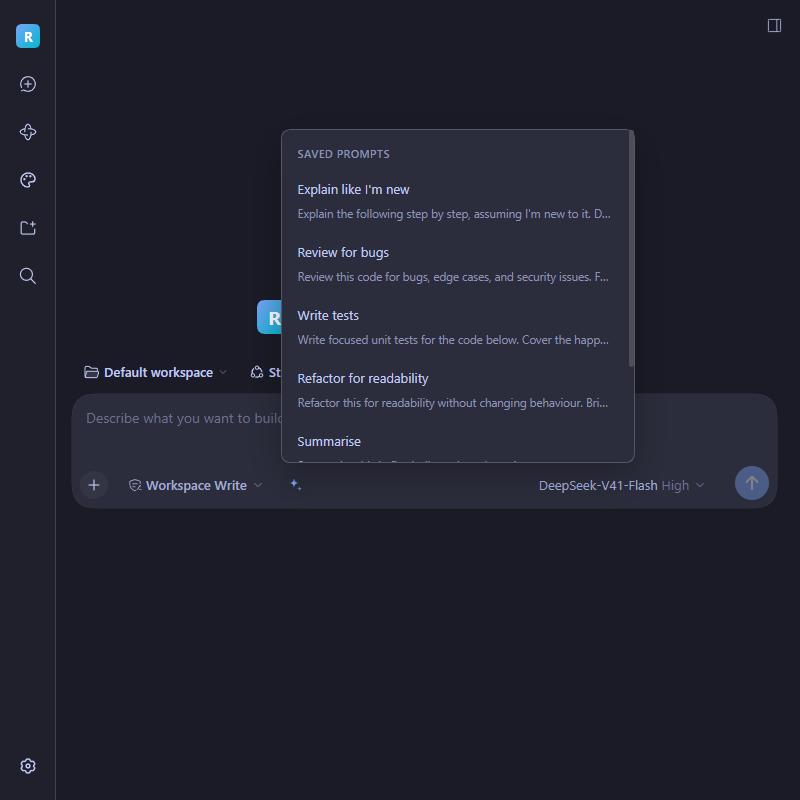
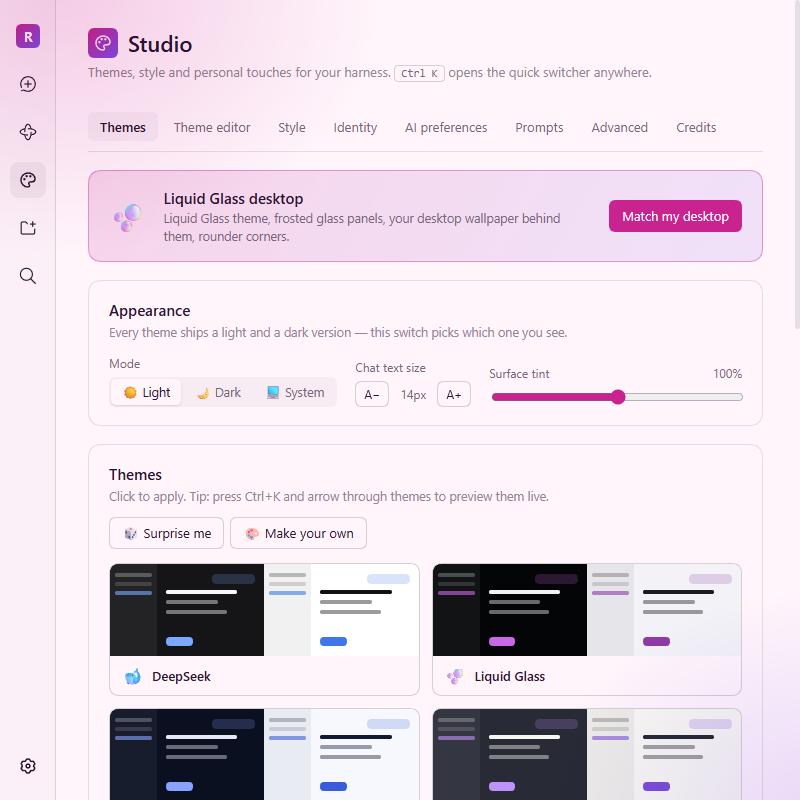
| Prompts that ask first | Saved prompts | Light mode (Synthwave) |
|---|---|---|
 |  |  |
From the app: open DSH → sidebar Plugins → Add plugin → enter
github:IRdotAI/dsh-studio
From a terminal:
npx @deepseek-ai/dsh plugin --profile web add github:IRdotAI/dsh-studio
Then restart dsh web. A Studio entry appears in the sidebar. Requires DSH 0.2 (tested with 0.2.0-rc.2), the web profile, and Node 22.5+. pnpm must be on your PATH for plugin installs (npm install -g pnpm).
Already on 1.3 or later? Studio offers the update itself (Studio → Updates).
To remove it, use Uninstall on its Plugins page entry.
| Area | What you get |
|---|---|
| 18 themes | Liquid Glass, Midnight, Dracula, Nord, Tokyo Night, Catppuccin, Rosé Pine, Gruvbox, Solarized, Forest, Ocean, Synthwave, Sakura, Arc Reactor, Espresso, Paper, AMOLED and High Contrast, plus the stock look. Each has a light and a dark version, so DSH's Light / Dark / System switch keeps working. |
| Theme per workspace | Give any workspace its own theme or look, so you can tell your projects apart at a glance. It switches as you move between workspaces and goes back to your usual theme everywhere else. |
| Theme editor | Pick a background, text and accent colour per mode, plus an optional second accent for gradients. Studio derives every surface, border, button and text shade from them in OKLCH, with contrast floors so secondary text stays readable. Live contrast badges with one-click Fix, a screen colour picker 💧, any CSS colour (rgb(…), hsl(…), tomato), undo/redo (Ctrl+Z / Ctrl+Y), Make Light from Dark (and back), a colour-blindness preview, whole-app preview while editing, shareable dshs1: codes and .json theme files. |
| Make a theme | Twelve moods (Calm, Cozy, Cyber, Sunset…, a new take every click), one colour with a colour-harmony rule (monochrome, analogous, complementary, split, triadic), any word (the same word always makes the same theme), or 🎲 Surprise me. Lock 🔒 the colours you like and generators keep them. Fine-tune sliders move the whole theme (hue, vividness, warmth, background), and Variations offers eight ready-made twists. Text always stays readable. |
| Theme from an image | Build a theme from your desktop wallpaper, your Studio wallpaper or any picture: Studio clusters its colours, picks a background tint and accents, and fits them for contrast in both modes. |
| Community gallery | Studio → Gallery lists themes and prompt packs shared by other users; one click adds a theme or a whole pack of prompts. Submit to the gallery in the theme editor, or on a prompt folder, opens GitHub with your file ready to propose. See gallery/. |
| Looks & schedule | Save your theme, style and wallpaper together as a named look, then switch whole setups in one click, or on a schedule: at a set time, or at sunrise and sunset where you are (e.g. a light theme at sunrise, Liquid Glass at sunset). Changing things yourself sticks until the next switch. |
| Windows colours | Use my Windows accent colour recolours the current theme's highlights to your Windows accent and follows it when you change it; Follow Windows light/dark switches with the system. |
| Liquid glass | Style → Material turns the sidebar, composer, cards, dialogs, message bubbles and menus into frosted, see-through panes: backdrop blur, a faint frost, a specular top edge and a diagonal sheen. DSH's own surfaces are found at runtime, so it keeps working across DSH updates. Match my desktop applies the whole look in one click. |
| Layout | Chat width (narrow to full), interface size (75–140 %), and focus mode, which folds the sidebar and side panel away. |
| Wallpaper | Upload an image or use a URL; (on Windows) use your desktop wallpaper, which follows wallpaper changes; Bing daily, a new picture every day; a slideshow from a folder of images, changing every few minutes to once a day; or a muted, looping video that pauses when the window is hidden. Adjustable visibility and blur. |
| Style | Interface and code fonts (presets, any installed font, or a folder of .otf/.ttf/.woff2 files), corner style, accent-tinted chat bubbles, accent text selection, surface tint. |
| Ambience | Aurora glow, vignette, film grain or CRT scanlines, with a strength slider. Never blocks clicks; honours reduced motion. |
| Identity | Rename the app in the sidebar, swap the logo (emoji, monogram or your own image, removable with one click), and replace the new-chat headline with a greeting like Good {timeOfDay}, {name}, in your language. |
| AI preferences | Optional custom instructions: your name, about you, a response style (Concise, Thorough, Friendly, Mentor, Butler, Hype), reply language and free-form instructions. Off by default; the tab shows exactly what the model will receive. |
| AI modes | Saved sets of style, language and instructions: Coding, Writing, Explain simply and Brainstorm to start, plus any you save yourself. Switch with /ai in the composer, from Ctrl+K, or on the AI tab. |
| Saved prompts | Six starters; add, edit, reorder and file your own into folders. Placeholders fill themselves in when you insert: {clipboard}, {date}, {time}, {day}, and {ask:Topic}, which asks you first. Share all your prompts as one dshp1: pack code, add a pack from a code or file, or send a folder to the gallery. |
| Chat export | /transcript (or Ctrl+K → Export this chat) saves the open chat as a Markdown file, a PDF (in your theme's colours or plain black on white), or copies it as Markdown. |
| Task alerts | A desktop notification and a sound (four built-in, synthesised, with volume) when a task finishes, and optionally when the agent needs your approval or an answer. Only when you're looking elsewhere, and only for tasks longer than a threshold, if you like. |
| Usage & cost | Exact token counts from every model call (input, output, cache reads), totals for today, the last 7 and 30 days and all time, a 30-day chart, a per-model table, and recent calls. Enter prices per million tokens to see spend in any of eight currencies. Check balance asks DeepSeek for your account balance. |
| Spending alerts | Set a daily and/or monthly budget. Studio shows how much of it you've used and alerts you (toast, sound and desktop notification) once when you're close and once when you reach it. |
| Accessibility | A High Contrast theme, Reduce transparency (solid panels, no wallpaper; follows Windows' own setting), strong keyboard focus outlines, and an easy-reading font with roomier spacing. |
| Sync | Back up your Studio settings to a private GitHub Gist and restore them on another computer, by hand or automatically a minute after each change. Uploaded images stay local unless you include them. |
| 19 languages | English, 简体中文, 繁體中文, 日本語, 한국어, Español, Français, Deutsch, Português (Brasil), Italiano, Русский, Українська, Polski, Nederlands, Türkçe, Tiếng Việt, Bahasa Indonesia, हिन्दी and العربية (right-to-left). |
| Advanced | Custom CSS (applied last; use the --dsw-* design tokens), export/import settings as JSON, reset. |
| Updates | Update banner and sidebar dot when a new version is out, optional auto-updates, every release listed for updating, reinstalling or downgrading, and an automatic harness restart afterwards so the new version takes over by itself. |
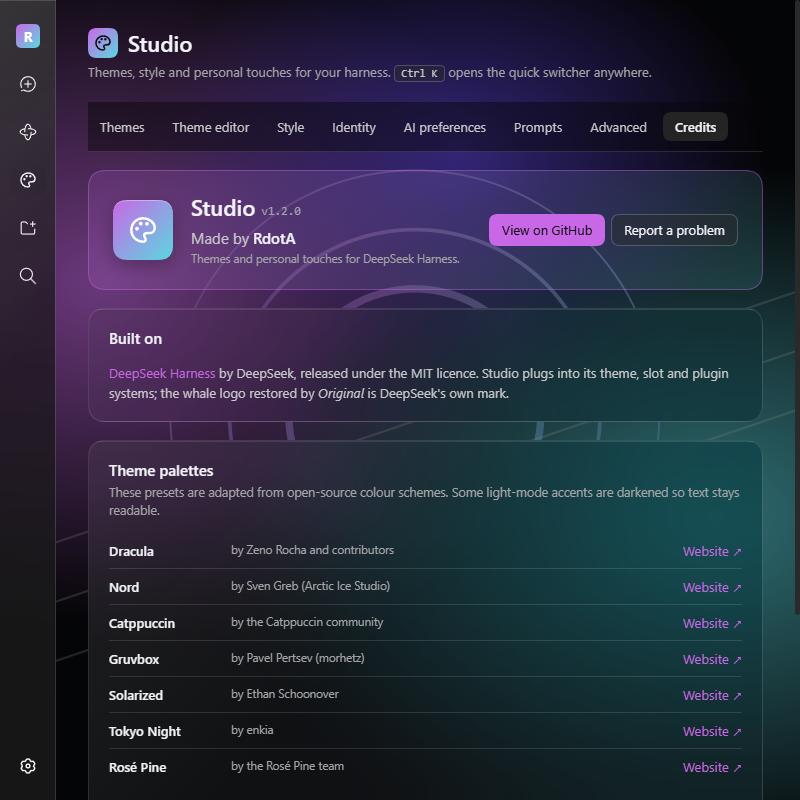
| Credits | Who made Studio, what it builds on, and where each adapted theme palette comes from. |
Studio updates itself from this repo's releases:
dsh command needs a manual restart, and the Updates page says so.~/.dsh/studio/studio.backup-*.json, newest five kept).github:IRdotAI/dsh-studio again.One-click updates need Studio to have been installed from GitHub. A copy linked from a local folder (a developer install) says so on the Updates page and updates from that folder instead.
~/.dsh/studio/studio.json (or $DSH_HOME/studio/studio.json), uploaded images included. Usage records live next to them in usage.json and never leave your machine.~/.dsh/studio/github-token (readable only by you), is never sent to the browser, and is only used to talk to GitHub. Backups go to a private gist on your account.~/.dsh/studio/bing/.DSH plugins have a host half (Node) and a browser half (React). Studio's host half stores settings, serves them over authenticated /api/studio/* routes, injects the stylesheet into every page load (so your theme is there from the very first frame), serves the desktop wallpaper and font files, reads the Windows accent colour, records token usage from the llm/stream waterfall, runs the gist sync, and contributes the optional system-prompt section. The browser half renders the UI and updates the stylesheet live.
Theming works by re-deriving DSH's three static colour scales (--dsw-static-neutral-bluish-*, --dsw-static-neutral-*, --dsw-static-deepseek-*). Every alias token points at them, so the whole interface follows while keeping the original contrast ladder.
| File | Role |
|---|---|
lib/shared.js | Pure core: colour maths, presets, palette extraction, stylesheet builder, settings validation, schedule and sun times, prompt placeholders, usage totals and budgets, persona text and modes, chat export. Shared by both halves. |
lib/index.js | Host half: settings file, API routes, first-paint stylesheet, wallpaper (desktop, Bing, slideshow, video) and font serving, gallery and balance lookups, chat export, system-prompt section. |
lib/updater.js | Finds releases on GitHub and installs updates or downgrades through the harness plugin manager. |
lib/restart.js | Restarts the harness after an install: a graceful shutdown, then the same dsh web command again in the same process tree. |
lib/usage.js | Usage recorder: wraps llm/stream and stores each call's token counts. |
lib/windows.js | Reads the Windows accent colour. |
lib/sync.js | Private-gist backup and restore. |
src/client/*.js | Browser half source, one file per area (store, styles, each tab, quick switcher, composer button, slash commands, entry). |
locales/*.json | Interface text, one file per language. English is built into the bundle; others load on demand. |
lib/client.js | Generated browser bundle. Edit src/client/, locales/en.json or lib/shared.js, then run node scripts/build.mjs. |
gallery/ | Community themes and prompt packs, and the generated index.json the Gallery tab reads. |
All routes are behind DSH's own browser authentication.
GET /api/studio/state: settings plus what this machine offers (desktop wallpaper, served fonts, Windows accent)POST /api/studio/patch: partial update (objects merge, arrays replace)POST /api/studio/replace: whole-settings importPOST /api/studio/reset with {"confirm":"reset-studio"}GET /api/studio/desktop-wallpaper: the current Windows wallpaperGET /api/studio/bing-wallpaper: today's Bing picture (downloaded once a day)GET /api/studio/wallpaper-file?i=<n>: one image from the slideshow folderGET /api/studio/video-wallpaper: the video wallpaper file (supports Range)GET /api/studio/export?session=<id>: one chat's messages, for exportGET /api/studio/font?f=<file>: a file from the configured font folder (only files in that folder are served)GET /api/studio/updates: version, releases and update status; POST it {"action":"check"}, {"action":"install","version":"x.y.z"} or {"action":"restart"}GET /api/studio/usage: usage totals and recent calls; POST it {"action":"clear"} or {"action":"balance"}GET /api/studio/sync: sync status; POST it {"action":"set-token","token":"…"}, clear-token, push or pullGET /api/studio/gallery: the community gallery (cached for an hour); POST to refreshGET /api/studio/locale?lang=<code>: one language's interface textgit clone https://github.com/IRdotAI/dsh-studio
cd dsh-studio
node scripts/build.mjs # rebuild lib/client.js
node test/selftest.mjs # 41 checks
node scripts/check-locales.mjs # every language has every string
node scripts/build-gallery.mjs # validate gallery themes and prompt packs, rebuild gallery/index.json
npx @deepseek-ai/dsh plugin --profile web add "$PWD" # install your local copy
Restart dsh web after changing anything under lib/ (host modules are cached).
Adding a language: add it to LANGUAGES in lib/shared.js, copy locales/en.json to locales/<code>.json, translate the values (keep every {placeholder}), and run node scripts/check-locales.mjs.
DSH plugin pitfalls worth knowing:
connection.fetch.register paths must be the full path starting with /api/; anything else throws "invalid exact Fetch route".methods: ["GET", "POST"].requestBody: "streaming" route cannot serve GET (the bridge always attaches a body). Keep reads buffered.<style> using html:root body selectors outranks DSH's token sheets and also covers the first paint.<body> and positions them from on-screen rectangles, so scale the app with zoom on #root, never on <html>./export, /plan, /goal, …) makes the whole / menu fail. Host rows also rank first, so a name that is the start of a host command (/mode vs /model) can never be picked with Enter. Studio checks the host's commands before offering each of its own.Made by RdotA. Theme palettes adapted from Dracula, Nord, Catppuccin, Gruvbox, Solarized, Tokyo Night and Rosé Pine. Full credits, with links, are in CREDITS.md and in the app under Studio → Credits.
DeepSeek Harness(DSH)Web 插件聚合生态包 · 一切皆插件,创意工坊分发(dsh-market.com)
把回答做成一页可视化 HTML:模型只写简短的 Markdown 草稿,随包附带的 `am` 命令行生成页面,支持流程图、时序图、树、时间线、ER 图、表格和提示框。
在 dsh 里装上这个插件即可,无需登录、注册或填 API Key,就能使用包括 Muse Spark 1.3、MiMo V2.6 在内的前沿模型——完全免费,不限量。 All you do is install this plugin in dsh: no login, no sign-up, no API key — the frontier models are just there, Muse Spark 1.3 and MiMo V2.6 among them. Completely free, with no usage cap.

