packages/dsh-task-board
zhu1090093659/dsh-web侧边栏多列任务看板:卡片交给真实 DSH 智能体会话执行,支持 cron 定时(Host 侧到点执行,关浏览器也生效)。

在 DeepSeek Harness 的对话页和右侧边栏中以多叉树展示当前会话的智能体工作流,每个卡片显示状态、计划进度、Token、费用(需挂载 dsh-cost-meter)和运行时间。
Agent Trees / 智能体树 — a DeepSeek Harness UI plugin that renders the current
session's agent workflow as a live multi-way tree, in a top-down chart layout by
default. It is a standard DSH bundle (dsh.bundle) with a Web Client half and no
build step.
中文简介:在 DeepSeek Harness 的对话页和右侧边栏中以多叉树展示当前会话的智能体工作流;每个卡片显示状态、计划进度、Token、费用和运行时间。
Each agent is a compact card ("小方块") with a minimal 1px outline:
P0–P3 priority badge,The current session is the highlighted card. When the current session is itself a subagent, the tree walks up to the topmost available parent and marks the current agent in the family tree.
The plugin is prepared for the dsh-market
catalog through awesome-dsh-plugin.
Once the catalog entry is live, search Agent Trees / 智能体树 in
Settings → Plugin Market.
You can install it directly from the repository now:
dsh plugin --profile web add github:xiezouqu12/agent-trees
On DSH Desktop, install from Settings → Plugins (the desktop app owns its profile, so the CLI does not change the running app's profile).
Repository: xiezouqu12/agent-trees.
Requires DeepSeek Harness >=0.2.1-rc.1 <0.3.0.
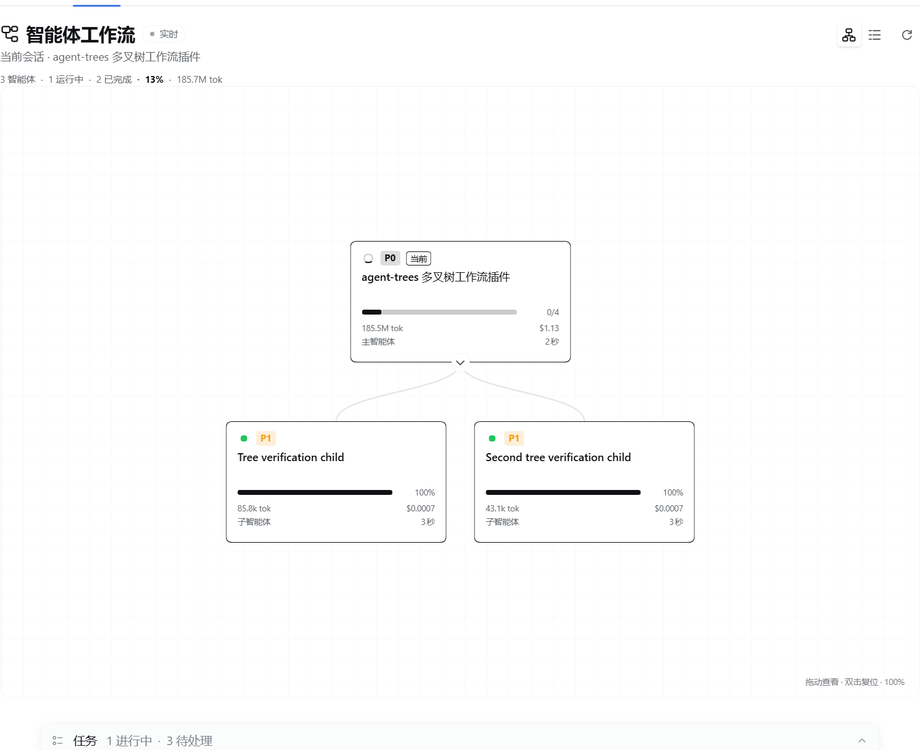
Open a conversation and select the Agent Trees / 智能体树 tab next to
Chat, Trajectory, and the other views. The tab is added through the
conversation.view Client slot.
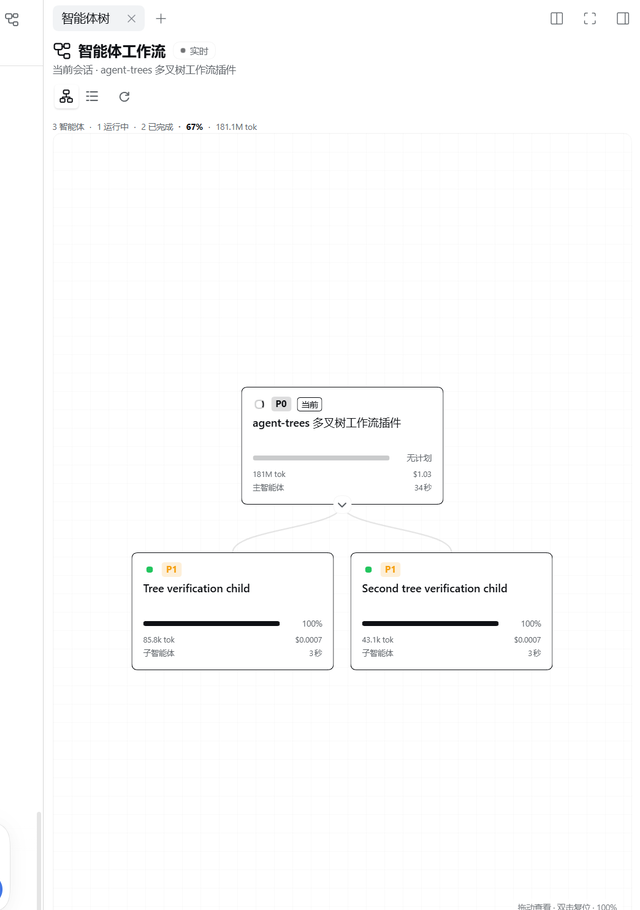
It also opens in the right sidebar:
+ guide lists an Agent Trees capsule, so the tab can
also be opened from there.sidebar.right.pane.tab body with a compact
layout, and it stays open beside the chat while the session changes.The sidebar is not opened automatically for an ordinary session. It opens
when you click the header tree icon or pick the capsule from the sidebar +
guide. A long multi-agent task may auto-open it once after 3+ agents have had
at least one running for about 25 seconds, and only while the sidebar is
collapsed; a simple project never triggers it.
The view opens in Chart layout: a top-down org chart with rounded cards and smooth curved connectors on a graph-paper canvas that fills the remaining panel height (the whole sidebar body in the right-sidebar tab). Drag anywhere on the canvas background to pan the whole tree; use the mouse wheel to zoom around the cursor (35%–250%); double-click the background to reset pan and zoom. The canvas hint shows the current zoom percentage. Each card shows the task, priority, status, progress, tokens, cost, role, and runtime. Collapse a branch with the round chevron at the card's bottom edge; the chart reflows immediately.
The two icon buttons in the header switch between Chart and List (the indented tree). The same layout applies to the conversation tab and the right-sidebar tab.
The plugin is Client-only and reads existing client-visible session projections — it writes no session events and registers no Host route:
| Projection | Used for |
|---|---|
subagentCatalog | parent → child topology, delegation mode, task label |
subagentTiming | last-turn completion, settled/active duration |
tokenUsage | per-agent token total |
costUsage | per-agent token buckets and USD cost (when dsh-cost-meter is mounted) |
todos | per-agent task progress, when the agent used todo_write |
Session summaries (useSessions().byId) supply titles, running state, blank,
and the parent link. useSessionStatus supplies the live status map.
(completed + 0.5 × in_progress) / total, and the card shows done/total.无计划; the top-left spinner indicates that it is running. Nothing flows or
animates.无计划 when it had
no plan.mode: "external") have no local session, so their bar is
neutral and labelled "外部".无计划 until a new plan is written; it keeps the last plan it
observed.The header's overall percentage follows the main task's todo plan when the root has one, so a small finished child cannot inflate the main task. When the main task is running without a todo plan it uses the finished-agent ratio instead; otherwise it averages the per-agent progress values that are known. The value is shown inline with the agent counts; hover it for the estimate source.
P0, direct children = P1,
grandchildren = P2, deeper = P3.[P0], P1:, P0 -, etc.
prefix; the prefix is removed from the displayed task title.Cards no longer display sequence numbers (#01, #02, …). Siblings keep the
parent catalog's event order, and the tree position itself conveys the workflow
order.
ArrowUp / ArrowDown move between cards, ArrowRight /
ArrowLeft expand or collapse, Home / End jump to the ends, Enter /
Space opens.Projection updates arrive through the normal Client store, so topology, status, todos, duration, and token counts update live. A one-second clock refreshes durations while any agent runs.
Built and tested against DeepSeek Harness 0.2.1-rc.2 (the version in this
desktop install). The package declares engines.dsh: >=0.2.1-rc.1 <0.3.0.
It depends only on the Web Client slot surface and the standard session hooks:
conversation.view slot with sessionId, useSessions, useSessionStatusctx.sessions.refreshProjectionsctx.uiWorkspace.openSessionctx.locale and ctx.slotsNo Harness Client package is imported as a module; React comes from the browser module table.
| File | Purpose |
|---|---|
index.js | Host half (metadata only) |
client.js | Browser module: view, tree, cards, styles, locale dictionaries |
cordis.patch.yml | Inserts the agent-trees row |
locale/en.json, locale/zh.json | Plugin Manager display metadata |
icon.svg | Original artwork |
screenshot-main.png, screenshot-sidebar.png | Marketplace screenshots |
screenshots.json | dsh-market screenshot manifest |
marketplace/agent-trees.yml | Entry submitted to the awesome-dsh-plugin catalog |
LICENSE | MIT |
subagentCatalog (for example an external task
without a parent-owned catalog fact) cannot be shown as a local child.无计划; the card never invents a percentage.The plugin has no build step. Edit client.js (a browser module registered
through window.__ModuleLoader__) and let DSH HMR reload it, or reload the page.
Run node --check client.js for a syntax check. The host half index.js is a
no-op metadata module; the bundle patch inserts the client row.
MIT © 2026 xiezouqu12. See LICENSE.
侧边栏多列任务看板:卡片交给真实 DSH 智能体会话执行,支持 cron 定时(Host 侧到点执行,关浏览器也生效)。
DSH Web UI 插件与皮肤合集:任务看板、git 图、右侧面板、远程移动端 UI、桌宠、实时 token 统计与皮肤中心。
助手回复内渲染交互式 UI 组件:布局、图表、表单、测验、mermaid、3D 场景与回传事件循环。