
dsh-web
zhu1090093659/dsh-webDeepSeek Harness(DSH)Web 插件聚合生态包 · 一切皆插件,创意工坊分发(dsh-market.com)

Per-session automatic compaction threshold for DeepSeek Harness: a compaction backend whose trigger percentage is stored per session and adjustable from the Web composer while the session runs.
Per-session automatic compaction threshold for DeepSeek Harness, adjustable from the Web composer while a session runs.
The shipped backend (@deepseek-ai/dsh-compaction-basic) fixes the trigger
percentage in the agent preset: one number for every session that preset serves,
changeable only by editing YAML and reloading the host. That is the wrong
granularity for real work — a long refactor wants to compact late and keep its
history verbatim, a scratch session wants to compact early and stay cheap, and
neither should require a host restart.
This plugin keeps the same compaction transaction and makes the percentage per
session: a chip beside the permission and model chips shows the value, a menu
changes it in one click, /compaction-threshold does the same from the keyboard,
and the value is stored durably beside the session log so it survives a restart.
A forked session and a delegated subagent inherit their parent's value.
The package is third-party, and it is honest about its coupling: a compaction
backend must be a subclass of the shipped engine, so unlike a plugin that only
talks to the Cordis context, this one imports
@deepseek-ai/dsh-compaction-basic and copies its trigger policy. Read
Known limitations before upgrading the harness.
The chip sits with the permission and model chips in the composer, and shows the session's current percentage:

The menu offers the preset default and 30 %–100 %. Here the session is a fork that inherited its parent's 70 %, so the menu also states where the value came from:
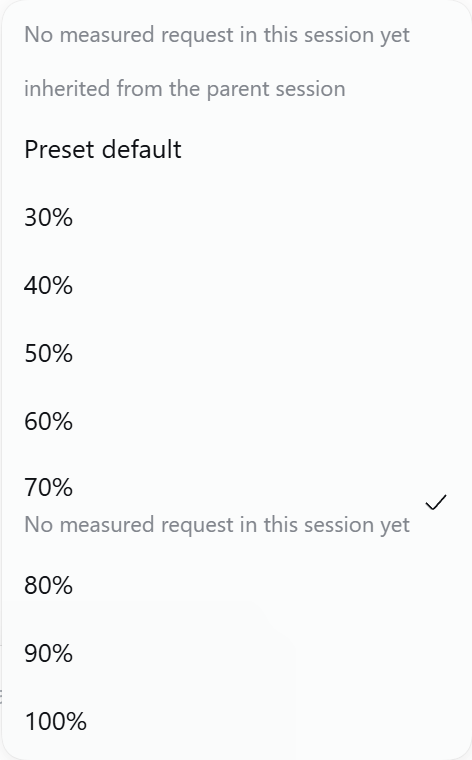
Once a request has been measured, the chip's tooltip and the menu heading report the token count the trigger resolved to, so the percentage in force is visible rather than implied.
dsh plugin --profile web add github:windwhiterain/dsh-compaction-threshold
Then wire two rows into ~/.dsh/profiles/web/cordis.patch.yml — one on the host
plane, one inside each agent preset that should become adjustable:
# host plane: the durable store, the Session projection, and the command
- insert:
    - id: compaction-threshold
      name: 'dsh-compaction-threshold'

# agent plane: replace the shipped backend inside the preset's compaction group
#   - id: compaction-basic
#     name: '@deepseek-ai/dsh-compaction-basic'          # remove this row
#   ...and add:
#   - id: compaction-threshold-engine
#     name: 'dsh-compaction-threshold/engine'
Keep command-compact and tool-result-pruner exactly as they were. Omit
thresholdRatio on the engine row to follow the backend default (0.8); state it
to give that preset a different starting point.
The composer chip appears only in sessions whose preset declares the engine
row. Swap it in as many presets as you want the knob to be adjustable in, and
leave it out of the rest: a session on a preset that still mounts
@deepseek-ai/dsh-compaction-basic has no chip, and /compaction-threshold
there reports that nothing would honour the value instead of storing one. Note
that a session recording no preset composes the deployment's default, so the
chip follows whichever preset is the default — set selectedDefault in
agent-preset-registry if the default is not the preset you are adjusting.
Restart the host afterwards. A new dependency is read at startup, so the row
cannot resolve in the running process, and applying the preset swap before that
restart leaves new sessions mounting an unresolved row. deploy/ holds the same
instructions as a checklist and a script that applies them structurally:
node deploy/apply-web-wiring.mjs ~/.dsh/profiles/web/cordis.patch.yml [--write]
The chip opens a menu of Preset default plus 30 %–100 %. The same change can be
typed:
| Input | Effect |
|---|---|
/compaction-threshold | Report the current value, its origin, and the resolved trigger |
/compaction-threshold 60 or 60% | Compact this session once pressure reaches 60 % of its window |
/compaction-threshold 0.6 | The same, written as a ratio (bare values ≤ 1 are ratios) |
/compaction-threshold default | Drop the value and follow the preset again |
The change applies from the next step, is enforced against a turn already in flight (the value is read at every step boundary), and survives a restart.
A forked session and a delegated subagent both record their direct parent in
SessionHeader.parentSession, so both inherit. A child receives a snapshot of
the nearest ancestor that owns a value, up to 16 generations, and owns it from
then on:
| Situation | Result |
|---|---|
| Child's parent has 70 %, preset default 10 % | Child shows 70 %, marked inherited from the parent session |
| The parent had no value, its own parent had 25 % | Child inherits 25 % (nearest ancestor with a value) |
| The parent changes 70 % → 50 % after the child exists | Child keeps 70 %: the snapshot was taken once |
Child's /compaction-threshold default | Child returns to the preset default and does not re-inherit |
| No ancestor owns a value | Child follows the preset default |
The record that carries a snapshot is also the marker that the inheritance was
spent, which is what keeps default meaningful in a child. The value is written
durably, and the chip keeps the origin visible until the child's own value
differs from the inherited one.
Two rows, because a compaction backend and the interface that configures it live on different planes:
| Row | Plane | Owns |
|---|---|---|
dsh-compaction-threshold | Host | The storage domain keyed by Session id, the compactionThreshold Session projection, and the /compaction-threshold command |
dsh-compaction-threshold/engine | Agent preset, inside its compaction group | The ctx.compaction service: the shipped engine with a per-session pressure ratio |
The engine reads the value synchronously from the host service and falls back to
its own configured thresholdRatio when the host row is absent, so a miswired
composition degrades to the shipped behaviour instead of disabling compaction.
Context-overflow recovery, retention, pruning, retries, and summarization are
inherited unchanged.
thresholdTokens = floor(contextWindow × ratio)
A percentage here is the share of the declared context window the session may fill before it compacts, and nothing else scales it down.
That is the plugin's one deliberate divergence from
@deepseek-ai/dsh-compaction-basic, which also caps the threshold at
contextWindow − outputReservation − headroomTokens. That cap makes a large
output reservation shrink every percentage at once: on a 262 144-token window
with maxTokens: 131072 and the default 65 536 headroom, the cap is 65 536
tokens, so every setting from 25 % to 100 % behaves identically and the knob
stops meaning what it says. Removing the cap restores the full range: 100 % now
means "compact only when the window is essentially full".
The consequence is worth stating plainly: the prompt plus its reserved completion still has to fit the provider's real window, so a high percentage can reach a provider overflow. The upstream recovery path handles that case and bypasses the ratio by design — it is the provider telling the session it is out of room, not the threshold policy firing.
headroomTokens is still accepted because the inherited schema carries it, and
it still supplies the default summary budget, but it no longer shifts the
trigger. retainRatio/retainTokens are window-relative for the same reason.
The Session persistence reader refuses an event type outside the generated
known-type catalog unless the record carries ignorable: true
(packages/session/session-persistence/src/storage-contract.ts), and
Session.append() cannot set that marker. A plugin outside the harness
repository therefore cannot add a Session event: its own logs would stop loading.
The override is non-session application data, so it belongs in
ctx.storageDomain, and the client is notified through a Session projection —
which is key-addressed and needs no client code per domain.
Nothing directly: the plugin adds no tool and no prompt text. Indirectly it
changes when a <compacted-summary> checkpoint replaces older history and how
much recent history stays verbatim, exactly as the shipped backend does.
Lowering a session's ratio compacts earlier and therefore spends fewer prompt tokens per request at the cost of more summaries; raising it compacts later, up to the point where the provider itself reports the request as too long. The summarization request itself is the same one the shipped backend issues.
The summarization call reuses the conversation's own prefix, as the shipped backend does. Changing the ratio never rewrites a request prefix, so it invalidates no provider cache; it only changes which requests still carry the un-compacted prefix.
node probe/probe.mjs
The probe drives the pure policy module without a host: the window fraction and its retention, the command grammar, range selection, the inheritance walk (direct parent, ancestor skipping, unusable values, cycle safety, depth cap), the engine brand's survival across module generations, and the preset gate that decides where the chip appears. 28 probes pass.
Further probes need no browser. probe/session-tools.mjs decodes the zstd-framed
session logs and reports each stored session's preset, tool catalog, and
delegation depth. probe/session-detail.mjs reports one session's selected
presets, routes, token counts, and compaction events, and
probe/surface-tokens.mjs prices its surface with the harness's own estimator —
the pair behind a "compaction did not trigger" report. probe/tsx-identity.mjs
proves that a plugin outside the checkout shares the host's
BasicCompactionEngine and Service objects under a source-launched host.
The browser probes drive the installed Edge through playwright-core and verify
against a dev host that the chip renders, the menu writes through the command,
the value is per session, default clears it, clearing does not re-inherit, a
fork inherits, and a delegated child inherits:
node probe/dev-ui.mjs http://127.0.0.1:3081/?token=…
node probe/dev-fork.mjs http://127.0.0.1:3081/?token=… 70
node probe/dev-subagent.mjs http://127.0.0.1:3081/?token=… 80
node probe/dev-chip.mjs http://127.0.0.1:3081/?token=… 4
A dev host is required to verify anything the client half renders, and it must never share the primary host's port. A second host that inherits the default port tries to bind the same address, and on Windows that second bind can take the listener away from the running host — the running host then dies. Check the port first, then boot with an explicit one:
Get-NetTCPConnection -State Listen -LocalPort 3081 -ErrorAction SilentlyContinue   # expect nothing
./scripts/dev-host.ps1                      # DSH_HOME + profile + 127.0.0.1:3081 + --no-open
./scripts/dev-host.ps1 -Checkout C:/path/to/deepseek-harness   # boot from source through tsx
scripts/dev-host.ps1 refuses the primary port, refuses a port that is already
listening, refuses ~/.dsh as DSH_HOME, and binds loopback only. The three
isolations it guarantees:
| Resource | Primary host | Dev host |
|---|---|---|
| Port | the deployment's own port | explicit free port, 127.0.0.1 |
DSH_HOME | ~/.dsh | a separate directory |
| Browser | opened by the harness | --no-open, so no window steals focus |
Other rules that matter here:
--port 0 lets the OS assign a free port, which cannot collide at all.--from-default-profile web boots the profile it initializes; it is not an
init-only switch. Pass the port flags in that same command.cordis.patch.yml is live-reloaded, but a new dependency is read
at startup, so the dev host needs one restart after installing the plugin..credentials.yaml into the dev home, or export
the provider key in the environment before booting.hmr roots reload the host half without a restart; after adding a
root, touch the file once, because the watcher reacts to a change. A root list
added to a live patch while the host runs is not a reliable signal either —
restart once after wiring, and the roots are active from then on.dsh-compaction-threshold (the
store, the projection, the command) reloads on a file change; the engine row is
mounted inside an agent preset's realm, and the reload does not re-import it, so
an engine change needs the preset remounted — a host restart, or a preset edit
that rebinds its sessions. Reach for a restart when a change touches
engine.js or lib/policy.js.window − outputReservation − headroomTokens, which can compress the whole
25 %–100 % range of the knob onto one value. Span selection, the summarization
transaction, retention, pruning, and retries are still transcribed from
@deepseek-ai/dsh-compaction-basic 0.1.7-rc.1 (src/region.ts
selectCompactableRange and the engine's transaction). Those internals are not
exported, so an upstream change must be mirrored here by hand, and the Config
schema is inherited from the installed package rather than owned. The probe
pins the arithmetic, not upstream file contents.summary is not smaller than the shadowed content. A ratio changes when the
engine tries; it cannot create headroom the surface does not hold.SessionHeader.parentSession and the copy happens the first time the child is
read (the engine's pressure check or the projection). An ancestor that changes
its value between the fork and that first observation is what the child
inherits, and a child that owns no record yet still inherits a value its
ancestor sets later; owning any record spends the inheritance for good.@deepseek-ai/cordis,
@deepseek-ai/dsh-compaction, and @deepseek-ai/dsh-compaction-basic must
resolve from the host, exactly like the shipped rows do; a link: or git
install inside a DSH profile resolves them through that profile, so the plugin
shares the host's module instances instead of loading a second copy of the
engine and of Service. Running import('dsh-compaction-threshold') outside a
host therefore fails on those specifiers, which is expected./compaction-threshold default clears one session's value, and the whole
domain can be dropped by deleting its storage unit file.ctx.storageDomain the
value lives in process memory only (the plugin logs one warning) and the engine
keeps working.null for a session whose own compaction service is
not this engine, which the chip reads as "not offered"; /compaction-threshold
reports the same instead of storing a value nothing would honour. The gate is
evaluated on every read rather than in the fold, so switching preset takes
effect at once, and it reads that engine through agentPresets.serviceFor:
a preset revision publishes its services behind an isolate realm, so
agent.ctx.get('compaction') resolves outside it and finds the host plane
instead. Absence is null and never an omitted or undefined value:
the registry assigns the key unconditionally and a SessionSummary forwards
these values through api-session/added, whose lossless-JSON check rejects an
undefined member.agent-preset/selected;
until the registry answers, and for a preset nothing declares, the gate keeps
the control rather than withholding it from a session still being composed.
Answering true for every unregistered session instead of reading the roster
put the chip across the whole sidebar after any host restart, which is how
this shipped; presetMountsEngine in lib/policy.js is the pure decision and
the probes cover both sides of the boundary.MIT — see LICENSE.
DeepSeek Harness(DSH)Web 插件聚合生态包 · 一切皆插件,创意工坊分发(dsh-market.com)
把回答做成一页可视化 HTML:模型只写简短的 Markdown 草稿,随包附带的 `am` 命令行生成页面,支持流程图、时序图、树、时间线、ER 图、表格和提示框。
在 dsh 里装上这个插件即可,无需登录、注册或填 API Key,就能使用包括 Muse Spark 1.3、MiMo V2.6 在内的前沿模型——完全免费,不限量。 All you do is install this plugin in dsh: no login, no sign-up, no API key — the frontier models are just there, Muse Spark 1.3 and MiMo V2.6 among them. Completely free, with no usage cap.

