
dsh-web
zhu1090093659/dsh-webDeepSeek Harness(DSH)Web 插件聚合生态包 · 一切皆插件,创意工坊分发(dsh-market.com)

降低 LLM 成本:Jev(System One)分类器按声明式策略审查每一轮任务并推荐 subagent 模型路由,让常规工作以 flash 价格运行、主模型专注难点;显式 /route 触发、运行时代理能力门控、凭据脱敏,以及基于判定日志的离线策略回放。
Cut LLM costs: routine tasks go to cheap subagent models; the main model keeps the hard parts.
Jev-guided subagent dispatch for DeepSeek Harness: the plugin asks Jev — TypeSafe's typed-decision model — a handful of atomic questions about the task, applies your routing policy, and appends a dispatch recommendation: which subagent model route should take the turn. The division of labor is deliberate — Jev guides, the main agent performs the handoff through the harness-native subagent tool; the plugin owns no delegation machinery of its own.
Jev does not write code and is not a chat LLM. It answers typed questions (choice / score / noul) with probabilities and a confidence, in one parallel pass, in tens of milliseconds. That makes it an ideal guide: the expensive main agent stops spending tokens deciding who should do the work.
[jev-subagent-dispatch]is to your agent what a team lead is to a developer: it reads the ticket for 200 ms and decides whether it goes to a junior — and it never lets a junior touch production.
The injection is advice, not enforcement: the main agent weighs it and can ignore it. Measure the recommendation's quality (see Measuring impact) before trusting it in daily work.
The Subagent plugin has to be active. Delegation is not something this plugin can provide: DSH composes the subagent service, a child provider behind it, and the subagent tool separately, and this package deliberately takes no dependency on any of them — it re-checks at request time instead, and the card warns you when the plugin's absence is visible from settings. With it off, a verdict is still produced; there is simply nowhere to send it.
Its routes must name models your session allowlist permits. A route the allowlist forbids still classifies, so the verdict reads as healthy while dispatch is impossible. The card removes the trap: one select per role, offering exactly the allowlisted models.
| Jev's task class | Role that takes it | Shipped route | Delegated |
|---|---|---|---|
mechanical — renames, reformatting, comments, boilerplate | junior | openrouter/qwen3.8-flash | yes |
bugfix | implementer | openrouter/deepseek-v4-flash | yes |
research | researcher | openrouter/qwen3.8-flash | yes |
review — a second opinion on work that already exists | reviewer | openrouter/qwen3.8-flash | yes |
refactor, feature_work, meta_chat | — | — | no — absent from profiles.*.delegate.taskClass, so they never reach a route |
Delegated is the shipped auto profile. The stricter careful profile delegates only mechanical, and the predicate's ceilings (effort, blast radius, per-question probabilities) can hold any class back regardless of its role.

Roles name the worker, classes name the work. routeFor maps a class to a role and routes maps a role to a model, so you can add a role, or point an existing one at a different model, without touching the rubric. junior exists because mechanical and bugfix are delegated together but are not one job — a rename has an unambiguous spec, a bug fix has to find the cause first — and it is the role to point at your cheapest model. reviewer ships on the same example gateway as the others, because which models exist is your composition's business and not this plugin's: the one thing the role asks of whoever configures it is that it points at a different model than your implementer — a second opinion from the model that wrote the change, or from its twin, is worth less. Every shipped route is a placeholder you replace with one select in the card; a route that is not composed fails loudly, naming the role.
Everything below is the detail behind those facts; the failure modes are in Dispatch capability is a prerequisite.
For a dispatch plugin, calling Jev before knowing whether the agent can delegate at all would waste the call. DSH needs three pieces for delegation — the subagent service, a child provider behind it, and a delegation tool visible to the agent — and a depth limit of 0 disables delegation entirely. Installing this plugin implies none of that, so every routing request re-verifies capability at request time against the live host services (never a package dependency, never a boot-time snapshot):
subagent / subagent_fork) is visible to this agent;session.header.delegationDepth against the effective depth limit — provider-managed limits always leave room locally);subagentModelSelectionPolicy projection): when model selection is off, the subagent tool takes no model argument and the recommendation names no model — the session's configured child default applies; when it is on, a configured route is named only if the session allowlist contains it, otherwise the message points the agent at list_subagent_models;subagent_fork and for a custom-named tool with provider: fork alike. A model name is only ever advice the visible tool can follow.| Situation | Explicit /route request | Ordinary turn (auto) |
|---|---|---|
| Capability check passes | classify → inject recommendation | classify → inject recommendation |
| Capability check fails | inject a diagnostic naming what is missing; no Jev call | fully silent — no injection, no call, no log line |
| The Jev call itself fails (timeout, rejected key, HTTP error) | inject a one-line diagnostic naming the failure; the turn proceeds unrouted | fully silent — the turn proceeds unrouted |
Changes to session or plugin setup take effect on the next request — nothing is cached from boot.
The settings card carries a lighter, earlier version of the same check: it reads the Subagent plugin's own settings namespace, which the loader serves only while that row is composed and enabled, and shows a warning when it is gone. That catches the one case you would otherwise meet as a verdict with nowhere to go — a profile where the plugin was never enabled. It is a probe, not the authority: only the request-time check above sees the session's tool visibility, which is why a missing namespace warns while a depth-limited or tool-disabled session still reports itself through the diagnostic message.
The default is off — nothing is registered, nothing is shared. Three activation models, cheapest first:
| Mode | How it works | Trade-off |
|---|---|---|
off (default) | No pre-step listener at all. | Zero cost, zero data sharing; you must configure more to get value. |
once | Only turns that explicitly ask are classified: /route fix the failing tests calls Jev once; every other turn passes through untouched. | Predictable cost and data sharing, but you must remember to ask. |
auto | Every plain user turn is considered (the original behavior). | No user effort, but enable it only when the verdict log shows the recommendations earn their place. |
Trigger syntax (configurable via triggers):
/route fix the failing tests        → one Jev call, a routing recommendation
/jev should I delegate this?        → free-form decision request to the rubric
/route preview rename everything    → evaluation-only verdict (see below)
A request may name the decision: the text after the trigger leads the state sent to Jev (/jev which specialist? becomes a decision request the typed rubric answers through its vocabulary). This makes Jev a small decision service the agent can reuse, while the routing policy remains one specific use of it.
Preview — /route preview <task> classifies and injects an evaluation-only verdict: full answers — including score distributions (blast_radius distribution: trivial 0.20, …) so the risk policy can be tuned against real mass — an explicit "do not delegate based on this", and a trigger: preview mark in the verdict log. Misses are rendered too: a verdict the policy declines injects verdict: skip — <reason> with its answers, because the skipped cases are exactly the ones you cannot see any other way. Collect real examples this way and read them against actual outcomes before allowing automatic delegation.
Roadmap, in the order the evidence would justify it: an agent-called route_task tool (the main agent asks when unsure — natural in conversation, but it still spends a step deciding to call), and selective auto (cheap local rules first, Jev only for turns whose route stays unclear — needs collected data to tune the trigger).
user message ──▶ agent/pre-step waterfall
                   │
                   ├─ downstream listeners (memory plugins, …) run first
                   │
                   └─ jev-subagent-dispatch (prepended, sees the final batch)
                        ├─ mode gate: off → never; once → only /route, /jev turns
                        ├─ capability gate: delegation tool + provider + depth
                        ├─ build state: redacted turn + explicit request, capped
                        ├─ POST {provider endpoint}{apiPath} (6 atomic questions, one call)
                        ├─ apply profile policy (predicate + confidence gates)
                        ├─ log verdict to NDJSON (opt-in)
                        └─ "delegate" verdict? append a routing recommendation
                              ▼
        main agent spawns the recommended subagent (harness-native tool)
Fail-open everywhere: a missing key, a timeout, a 429, or a broken config logs the reason and the turn proceeds unrouted. The plugin injects only when it is confident; otherwise it stays silent.
The state sent to TypeSafe is deliberately minimal and is redacted before it leaves the machine:
workspace: line — no diffs, no tool output, no file contents;stateChars (default 1200) as a whole, so no path length can leak, exceed the cap, or push the task out;sk-…, ghp_…, github_pat_…, AKIA…, Bearer …, api_key=…, long base64 tokens) are replaced with [redacted] by built-in patterns; redactPatterns adds your own regex sources;logDir), and the user's turn text reaches the log only when logTurnText is true — the verdict itself (class, scores, probabilities, route, usage) is what you calibrate against.Sending task text to TypeSafe is the point of the plugin; if that is unacceptable for a repository, set enabled: false for it.
The questions config mirrors TypeSafe's documented request shape exactly — a map keyed by question id, each entry carrying type, instructions, and criteria — so what is configured is what goes on the wire. Six atomic questions in one request; adding questions does not add latency:
| Question | Type | Criteria |
|---|---|---|
task_class | choice (map of option → description) | mechanical · bugfix · feature_work · refactor · research · meta_chat |
effort | score (ordered level array) | S (0) · M (1) · L (2) · XL (3) |
blast_radius | score (ordered level array) | trivial (0) · module (1) · cross_module (2) · public_api (3) · infra (4) |
needs_repo_context | noul | probability the task spans several repo modules |
user_explicit | noul | probability the user asked the main agent to do it personally |
risky | noul | probability the task touches secrets, migrations, infra, destructive ops |
A Choice answer names the selected option (choice) with per-option probabilities. A Score answer is a numeric position on the levels spectrum (0..n-1) that may land between two levels — 1.4 means "between M and L" — with a probability per level. A Noul answer is a single 0..1 probability.
activeProfile: auto
profiles:
  auto:
    confidenceMin: 0.7
    delegate:
      taskClass: [mechanical, bugfix, research]
      effortMax: 1.5          # up to "between M and L"
      blastRadiusMax: 1.5     # up to "between module and cross_module"
      maxNoul:
        needs_repo_context: 0.5
        user_explicit: 0.3
        risky: 0.2
      # cap the probability of a severe level, not only the average score;
      # levels are rubric names (structured criteria entries are addressed
      # by index), "name+" sums that level and everything worse; an
      # incomplete score distribution fails the gate closed
      probabilityMax:
        blast_radius: { "public_api+": 0.15, infra: 0.05 }
routeFor:            # task class → role that takes it
  mechanical: junior  # roles name the worker; the class keeps its own name
  bugfix: implementer
  research: researcher
  review: reviewer
routes:              # role → the model that role runs on
  junior:      { provider: openrouter, model: qwen3.8-flash }
  implementer: { provider: openrouter, model: deepseek-v4-flash }
  researcher:  { provider: openrouter, model: qwen3.8-flash }
  reviewer:    { provider: openrouter, model: qwen3.8-flash }
Delegation is recommended only when all of it holds: the declarative predicate over the answers (score ≤ ceiling, so boundary values pass; a missing answer fails closed), and the primary confidence above the profile floor. Two shipped profiles: auto delegates readily; careful (confidence 0.85, effort ≤ 0.5, blast radius ≤ 0.5) for repositories where a wrong delegation is expensive. Tune coefficients in config, not prompts. If you would rather gate on the probability of exceeding a level than on the numeric score, read probabilities from the score answer — the log records them per turn.
The routes mirror the allowlist in Settings → Subagent → "Models agents may choose" — the plugin owns no delegation machinery; the harness-native subagent tool spawns with the recommended provider/model.
The key's issuer determines the endpoint, the API path, the credential variable, and the pinned model id. One shared question format and routing policy sits on top; the provider preset swaps only the wire address and model:
| Key from | provider | Jev endpoint | Pinned model | Key env |
|---|---|---|---|---|
| B.AI | bai | https://api.b.ai/v1/decisions | jev-1.13.0 | OPENROUTER_API_KEY |
| OpenRouter | openrouter | https://openrouter.ai/api/v1/systemone | jev-1.13 | OPENROUTER_API_KEY |
| TypeSafe | typesafe (default) | https://api.typesafe.ai/v1/systemone | jev-1.13.0 | TYPESAFE_API_KEY |
B.AI's Decisions API and OpenRouter's System One API both return typed Jev answers in the same shape; the plugin sends the identical rubric and applies the identical policy regardless of provider. Explicit endpoint, apiPath, apiKeyEnv, or model values in the row config override the preset — so a self-hosted or proxied Jev endpoint needs only those four strings. If your key came from B.AI, set provider: bai and you are done. An inherited value stays blank in the card, which shows the preset's value as that field's placeholder — blank means "take it from the preset", not "unset".
dsh plugin --profile web add /path/to/dsh-jev-subagent-dispatch   # local checkout
# or, once published:
dsh plugin --profile web add dsh-jev-subagent-dispatch
The host half builds its injected message with the harness's own
@deepseek-ai/dsh-llm. That is declared as an optional peer and resolved through
the entry point of the running host, so a link:ed development checkout — which
has no node_modules of its own — behaves exactly like an installed copy.
Then make the issuer's key available under the name the preset expects (OPENROUTER_API_KEY for B.AI, TYPESAFE_API_KEY for TypeSafe direct). The plugin resolves that name before every call, credentials store first and process environment second — so the usual case needs nothing at all, because the key is already stored under that name by the Models page. An environment variable works too, but only if it is set for the process that runs dsh web. the profile. In once mode nothing is sent or classified until you send a trigger.
Set mock: true in the plugin row config. The mock classifier answers from keywords with fixed 0.9 confidence in the documented answer shapes, so you can see the injection, the log, and the thresholds end-to-end. It classifies nothing — flip it off for real routing.
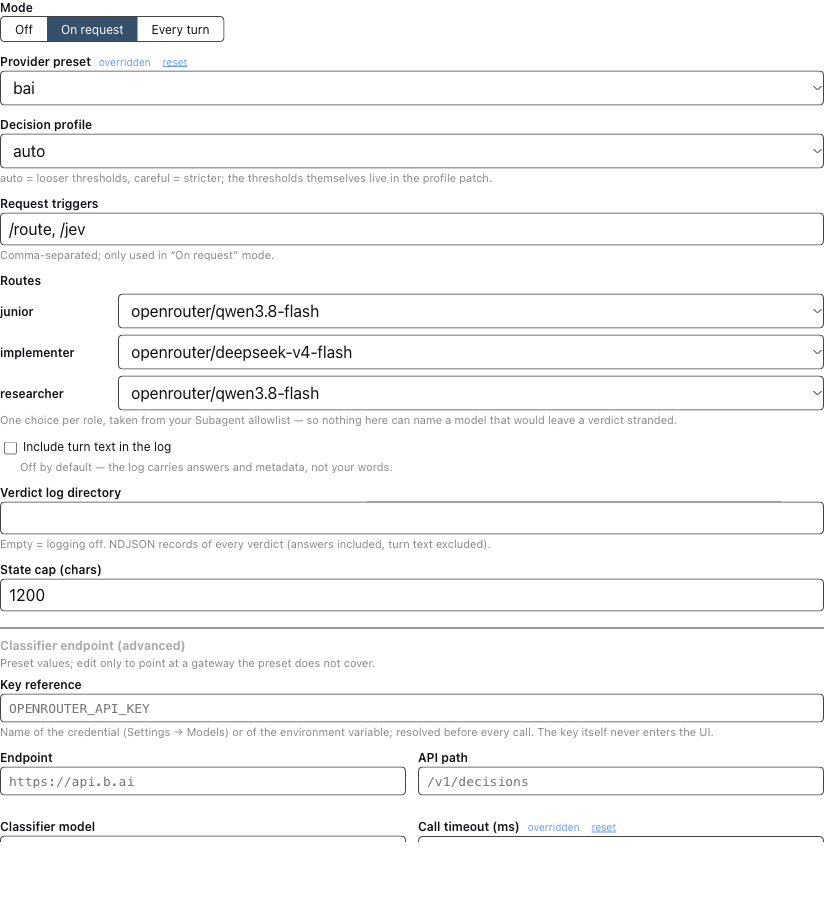
Two surfaces, one source of truth. The plugin's own page under Plugins (DSH 0.1.7+, where the form renders inline on the package page; the row's Configure control opens the same form) — or the Plugins settings tab on 0.1.5 — edits the top-level fields live: mode, provider preset, decision profile, triggers, routes, log directory and turn-text switch, state cap, and the classifier endpoint group — edits reach the next turn without a host restart, and a rejected value keeps the previous good config. Routes are here because they are the one nested field that fails quietly: a route naming a model your Subagent allowlist forbids still classifies, so the verdict reads as healthy while there is nowhere to dispatch. The card reads that allowlist from the subagent-model-selection-settings namespace — another plugin's, bound through configForms.get, which the framework documents for exactly this — and offers its models as one select per role, so the mistake is not available to make. Where that namespace is not served, the raw role=provider/model field returns unchanged. The profile patch remains the base layer for everything the card deliberately does not fake: profile thresholds (effortMax, noulMax, probabilityMax), routeFor, custom questions, delegationTools.
The card prints the version it was built from, in the bottom corner. A browser tab keeps the bundle it loaded, and restarting the host does not reload it — so if a control you just installed is missing, check that line first: no version line at all means the tab is running a build from before it existed, and a reload fixes it.
All settings live in the plugin row's config. The bundle patch ships the documented defaults; override the same row by id in your profile's cordis.patch.yml (edits there are the base layer the card rides on). Merging: questions and routes merge per key (override one entry, keep the rest); profiles deep-merge (tweak one threshold, keep the predicate); everything else follows ordinary deep-merge rules.
| Key | Default | Meaning |
|---|---|---|
mode | off | activation: off (inert), once (explicit triggers only), auto (every turn) |
triggers | ["/route", "/jev"] | leading commands that mark a turn for classification in once mode |
provider | typesafe | which Jev issuer preset applies: typesafe, bai, openrouter |
endpoint | per preset | TypeSafe API base — override for a proxied endpoint |
apiPath | per preset | path appended to the endpoint (/v1/systemone, /v1/decisions, …) |
apiKeyEnv | per preset | name the Bearer key is resolved by, per call: a credential from the store the Models page writes, else an environment variable |
model | per preset | pinned System One model — thresholds are calibrated per version; do not use jev-latest |
timeoutMs | 4000 | classification budget; on expiry the turn proceeds unrouted (a live decision measured 1517 ms) |
stateChars | 1200 | head cap of the redacted state built from the user turn |
redactPatterns | [] | extra regex sources redacted from the state and log text, on top of the built-in credential patterns |
mock | false | keyword classifier for wiring tests only |
questions | see bundle patch | the atomic rubric in TypeSafe's request format |
activeProfile | auto | which profile's policy applies |
profiles | auto, careful | { confidenceMin, delegate } predicates |
routeFor | class → role | which named route a task class maps to |
defaultRoute | implementer | fallback role when the class has no mapping |
routes | junior, implementer, researcher | role → { provider, model }; mirror your Subagent allowlist. The card shows one select per role, limited to the models that allowlist permits; without that namespace it falls back to comma-separated role=provider/model, where clearing the box restores the shipped triple |
skipSubagentSessions | true | only main-agent turns are routed |
logDir | null | NDJSON verdict sink; null or "" disables logging; set a directory path to opt in |
logTurnText | false | when logging is on, include the (redacted) turn text in the log |
includeFallbackLine | true | add the "proceed yourself if subagents are unavailable" line |
delegationTools | subagent, subagent_fork | { toolName, provider } pairs the capability gate probes; a preset that configures a custom toolName must list it here, or dispatch reports itself unavailable |
With logDir set, every verdict — delegate, skip, or error — appends one NDJSON line:
{"at":"2026-09-27T20:41:03.114Z","action":"delegate","reason":"predicate holds",
 "confidence":0.94,"role":"implementer","route":{"provider":"openrouter","model":"deepseek-v4-flash"},
 "model":"jev-1.13.0","usage":{"input_tokens":360,"output_tokens":39},"latencyMs":180,"answers":{…}}
The recalibration loop: when tests fail or work needs redoing after a delegation, that is a routing miss — raise confidenceMin or tighten the predicate for the failing class; when the log shows mechanical turns routed to the main model, loosen it.
The recommendation costs one classification call per turn; it should earn its place with evidence, not faith. The verdict log plus usage gives you the inputs:
delegate verdict. Every record carries an id and a delivered flag (whether the recommendation was actually injected — a missing message factory makes a verdict undelivered);latencyMs and usage.input_tokens per verdict against the main model's tokens saved on mechanical turns;enabled off for a comparable baseline period).If the deltas do not justify the extra call, tighten the policy so it fires less often — a quiet router is a good router.
Be honest about the gap: today's log measures policy verdicts and delivery, not adoption — it cannot see whether the main agent actually spawned a child, which model ran, or whether the work was re-done. The next step is a closed-loop routing ledger: correlate each verdict id with the actual subagent call, elapsed time, and rework, then report
DeepSeek Harness(DSH)Web 插件聚合生态包 · 一切皆插件,创意工坊分发(dsh-market.com)
把回答做成一页可视化 HTML:模型只写简短的 Markdown 草稿,随包附带的 `am` 命令行生成页面,支持流程图、时序图、树、时间线、ER 图、表格和提示框。
在 dsh 里装上这个插件即可,无需登录、注册或填 API Key,就能使用包括 Muse Spark 1.3、MiMo V2.6 在内的前沿模型——完全免费,不限量。 All you do is install this plugin in dsh: no login, no sign-up, no API key — the frontier models are just there, Muse Spark 1.3 and MiMo V2.6 among them. Completely free, with no usage cap.

