
dsh-web
zhu1090093659/dsh-webDeepSeek Harness(DSH)Web 插件聚合生态包 · 一切皆插件,创意工坊分发(dsh-market.com)

Audio-reactive turn rail for DeepSeek Harness: the transcript's own turn marks dance to whatever the system is playing (WASAPI loopback), with hover-only highlighting and a left/right rail option.
Takes over the transcript's own turn rail — the marks down the right edge of the conversation — and makes them dance to whatever the machine is playing, while replacing DSH's built-in "newest turn is highlighted" state with Codex's behaviour: nothing highlighted by default, highlight only under the pointer, click-to-jump unchanged.
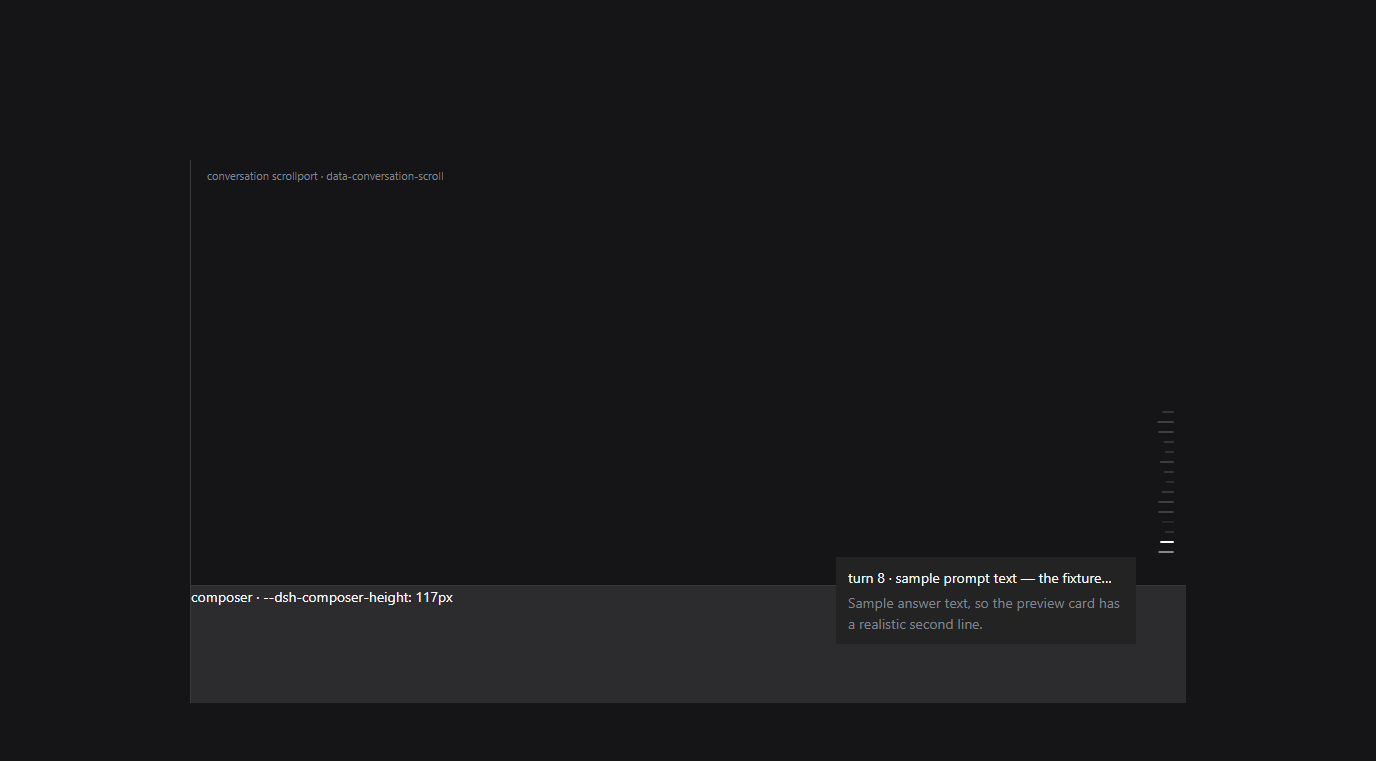
That is not an illustration. tools/verify/rail-preview.mjs builds a real Chromium
page from the shipped rail's own stylesheet and class names, extracted from the
installed dsh-client-ui-chat bundle, then loads the real lib/client.js and
drives it (only /api/dsh-pinpu/spectrum is stubbed). The differences in mark length
are the spectrum: low frequencies at the foot of the rail, next to the newest turn.
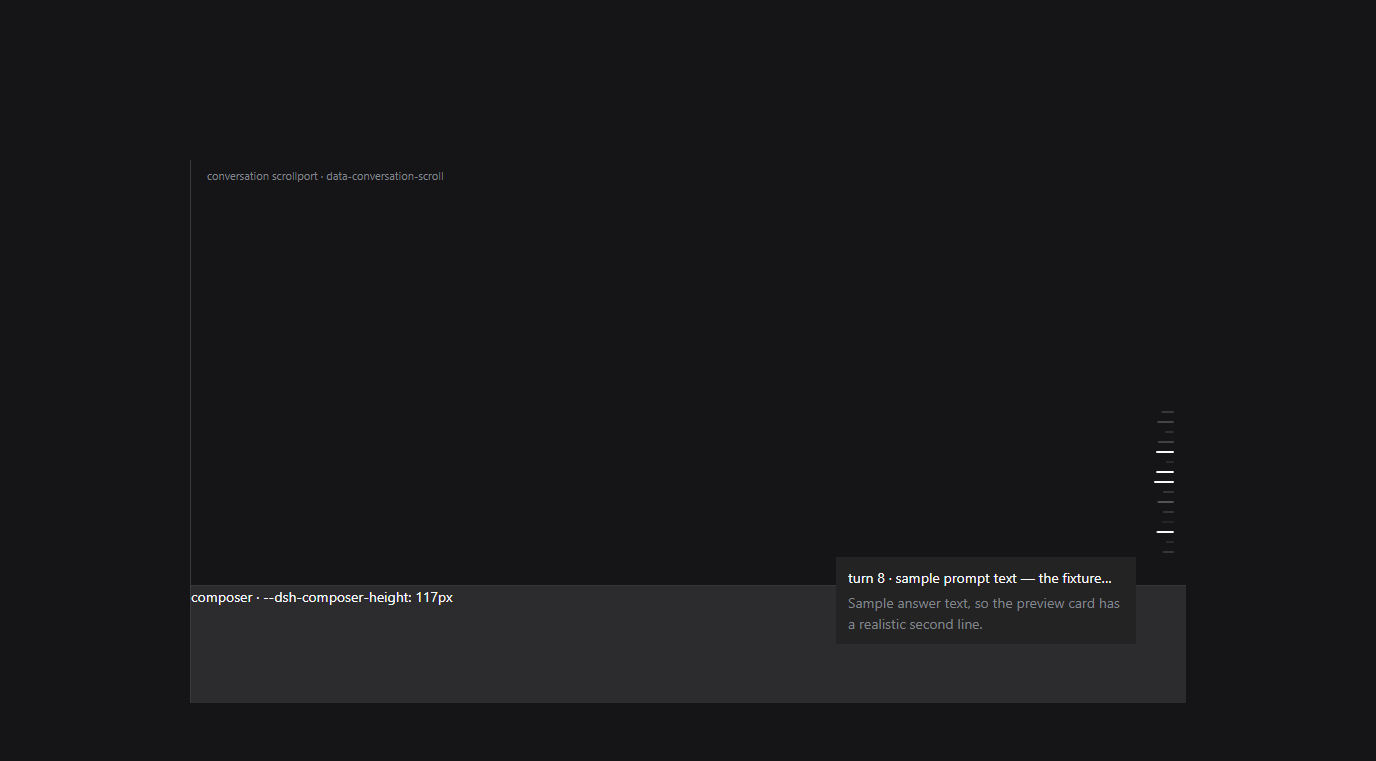
Hovering brightens exactly one mark (the third screenshot from the same run):
sqslm/dsh-pinpu from DSH's plugin
page, the same way any other GitHub plugin is installed, ornode tools/install-profile.mjs (pnpm pack, then write the package
into the profile's dsh.profile.bundles; --uninstall undoes it, --dry-run prints the
plan).getUserMedia monitor or PulseAudio .monitor), which is not implemented.
The rail's states are CSS-module classes (mark, markActive, markPreview,
markBusy, markUnloaded → build-hashed xpvNua_* names). The plugin reads no
class name:
[data-conversation-scroll], find a group of
sibling buttons with one size, one shared right edge and a constant vertical step
(≈10px). That group is the rail.data-pinpu-rail, each mark data-pinpu-tick="i"
counting from the bottom mark (0) upwards.!important stylesheet —
:hover brightens the mark under the pointer to full length — and only that;transform: scaleX(var(--pinpu-scale))), bands laid out logarithmically from
45 Hz to 16 kHz;markBusy, detected from the ::before animation)
is left alone so its pulse survives.Click-to-jump is untouched: only the ::before pseudo-element is restyled, the hit
area is still the app's own button, and its click listener still fires (measured in
the preview: clicks delivered to the app handler: ["7"]).
Measured in one preview run:
| State | Last mark (the built-in highlight) | Hovered mark | An un-hovered mark |
|---|---|---|---|
| before | rgb(249,250,251), scaleX(1) | — | dim |
| after, playing | rgba(255,255,255,.2), scaleX(0.87) | rgb(249,250,251), scaleX(1) | dim, scaleX(0.49) |
any player → default output device → WASAPI loopback → spectrum → the rail
vendor/loopback.py with the Python
the harness ships, and that helper uses the vendored PyAudioWPatch (≈290 KB, the
PortAudio build with loopback support) to open a [Loopback] input and stream mono
float32 PCM on stdout. The host does the FFT and band mapping; the browser half only
draws.Why not getUserMedia: it can only open capture endpoints. Measured on this machine,
the registry has 立体声混音 (Realtek USB Audio) but disabled (DeviceState=0x10000001
where every endpoint Chromium lists is 0x1), so navigator.mediaDevices never shows
it; more importantly Stereo Mix mirrors one render device, and this machine listens
on that headset — so even enabled it would not carry what you hear. Loopback of
the default output is the only thing that works.
The host owns the signal, the browser owns the presentation. Everything is
.volatile(), so edits apply live (mounting the bundle still needs one restart).
| Field | Default | Side | Meaning |
|---|---|---|---|
enabled | true | host | master switch; off spawns no capture process at all |
device | '' | host | empty follows the default output, else a [Loopback] device |
fftSize | 1024 | host | FFT window, ≈21 ms at 48 kHz |
smoothing | 0.78 | host | frame-to-frame smoothing |
gain | 1 | host | gain after the level curve |
autoGain | true | host | normalise per band against the loudest band |
gate | 0.04 | host | at or below this is silence |
minHz / maxHz | 45 / 16000 | host | spectrum range |
disableActiveHighlight | true | browser | remove the built-in newest-turn highlight |
hoverHighlight | true | browser | highlight only under the pointer |
restoreOnSilence | true | browser | stop moving once the audio has been quiet for a while |
minScale / maxScale | 0.4 / 1 | browser | shortest / longest mark, as a fraction of 20px (0.4 is the app's own "unloaded" length) |
invert | false | browser | put the low band at the top instead |
colorMode | theme | browser | theme keeps the rail's colour; spectrum hues by band; custom uses one colour |
customColor | #4d93f8 | browser | the custom colour |
glow | true | browser | let each mark's brightness follow its own level |
hotScale | 0.85 | browser | length threshold highlight: light a mark whose length reaches this fraction of full (0 = off) |
spark | 1.5 | browser | random highlight: expected highlights per second, each lighting one random mark for 160–420 ms (0 = off; silence never sparks) |
demo | false | browser | drive the marks with a synthetic waveform while nothing is captured |
Both light up marks that are already there — nothing is drawn, added or moved. A highlighted mark takes the same bright colour a hovered mark gets, at full strength, while keeping the length the spectrum gave it.
hotScale): the comparison is made on the visible length — the very
value written into --pinpu-scale — rather than on the level, so one parameter is only ever
interpreted once. The default 0.85 lights a band that is nearly full length; 1.05 is
equivalent to off (the spectrum cannot reach it), as is 0.spark): a rate, not a probability, because a per-frame chance is meaningless to
tune. Each highlight picks one mark that is neither busy nor already lit and lights it for
160–420 ms; it releases by itself on a later poll, with no extra timer to leak. Silence
never sparks, so ordinary listening gets an occasional accent rather than a strobe.markBusy) is left entirely alone, and a pointer on the
rail still outranks both.Measured in a real browser (tools/verify/rail-preview.mjs, 28 sampled frames):
samples with a highlighted mark: 23 of 28 (threshold 20, random 3)
a highlighted mark, computed: {"reason":"spark","background":"rgb(249, 250, 251)","opacity":"1","transform":"matrix(0.693…)","scale":"0.723"}
Bright colour, full strength, and the mark's own length (0.723) untouched.
Measured with the preview harness: without normalisation, 24 bands span only
0.51..0.76, which draws as six distinct lengths out of 37 — a flat wall. With it, the
same signal spans 0.18..1.0 and eleven lengths. The same harness showed Chromium's
default -100..-30 dB analyser window pegs normally-mastered material, so the ceiling
is raised to -25 dB.
| Means | Covers | Result |
|---|---|---|
node --test test/*.mjs (55) | manifest/patch contract, three-way default agreement, real schemastery validation, route auth and payloads, capture start/stop, FFT checked band-by-band against a naive DFT, band/resample/level contracts, the geometry rules that identify the rail, and the engine's whole take-over (discover → tag → poll → write lengths → hand back on silence → park on error → clean up when disabled) | all green |
node tools/verify/host-smoke.mjs | the real host chain: apply() → capture process → loopback PCM → FFT → route payload | status: live, device Speakers (Realtek Audio) [Loopback], peak 0.95, 11 distinct lengths, non-loopback Host rejected with 403 |
node tools/verify/rail-preview.mjs | real browser + the shipped rail CSS/classes + the real lib/client.js: built-in highlight gone, hover highlight, click still reaching the app's handler, lengths following the spectrum | VERDICT: the shipped rail was taken over and dances |
| the plugin page and settings card inside the running app | not verified — a restart would kill the session that performed the work | needs one restart; see below |
Checklist after a restart:
采集中 plus the device name (i.e. the host capture is up);错误, the card names the reason.cd path\to\dsh-pinpu
node --test test/*.mjs # run the tests first
node tools/verify/host-smoke.mjs # optional: prove system audio is captured
node tools/install-profile.mjs # pack, back up, edit the profile, pnpm install --offline
# then restart Harness once: a bundle row is applied at boot
link: — a link: dependency resolves to its real path outside
the profile, so the host half's import z from '@deepseek-ai/schemastery' would be
resolved against the source directory instead of the profile's node_modules, where
the core packages live. dsh-purge documents the same trap. An installed tarball
(including vendor/) resolves exactly like the harness's own packages.node tools/install-profile.mjs --uninstall, then restart — or restore
the .bak-pinpu-* backups of package.json / pnpm-lock.yaml.minScale/maxScale only
change the length range.pyaudiowpatch ships in the package); other platforms need their own.MIT.
DeepSeek Harness(DSH)Web 插件聚合生态包 · 一切皆插件,创意工坊分发(dsh-market.com)
把回答做成一页可视化 HTML:模型只写简短的 Markdown 草稿,随包附带的 `am` 命令行生成页面,支持流程图、时序图、树、时间线、ER 图、表格和提示框。
在 dsh 里装上这个插件即可,无需登录、注册或填 API Key,就能使用包括 Muse Spark 1.3、MiMo V2.6 在内的前沿模型——完全免费,不限量。 All you do is install this plugin in dsh: no login, no sign-up, no API key — the frontier models are just there, Muse Spark 1.3 and MiMo V2.6 among them. Completely free, with no usage cap.

