
dsh-web
zhu1090093659/dsh-webDeepSeek Harness(DSH)Web 插件聚合生态包 · 一切皆插件,创意工坊分发(dsh-market.com)

Prompt polishing for the DeepSeek Harness web GUI (dsh 0.2.x desktop runtime): concise rewrites, a built-in configuration page, and a route-leak fix. A derivative of dsh-prompt-enhance.
Prompt polishing for the DeepSeek Harness web GUI — one click (or one shortcut) turns a rough composer draft into a directly usable prompt, and your original draft is always preserved.
Derivative work — read this first
dsh-prompt-polishis a modified, unofficial derivative ofdsh-prompt-enhanceby its author (Apache-2.0). Upstream version 0.2.7 is the base of this project's1.0.0.What this fork adds: the plugin is actually configurable on the dsh
0.2.xruntime (upstream's configuration wiring had been removed from the harness, so its settings were silently unreachable), it ships its own configuration page, it no longer leaks its HTTP route when the entry is remounted, it drops pre-0.2 support, and the built-in rewrite strategy is the concise one. The full list is in Differences from upstream and CHANGELOG.md.Not endorsed. This is not an official release of the upstream project, and it is not affiliated with or endorsed by the upstream author or by DeepSeek. See NOTICE for the attribution and the list of changed files.
Two disclosures before you install. (1) The plugin serves an unauthenticated loopback HTTP route: any local process can call it and spend your model quota. (2) The draft you polish — and, with
contextAwareon, up tocontextMaxMessagesrecent turns — is sent to your configured model provider. Both are detailed under Security & privacy.
English | 简体中文
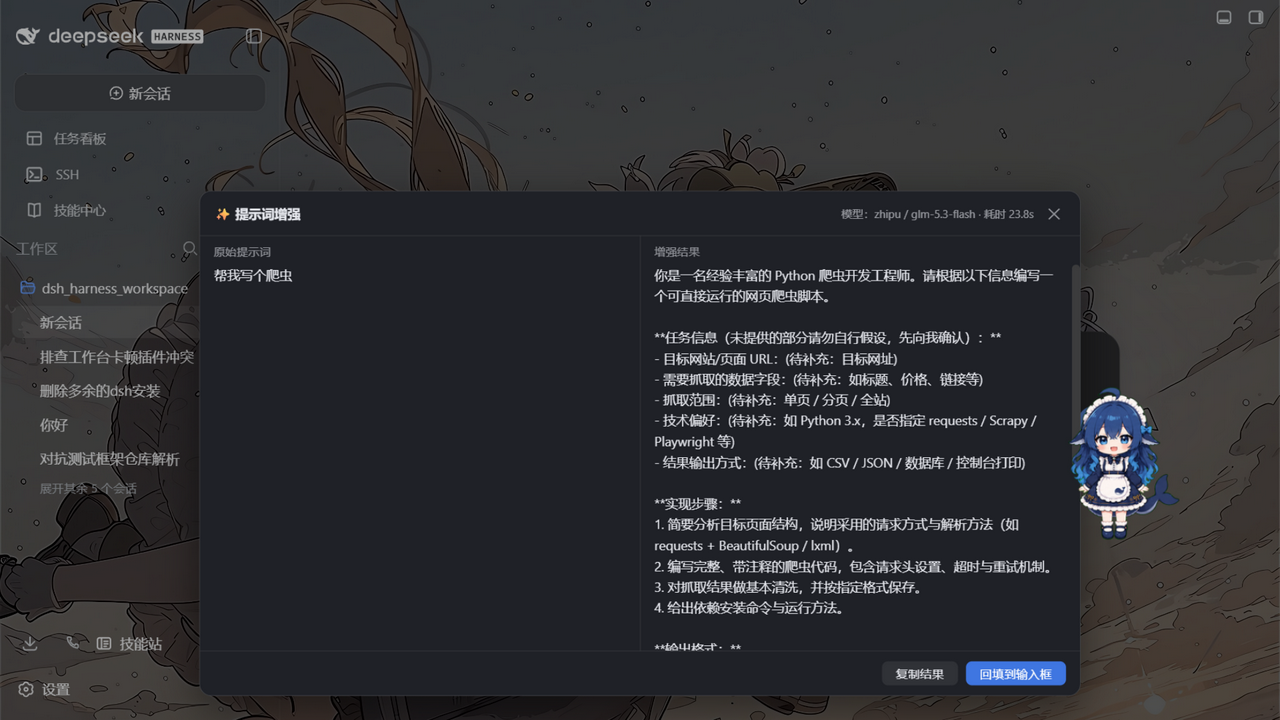
A plugin for the DeepSeek Harness web GUI. It adds a polish affordance to the composer: your draft goes through a low-temperature rewrite pass served by the harness' own LLM service, the result appears in a preview panel next to the original, and you choose to apply it, copy it, or throw it away. Applying raises an undo bar that restores exactly what you had typed.
One npm package, two halves, following the dsh plugin conventions: a host half (Node) that owns the HTTP route, the /enhance slash command and the settings namespace, and a browser half that contributes the composer button, the preview panel, the undo bar and the configuration page.
Upstream 0.2.x of the harness changed three things that this plugin depended on, and the result was a plugin that installed cleanly and then did nothing you could configure:
0.2.x derives a plugin's settings namespace from the Config schema the package exports and keeps only fields whose meta is volatile. Upstream marked none, so its entry was skipped entirely — no config page, no form, no way to write a value — while the installSection / installSettingsSection wiring it used instead had already been removed from the harness, so its compatibility probe returned without doing anything or logging anything. This fork marks every field volatile and serves the namespace the way 0.2.x expects.webserver.register() returns, so the /prompt-enhance prefix route outlived the entry that owned it; the next mount died on webserver: duplicate prefix route "/prompt-enhance" and left the entry failed until the host was restarted. This fork holds the disposer in an effect.plugins.row.config page, so the row's configure control on the Plugins page opens a real form.On top of that the built-in strategy is now the concise one (no mandatory acceptance-criteria or boundary-condition sections, no (待补充:…) placeholders) and maxOutputTokens defaults to 6000 instead of 2048, which is what produced "the rewrite hit the output limit" on long Chinese drafts.
| ✨ Composer button | A small button in the input box's tool row, next to the send button |
| 🔀 Preview panel | Original and polished text side by side, with model name and elapsed time |
| ↩️ One-click undo | After applying, a quiet bar above the composer restores the original draft |
| ⌨️ Shortcut | Default Ctrl+Alt+E, configurable, acts on the composer you are working in |
💬 /enhance command | Rewrite any text from the slash-command plane; the result never enters model history |
| 🧠 Model routing | Settings pair → current session model → harness default model, in that order |
| 🔑 Zero credential setup | Calls ride the harness LLM service; keys stay in the harness credential store |
| ⚙️ Live settings | All sixteen fields, on a page this package ships, applying to the very next call |
| 🛡️ Draft safety | Empty, over-length, images-only and reference-chip inputs are refused locally; upstream failures become readable messages; a failed call never touches your draft |
This project is prepared for its own npm release but has not been published yet, and the package is not on the registry under this name today. Until it is, install it from a checkout (or from this repository's GitHub URL) using the dsh plugin CLI:
# from a local checkout (built output is committed, so no build step is needed)
git clone https://github.com/rangercd67/dsh-prompt-polish.git
dsh plugin --profile web add link:/path/to/dsh-prompt-polish
# restart dsh web
# from the GitHub URL
dsh plugin --profile web add github:rangercd67/dsh-prompt-polish
Once dsh-prompt-polish is published under this name, the same command with the bare package name is the shortest path:
dsh plugin --profile web add dsh-prompt-polish
# restart dsh web
The row this package patches has the id prompt-enhance and the name dsh-prompt-polish. The id is deliberate and permanent: it is the settings namespace key, and every existing profile patch targets it. Only the name: in cordis.patch.yml follows the package name.
Uninstall:
dsh plugin --profile web remove dsh-prompt-polish
# check the profile's package.json `dsh.profile.bundles` array for a leftover
# row and remove it if present, then restart dsh web
If you use the dsh desktop application and install through the profile manager rather than the CLI, see the 1.0.0 release notes for the exact install_bundle / rollback steps used to verify this build.
All sixteen fields live in the prompt-enhance settings namespace. Edit them on the Plugins page: find this plugin's row and use its configure control (the row key is dsh-prompt-polish#prompt-enhance, registered by this package — no companion plugin is needed). On a profile that also bundles the harness' own settings surface, the same namespace appears under Settings → 插件配置. Changes apply to the very next call; no restart.
Every polish is one billable LLM call. maxOutputTokens bounds the cost of one call, and maxConcurrent / rateLimitPerMinute bound how often calls can be made.
| Field | Default | Description |
|---|---|---|
enabled | true | Master switch; off hides the composer button and disables every trigger |
provider | (empty) | Explicit route override; must be filled together with model (or leave both empty to follow the current session model) |
model | (empty) | Explicit route override; must be filled together with provider |
temperature | 0.3 | Sampling temperature (0–1). Low keeps the rewrite faithful to the original |
strategyMode | replace-default | How a custom systemPrompt combines with the built-in strategy: replace-default swaps it out entirely (the built-in hard rules — preserve intent, never fabricate, body-only output, language mirroring — are not retained and must be carried into your own text); extend-default appends your text after the built-in strategy, keeping those rules in force |
systemPrompt | (empty → built-in strategy) | Custom strategy text; blank uses the built-in concise strategy |
shortcut | ctrl+alt+e | Global shortcut spec (at least one of ctrl/alt/meta plus one alphanumeric or function key; bare keys are ignored so normal typing can never be swallowed); empty disables it |
maxOutputTokens | 6000 | Output token budget of one polish call (256–32768); it bounds that call's cost |
maxInputChars | 12000 | Input character cap (200–200000), counted in Unicode code points — an emoji is one character. Over-length drafts are rejected, never truncated |
timeoutMs | 60000 | End-to-end deadline of one call (5000–600000 ms) |
maxConcurrent | 2 | Concurrency cap within a single host process (1–16); extra requests answer 429 (concurrency-limit). The browser UI admits exactly one in-flight request (a single preview panel), so this cap mainly protects the /enhance command plane and multi-client callers |
rateLimitPerMinute | 10 | Sliding-window rate cap per minute within a single host process (1–600), counting successful calls only — failures never consume the window, so a run of failures cannot rate-limit you out; extra requests answer 429 (rate-limit) with a Retry-After in seconds |
streaming | true | Show the model's output in the panel as it streams instead of waiting for the whole rewrite — display-only: the applied text is still the normalized full result, and the client falls back to the one-shot JSON route when the host or network does not support text/event-stream |
contextAware | true | Ground the rewrite in the current conversation's recent history (resolve pronouns, fill in stated constraints, mirror the established stack and terminology). With no session, no history, or this switch off, the call degrades to the plain single-prompt polish. Privacy: the assembled snippet is sent to the configured provider alongside the draft — see Security & privacy |
contextMaxMessages | 8 | Context breadth: how many recent user/assistant turns may ground the rewrite (0–50); 0 admits none |
contextMaxChars | 4000 | Context depth: character budget of the assembled history snippet (0–100000), spent newest-first so the most recent turns win when the budget is tight; 0 admits none |
provider / model values match the harness settings: each key under the harness' provider settings (for example zhipu, muyuu) is a provider and each models[].id under it (for example glm-5.3-flash) is a model. example pair: provider: zhipu + model: glm-5.3-flash.
Model routing precedence: the explicit settings pair → the route recorded in the current session's request header → the harness-wide default model. If none of the three names a route (a fresh session with no default model, say), the plugin fails with an actionable message instead of guessing.
flowchart LR
    A[Composer draft] --> B{Local guards<br/>empty / length / chips / busy}
    B -- pass --> C["POST /prompt-enhance/enhance<br/>(loopback-fenced host route)"]
    B -- reject --> P[Preview panel:<br/>readable error, draft untouched]
    C --> D["ctx.llm.stream<br/>rewrite with the system strategy"]
    D --> E[Normalize:<br/>strip fences, trim, refuse empty]
    E --> F[Preview panel:<br/>original / polished]
    F -- Apply --> G["setDraft(polished)<br/>original pushed to the undo stack"]
    F -- Cancel / Copy --> H[Draft untouched]
    G --> U[Undo bar: one click restores]
Host half (exports ".", Node) — registers the /prompt-enhance prefix route on the shared webserver (POST /prompt-enhance/enhance for one JSON envelope, POST /prompt-enhance/enhance-stream for incremental SSE frames), the /enhance slash command, and the prompt-enhance settings namespace derived from the Config schema this package exports. The model call goes through ctx.llm.stream with a normalized output pass and the same auxiliary-call discipline the harness applies to session titles: deadline and caller cancellation rechecked during and after the stream, terminal-finish validation, tool-call rejection. Settings are read per request from the live composition config, which is what makes a saved change land on the next call without a remount.
Browser half (exports "./client") — registers the polish button into the conversation.input.right slot and the undo bar into conversation.input.dock, keeps a live mirror of the settings namespace, installs the global shortcut, and registers the plugins.row.config page keyed dsh-prompt-polish#prompt-enhance. All copy is localized (zh/en) through the harness locale system. The half hard-requires no service: slots, locale and configForms are all reached through optional ctx.inject, so a profile that lacks one degrades (bundled defaults, dictionary keys) instead of blocking the web boot.
Configuration page — the form is the harness' shared SettingsForm / SettingsFormModel machinery over the prompt-enhance namespace, which is what gives it the override badges, per-field reset, revision-fenced save and read-only/unavailable states. It lives in this bundle, so nothing else has to be installed to edit the plugin.
Composer button / shortcut — type (or leave) a draft and hit ✨ or Ctrl+Alt+E:
Esc, or clicking the overlay) discards everything./enhance <text> — rewrite any text from the slash menu. The result renders in the command plane (copyable) and never enters the conversation history or the model's context. To polish the composer draft itself, use the button or the shortcut: the draft lives in the browser. Cancelling a running /enhance follows the harness command plane; if the client offers no cancel affordance, the call runs to completion or times out.
Language consistency — the strategy instructs the model to mirror the input language (Chinese in → Chinese out). That is a best-effort instruction, not a guarantee.
The default system prompt makes the model a prompt editor: state the goal and the deliverable, add the steps the task actually needs, and put the constraints the draft itself implies under a short lead-in. It keeps the structure only as heavy as the task requires — no mandatory acceptance-criteria, boundary-condition, role or output-format sections, and no (待补充:…) placeholders: an unknown detail is simply left out, and only a detail that makes the task impossible to execute becomes one closing question. Length target is roughly 1x–2x the original, and an already-clear draft is polished lightly rather than inflated.
Hard rules: preserve intent exactly; never invent facts, data, names, numbers or constraints; keep the scope unchanged; output only the rewritten body (no explanation, no fences, no pleasantries); mirror the input language; treat the framed draft as literal data.
Set systemPrompt to use your own strategy; strategyMode decides how it combines. The default replace-default is a complete replacement — the built-in hard rules are not retained automatically, so your own text must include them. extend-default appends your text after the built-in strategy instead, keeping those rules in force.
| Case | Behavior |
|---|---|
| Empty / whitespace / invisible-only draft | Local refusal: "the input box is empty" |
Draft over maxInputChars | Refused locally and at the route with exact counts; no auto-truncation |
| Images attached but no text | Refused: text-only feature |
| Command or file-reference chips in the draft | Refused: filling back would destroy the chips |
| Submitting / busy phase, or a request already in flight | Refused with "try again in a moment" |
| Per-minute cap exceeded | 429 (rate-limit) with a Retry-After in seconds; the host message names the exact wait. The window counts successful calls only |
| Concurrency cap full | 429 (concurrency-limit), no Retry-After — a slot frees whenever an in-flight call settles |
| Upstream model failure | Stable codes mapped to readable hints: AUTH → check the API key, RATE_LIMIT → retry later, QUOTA_EXCEEDED → check the balance, CONTEXT_WINDOW_EXCEEDED → shorten the input, NO_ADAPTER/unconfigured → configure a model |
Output reaches maxOutputTokens | Refused with a hint to raise the cap or shorten the draft |
| Model returns empty / fence-wrapped / tool-call output | Normalized (fences stripped) or refused; retryable |
| Timeout | A 504-mapped message carrying the configured seconds; retryable |
| Browser tab closed mid-flight | The host route notices the disconnect and aborts the model call |
| Session switch | Panel state, undo stack and shortcut targeting are per-session; switching closes the panel and clears its undo entries |
Every failure surfaces inside the plugin's own panel, and the composer draft is never modified by a failed call, so manual input continues undisturbed.
The host route answers structured errors of the shape { code, message?, params? }: the browser renders its localized primary line from code + params using the current language dictionary, and message — when present — is an optional diagnostic detail (the provider's raw failure text, a config error) shown verbatim beneath it. The /enhance command plane has no locale dictionary; a host-side renderer of the same errors produces Chinese text directly.
| Error code | HTTP status | Browser primary copy (dictionary key) | Params |
|---|---|---|---|
rejected | 403 / 413 / 415 / 422 | generic error.rejected; with { count, max } it reuses error.tooLong | over-length input: { count, max } |
rate-limit | 429 | error.rateLimit | { limit, retryAfterSeconds } |
concurrency-limit | 429 | error.concurrencyLimit | { max } |
timeout | 504 | error.timeout | { seconds } |
unconfigured | 409 | error.unconfigured | — |
upstream | 502 | generic error.upstream; with reason it uses error.upstream.{reason} (auth / invalidCredential / rateLimit / quota / empty / contextWindow / toolCall / maxTokens) | { reason } |
internal | 500 / 502 | error.internal | — |
Button missing / shortcut dead — open the plugin's configure page (Plugins page row) and check enabled; check that the plugin is installed (dsh plugin --profile web list) and that dsh web was restarted; check the browser console for a failed apply.
"No model resolved for the polish" — routing follows the settings pair → the session model → the harness default; if all three are empty there is nothing to call. Pair provider/model in the settings, or send a message in the current session first so it carries a model route, and check the harness' default-model settings section.
Authentication failures — the message detail line carries the concrete cause (a 401, say). Check the provider's API key in the harness credential store; quota and balance problems surface as the quota hint.
Rate-limited (429) right after a run of failures — that should not happen, because the window counts successes only. If it does, check whether several profiles or processes are mounted (each counts independently and they stack up) or whether rateLimitPerMinute is set too low.
Poor rewrites (fabrication, dropped requirements, broken formatting) — with strategyMode set to replace-default, a custom systemPrompt replaces the built-in strategy entirely, hard rules included; carry them into your own text or switch to extend-default.
Project name changed, settings look reset — the namespace and row id are still prompt-enhance, so stored values and existing profile patches keep working across the dsh-prompt-enhance → dsh-prompt-polish rename. What changes is the package name, and with it the row key of the configuration page (<package name>#prompt-enhance); it is injected at build time, so a stale hand-built bundle from an older name will not show the page until it is rebuilt.
1. The loopback HTTP route is unauthenticated by design. Any process on your machine can POST /prompt-enhance/enhance and spend your model quota. Per-caller authentication is not attempted. What guards the route instead:
127.0.0.1 / ::1 only).Host header must be localhost / 127.0.0.1 / [::1], which defeats DNS rebinding (a rebound attacker domain keeps the loopback socket address but carries the attacker's hostname and is refused). Responses are cache-control: no-store.X-Forwarded-For or Forwarded are refused outright: those headers only exist when a proxy is in the path, which the trust model does not cover.maxInputChars (with a Content-Length fast reject), a sliding-window rate limit (rateLimitPerMinute, default 10, counting successful calls only) and a concurrency cap (maxConcurrent, default 2), both answering 429. Both counters live in a single host process's memory: several processes, a cluster or several profiles mounting the plugin each count independently, so this plugin supports single-process deployments and ships no shared rate-limit store.timeoutMs; connection-level timeouts (headers / request / keep-alive) are settings of the shared http.Server that a prefix route must not touch, so they fall to the host and Node's defaults.<raw_prompt> tags, literal closing tags inside the draft are neutralized, and the strategy prompt treats the framed text as pure data. That lowers the risk of a simple tag escape; prompt-based boundaries are best-effort, not a guarantee.**2. Your d
DeepSeek Harness(DSH)Web 插件聚合生态包 · 一切皆插件,创意工坊分发(dsh-market.com)
把回答做成一页可视化 HTML:模型只写简短的 Markdown 草稿,随包附带的 `am` 命令行生成页面,支持流程图、时序图、树、时间线、ER 图、表格和提示框。
在 dsh 里装上这个插件即可,无需登录、注册或填 API Key,就能使用包括 Muse Spark 1.3、MiMo V2.6 在内的前沿模型——完全免费,不限量。 All you do is install this plugin in dsh: no login, no sign-up, no API key — the frontier models are just there, Muse Spark 1.3 and MiMo V2.6 among them. Completely free, with no usage cap.

