
dsh-web
zhu1090093659/dsh-webDeepSeek Harness(DSH)Web 插件聚合生态包 · 一切皆插件,创意工坊分发(dsh-market.com)

Pre-install review gate for DeepSeek Harness plugins: audit, approve the change plan, backup, then install(插件装前审查)
Every plugin you install holds your keys. It can read every session, call every model, rewrite your profile. And "the author says it's harmless" — that is exactly what every plugin that ever went bad has said too.
This plugin does exactly one thing: before you hit Install, force the package to show its face — what it is, what it can touch, what it will change — and let you approve every change yourself.
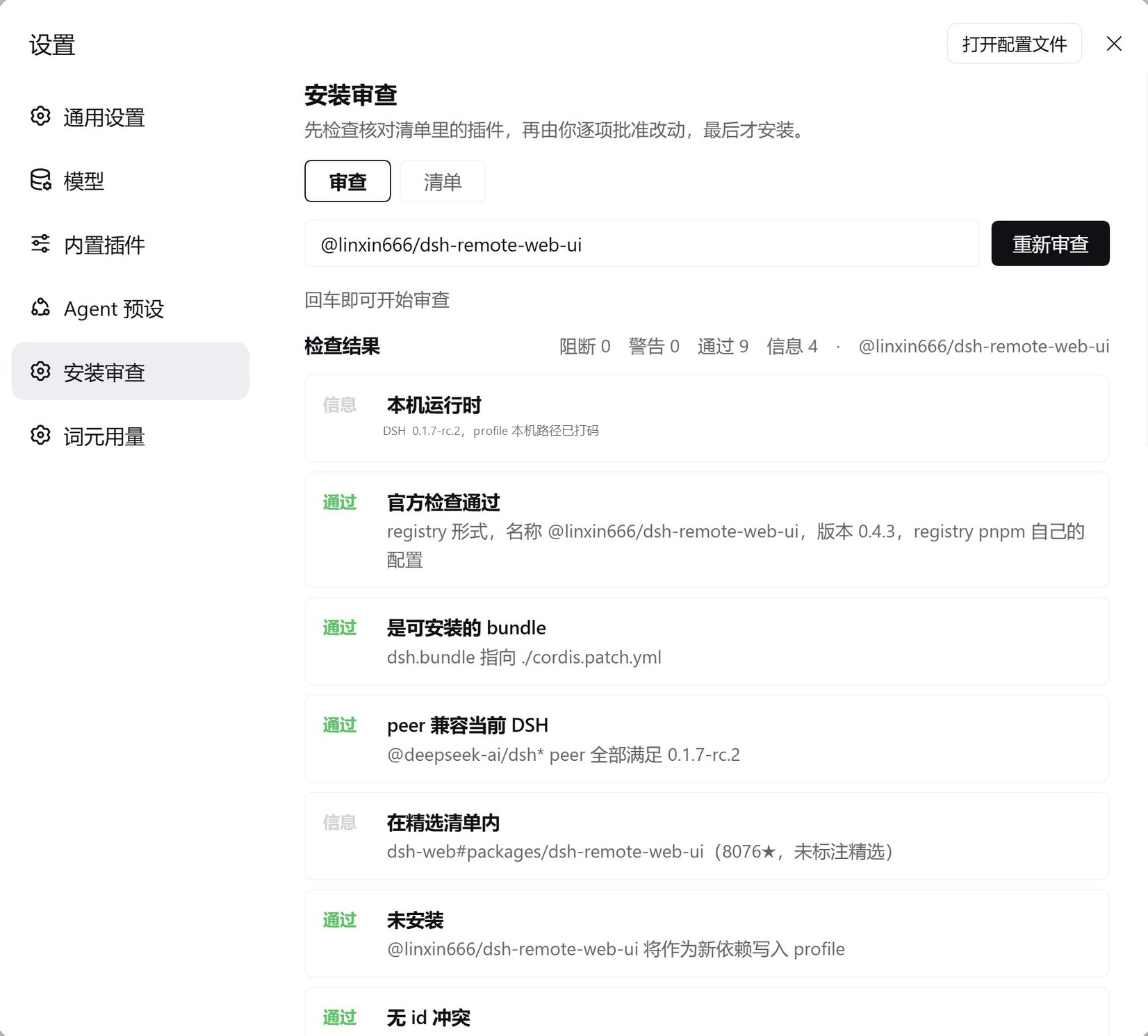
| 📋 Audit report (seconds, capabilities & red lines included) |
|---|
 |
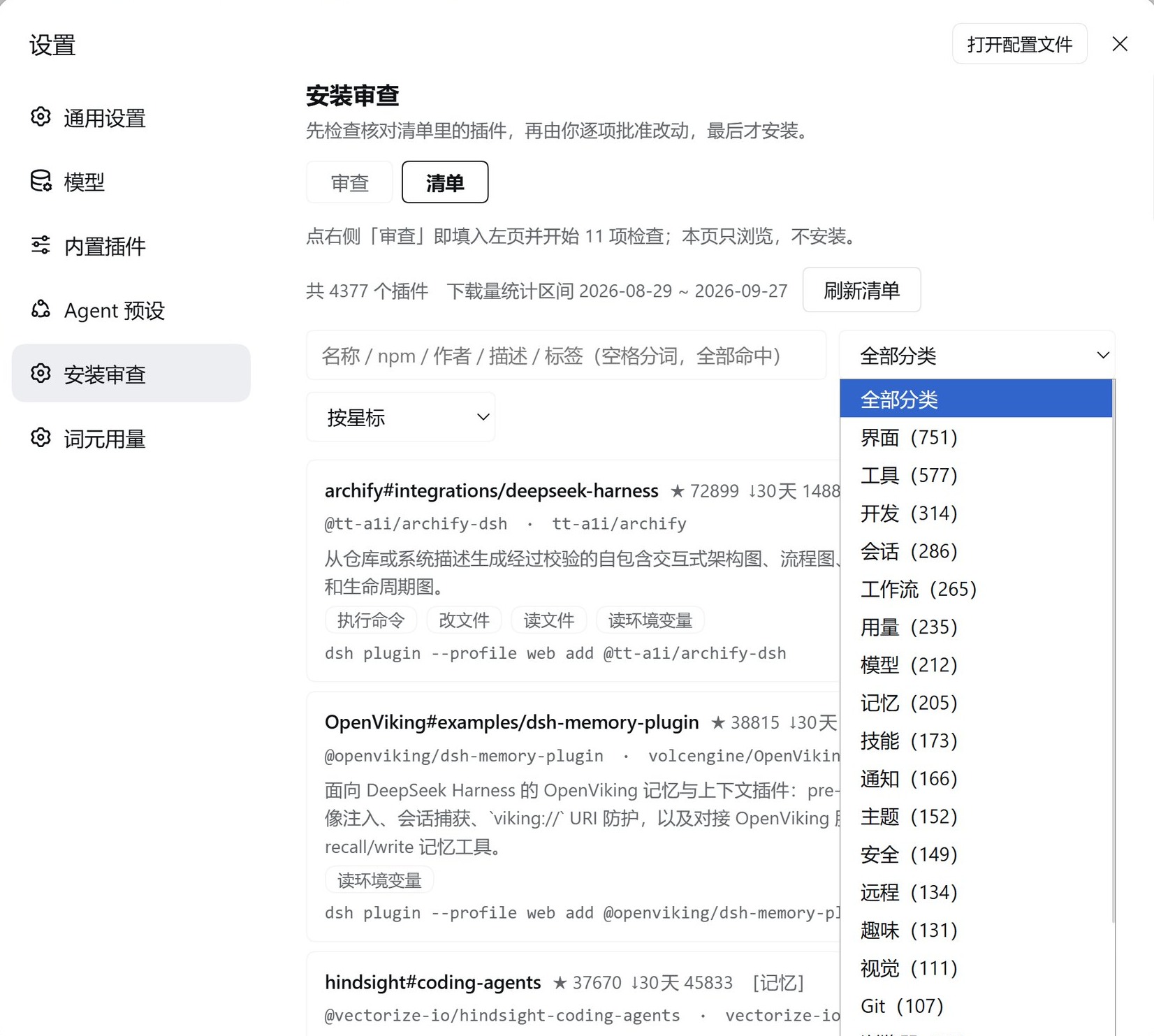
| 🗂 Browsable catalog (4,377-entry snapshot; server-side search / filter / sort) |
|---|
 |
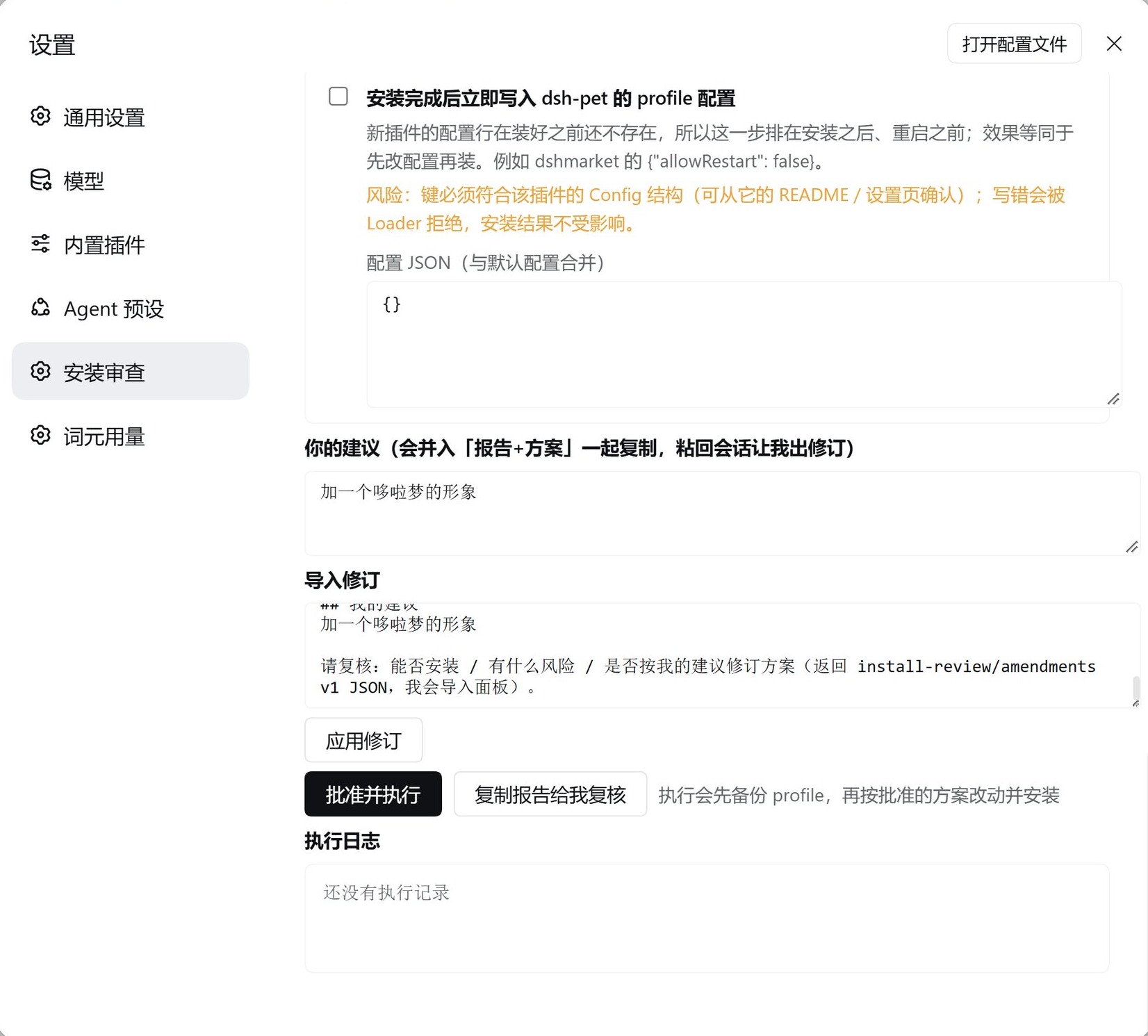
| ✅ Change plan · your note · import a revision |
|---|
 |
| Check | Detail |
|---|---|
| Local runtime | DSH version and profile (path auto-masked — screenshots are safe to share) |
| Official inspect | pluginManager.inspect: dsh.bundle / dsh.client / dsh.tool / dsh.page / dsh.configForm |
| Peer compatibility | Mirrors the host's own resolution (incl. includePrerelease) — 1,280 cases match host semver exactly |
| Catalog entry | Registry, repository, stars, 30-day downloads (no repo stars passed off as package stars) |
| Install state | Installed / not installed (recognises 4 loader-id shapes) |
| Loader-id collision | Intersects with every live loader row — a duplicate id crashes host startup; this check is bought with a real lesson |
| Patch override rows | The target patch's override rows: do their targets exist? double-written by another plugin? (self-review never flags itself) |
| Slot audit | Checked one by one against the local slot catalog — the source slot-catalog.ts, or on a packaged Desktop install the catalog compiled into app.asar/…/dsh-cordis-client-runner/lib/client.js — a slot check that cannot run is a warning: unknown ≠ pass |
| Install scripts | prepare / postinstall etc. → enters the "approve & retry" flow automatically |
| Terminal-shaped surface | CLI-flavoured description → warns it may do nothing in a web profile |
| engines | Both placements read: engines.dsh and dsh.engines.dsh (missing one misreports "undeclared") |
| Host-tampering language | Description talks about patching the DSH core → warning |
| Capabilities & red lines | The list's 10 capability tags plus red-line sentences, translated; unannotated stays unannotated |
npm package / owner/repo / github:owner/repo / a GitHub URL → report in secondspeer-compat red): grant the host's own exact-version exemption for
this exact pair (package@version + your DSH version) and continue installing. You must first tick
"I have read and accept the risk" — a human step an imported revision cannot take for you; the
exemption covers that one pair only, expires by itself when either side moves, and can be revoked
from the same panel (a standalone action that installs nothing)configEditor channel: lock, validate, roll back;
the template is pre-filled from the package's own patch defaults merged with your current
config, so you only review it)package.json, cordis.patch.yml, pnpm-workspace.yaml, cordis.yml
(plus compatibility.json when an exemption record exists) first → applies the approved
changes → installs → verifiesfailed is called out), whether its
bundle is selected, and whether a declared browser half reached the client module graph — with plain
conclusions such as "row X is not active yet — a dsh restart is usually required"<name> build scripts &
retry" button — no deadlock, no overreach (a name that is no longer pending is refused by
the official stale-approval guard)engines.dsh mismatch: it stays a block (the author's declaration is a real signal), but the
report says plainly that the host checks peerDependencies only and never refuses a plugin over
engines — so you get an "I understand, install anyway" box, plus a "use a version that satisfies it"
option.dsh.bundle,
a loader-id collision): the report says so and advises against installing.dsh plugin --profile web add github:GIN0076/dsh-install-review
@local/dsh-install-review to the profile's dsh.profile.bundles and add its insert row to
cordis.patch.yml; running only the add command puts the repository in node_modules but
does not mount the interfacedsh web, then hard-refresh (Ctrl+Shift+R) → Settings → 插件装前审查 / Pre-install ReviewDesktop (packaged app, measured on 0.2.0-rc.2): Settings → Plugins → Add plugin with the
local directory path (or install_bundle from the plugin-manager tooling).
!app.isPackaged) — so do not hunt for Ctrl+Shift+R. A changed client half
(the UI) usually hot-swaps by itself; to force the new bundle, quit and reopen
DeepSeek Harness.exe (sessions are durable — pick the conversation up from the sidebar). A changed
host half (the logic) needs no restart: remove_bundle + install_bundle reloads it.resources/app.asar and ships no src/ tree, so the slot audit reads
the compiled catalog (…/dsh-cordis-client-runner/lib/client.js);
② the window's origin is dsh-app://app and its protocol handler deletes Origin / Sec-Fetch-Site
/ Cookie before forwarding, then injects the Host's own session cookie → the panel no longer
compares Origin itself but asks the Host's connection.requestRejection (the same channel the
official @deepseek-ai/dsh-host-open-in-app uses; no cookie → 401, cross-site Origin → 403, and the
refusal carries a hint plus the headers it saw).Prefer not to use git? Copy the repository locally and point the plugin manager's
install_bundleat the directory, then complete the same two profile configuration steps.
Settings → Plugins → remove, or remove_bundle in the plugin manager.
Uninstall does not delete your backups — every pre-execution backup is
written to <profile>/install-review-backup (the row's backupDir can move it).
node semver-selftest.mjs          # 1,280 cases, identical to host semver (SKIP when no host semver)
node catalog-view-selftest.mjs    # categories / capabilities / red lines / projection
node patch-audit-selftest.mjs     # override-row parsing and verdicts
node audit-selftest.mjs           # parsing / peers / both engines placements / end-to-end
node remedy-selftest.mjs          # remedies: exemption before install, nothing without the human tick,
                                  # an imported revision cannot self-approve, revoke is standalone
node enhance-selftest.mjs         # capability proposals: config-template scanner / registry order /
                                  # upgrade keeps config / rows enabled by entryId / post-install activation
node runner-selftest.mjs          # backups / config edits / approvedBuilds / stale-approval
node host-selftest.mjs            # routes and same-origin fence
node client-selftest.mjs          # revision-import loop (+ SSR render when react-dom exists)
Nine self-tests — zero test framework, zero dependencies. The two end-to-end tests read the live upstream catalog: when the target declares peers incompatible with the current DSH, that block is expected. A green run is not an installation approval.
The self-tests resolve their host packages themselves (
selftest-host.mjs: source checkout → localnode_modules→ packaged runtime) — no install path is hardcoded any more. To get the real 1,280-case semver comparison on the Desktop build:$env:ELECTRON_RUN_AS_NODE=1; & "…\DeepSeek Harness.exe" semver-selftest.mjs— it uses the semver insideapp.asar. When node-semver / react-dom cannot be found, that pass printsSKIP(never FAIL); pointDSH_SELFTEST_SEMVER/DSH_SELFTEST_REACT/DSH_SELFTEST_REACT_DOMat an exact file to restore it. The username in the fixtures is fake (localtester) precisely so the tests can prove that local paths in reports are always masked.
This tool checks installability and blast radius before installation. No automated check replaces your own judgement of where a plugin comes from. Catalog data is an upstream snapshot (4,377 entries; downloads window shown in the UI) and reflects the moment it was fetched.
MIT © 2026 GIN0076
DeepSeek Harness(DSH)Web 插件聚合生态包 · 一切皆插件,创意工坊分发(dsh-market.com)
把回答做成一页可视化 HTML:模型只写简短的 Markdown 草稿,随包附带的 `am` 命令行生成页面,支持流程图、时序图、树、时间线、ER 图、表格和提示框。
在 dsh 里装上这个插件即可,无需登录、注册或填 API Key,就能使用包括 Muse Spark 1.3、MiMo V2.6 在内的前沿模型——完全免费,不限量。 All you do is install this plugin in dsh: no login, no sign-up, no API key — the frontier models are just there, Muse Spark 1.3 and MiMo V2.6 among them. Completely free, with no usage cap.

