
dsh-web
zhu1090093659/dsh-webDeepSeek Harness(DSH)Web 插件聚合生态包 · 一切皆插件,创意工坊分发(dsh-market.com)

DeepSeek Harness 网络代理设置页:配置全局 HTTP(S) 代理及免代理主机,或为单个 LLM 提供商单独指定代理或直连;保存即生效,无需重启。
English | 中文
A network proxy plugin for DeepSeek Harness (dsh):
http://127.0.0.1:7890 under Settings → Network proxy, and model requests, web search, web fetch, HTTP MCP, and commands the agent runs all go through it.http://127.0.0.1:7890 and DeepSeek direct.Precedence: provider setting > global proxy > HTTP(S)_PROXY from launch.
dsh plugin --profile web add @copylee/dsh-proxy
Restart dsh web, and a Network proxy page appears in Settings.
Keep the
@copylee/scope. The unscopeddsh-proxyanddsh-network-proxypackages on npm belong to other people and are unrelated.
You can also install straight from GitHub. Built output is committed, so no build script or allowBuilds entry is needed:
dsh plugin --profile web add github:copylee711/dsh-proxy
Open Settings → Network proxy:
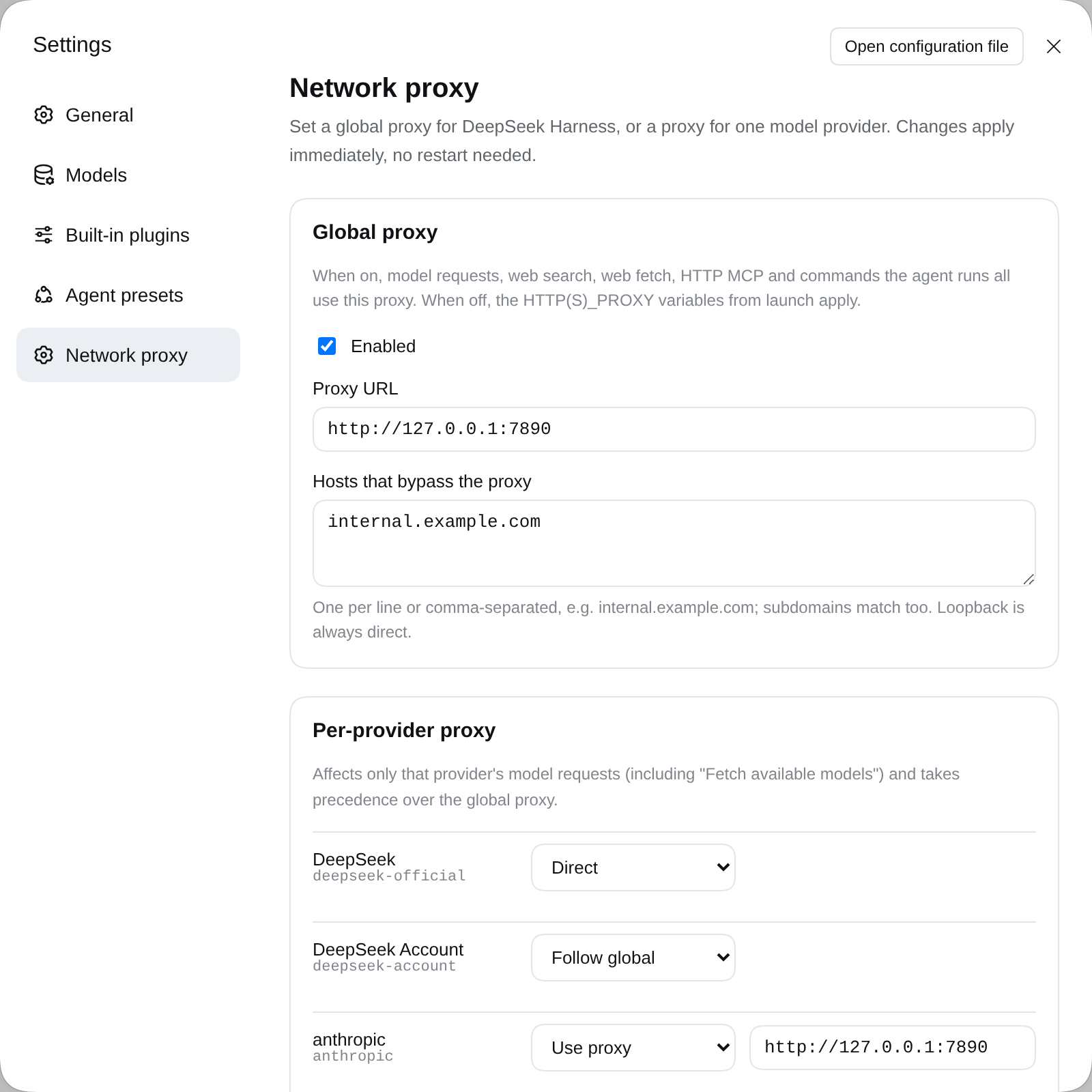
| Area | What it does |
|---|---|
| Global proxy | Tick Enabled and enter the proxy URL. Hosts that bypass the proxy takes one host per line and matches subdomains too. localhost / 127.0.0.1 are always direct. |
| Per-provider proxy | Lists configured model providers. Each can be Follow global, Use proxy, or Direct. Add a provider not in the list by typing its id below it (e.g. deepseek-official, anthropic, openai, or a custom Provider ID from the Models page). |
Save applies to the next request, including Fetch available models on the Models page.
The global selector offers Off (use launch settings), System proxy (auto-detect), and Manual proxy. Each provider can also select its own system proxy, overriding the global route. Menus follow dsh-free-search's floating cards, hover highlights, and selection checkmarks, with Arrow, Home/End, Enter, Esc, and Tab keyboard support.
Detection tries valid HTTP(S) values from HTTPS_PROXY / https_proxy, HTTP_PROXY / http_proxy, and ALL_PROXY / all_proxy in that order, then Windows current-user Internet Settings or macOS scutil. Linux uses environment variables. A launch environment snapshot prevents the plugin's own installed proxy from feeding back into detection. OS settings are checked every 30 seconds; the settings page also offers Detect again. SOCKS, PAC, and WPAD are not supported. When detection finds no usable proxy, the global layer restores launch settings and provider overrides fall back to the global route with a warning. Status and logs mask proxy credentials.
global:
  enabled: true
  mode: system
  noProxy: []
providers:
  openai:
    enabled: true
    mode: system
Existing configurations without mode continue using their manual proxy. The global proxy remains disabled by default.
The bottom of the page offers an accent colour (terracotta, blue or black) for the primary button and focus rings. The choice is shared with the other copylee plugins: changing it in any one of them recolours all of them.
The same settings live in $DSH_HOME/profiles/<profile>/cordis.patch.yml (the Web UI profile is web):
- id: dsh-proxy
  config:
    global:
      enabled: true
      url: http://127.0.0.1:7890
      noProxy: [internal.example.com]
    providers:
      anthropic:
        mode: proxy
        url: http://127.0.0.1:7890
      deepseek-official:
        mode: direct
| Field | Meaning |
|---|---|
global.enabled | Turn the global proxy on. Default false, which keeps the launch environment's proxy. |
global.url | Global proxy URL. |
global.noProxy | Hosts reached directly while the global proxy is on. |
providers.<id>.enabled | Use this provider's own setting. Default true; false follows the global route. |
providers.<id>.mode | proxy (use url) or direct (bypass every proxy, the global one included). |
providers.<id>.url | This provider's proxy URL. |
Proxy URLs may be http:// or https://. A bare 127.0.0.1:7890 becomes http://127.0.0.1:7890. Credentials go in the URL: http://user:password@host:port.
@deepseek-ai/dsh-http-proxy, the package the launcher uses for HTTP(S)_PROXY. Loopback bypass, NO_PROXY matching, web_fetch routing, and the proxy environment of spawned tools therefore behave exactly as upstream. Turning it off restores the launch policy.llm/stream middleware. A provider's model call runs in one async context. The plugin puts that provider's undici ProxyAgent (or a direct Agent) in an AsyncLocalStorage, and fetch uses it inside that context. Other requests are untouched, and concurrent calls to different providers don't interfere.loader/volatile-update, and the plugin switches routes in place without reloading.cordis.patch.yml. The global proxy URL also reaches commands the agent runs through their environment.http module, as it does in upstream dsh.npm install
npm run typecheck
npm test # global / per-provider / direct routing against local fake proxies
npm run build # regenerates lib/ and client/ (commit them)
Try it in a local dsh: dsh plugin --profile web add /path/to/dsh-proxy.
MIT
DeepSeek Harness(DSH)Web 插件聚合生态包 · 一切皆插件,创意工坊分发(dsh-market.com)
把回答做成一页可视化 HTML:模型只写简短的 Markdown 草稿,随包附带的 `am` 命令行生成页面,支持流程图、时序图、树、时间线、ER 图、表格和提示框。
在 dsh 里装上这个插件即可,无需登录、注册或填 API Key,就能使用包括 Muse Spark 1.3、MiMo V2.6 在内的前沿模型——完全免费,不限量。 All you do is install this plugin in dsh: no login, no sign-up, no API key — the frontier models are just there, Muse Spark 1.3 and MiMo V2.6 among them. Completely free, with no usage cap.

