
dsh-web
zhu1090093659/dsh-webDeepSeek Harness(DSH)Web 插件聚合生态包 · 一切皆插件,创意工坊分发(dsh-market.com)

Self-hosted SearXNG metasearch web-search plugin for DeepSeek Harness — no API key, adds a Plugins-page settings card. | DeepSeek Harness 插件:通过自托管 SearXNG 元搜索提供网页搜索,无需 API Key,附带设置页插件配置卡片。
English | 中文
0.4.1 keeps the DSH process proxy off by default. Enter your host and port directly in the bottom red risk section. Opening the switch shows a notice; view the risk statement, tick the acknowledgement and confirm before routing changes. Cancellation leaves it off. Configuration and acknowledgement are saved per profile in DSH credential storage. Unloading restores the prior process policy; re-enabling the plugin or restarting DSH restores an enabled proxy without another prompt. Turning the proxy off keeps it off and retains its configuration; Forget deletes the saved configuration and consent. No user .env is written and existing host proxies take priority. After updating, fully restart the DSH backend and refresh the page.
Give DeepSeek Harness (dsh) web search through your own self-hosted SearXNG instance.
✅ No API key required by default — optional authentication for protected instances ✅ No per-search API fee on the SearXNG path — paid fallback is off by default; host route overrides have separate cost notices ✅ Self-hosted search relay — your instance forwards queries to the selected search engines ✅ Configure directly in DSH — sidebar → Plugins → SearXNG search ✅ Tested end-to-end against the official web search — no quality difference observed
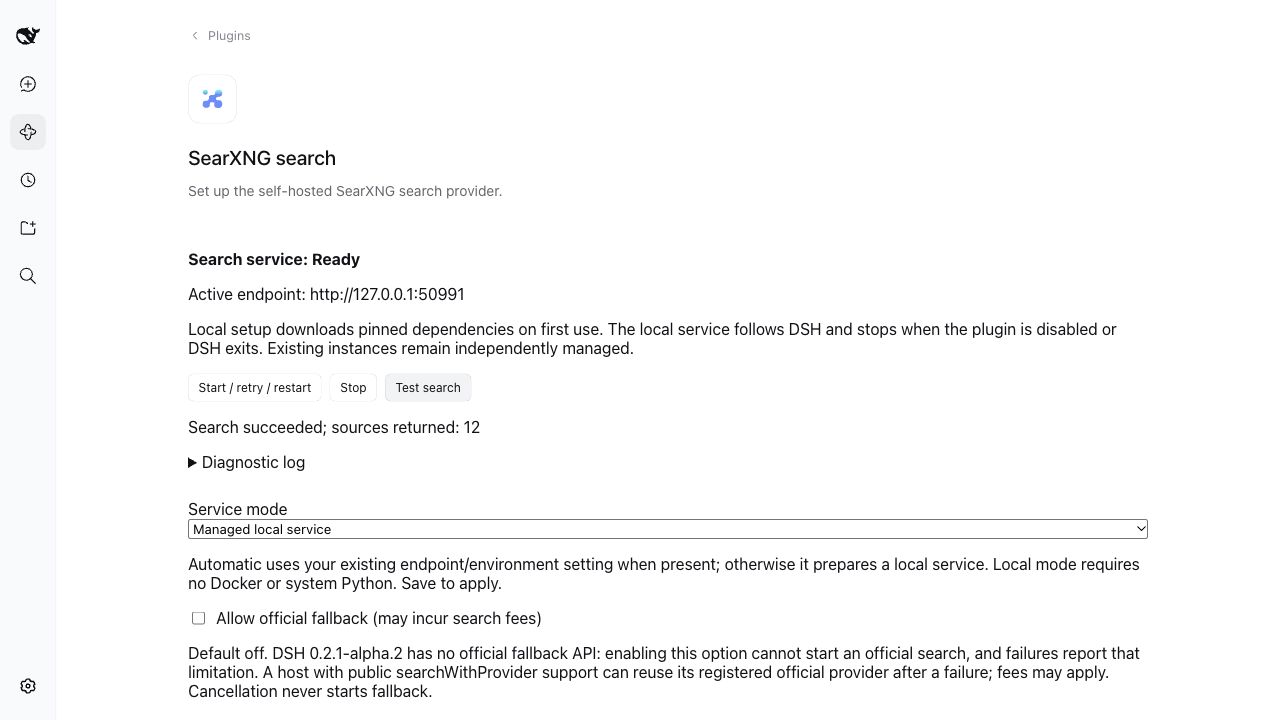
Version 0.3.0 in English, captured from a temporary DSH profile: managed service readiness, an automatically selected endpoint, lifecycle controls and Test search. The displayed port is an example. Engine/language changes apply to the next search without restarting; local port changes restart the managed service.
Version 0.4.1: adds remembered proxy configuration, default-off official Search/Fetch retries, host route/cost status and Restore plugin routes. First-use downloads wait for Prepare and start; usable caches start automatically. The card includes activity records, search reports and confirmed runtime cleanup. See release notes and managed runtime notes.
Prerequisite: DeepSeek Harness 0.2.1-alpha.2 with the standard Web/base bundles. No host patch is required. See configuration and upgrade notes.
The default is a plugin-managed local SearXNG service, without user-installed Docker or Python. After first-use confirmation it downloads a setup tool, isolated Python and search dependencies, with progress in the card. Existing endpoints or SEARXNG_BASE_URL continue using an external service. See managed runtime notes.
1. Install the plugin:
In DSH's sidebar, open Plugins → Add plugin, enter https://github.com/Chaos-Paradox/dsh-web-search-searxng#v0.4.1, and choose Enable now after installation. The equivalent CLI command is:
dsh plugin --profile <name> add https://github.com/Chaos-Paradox/dsh-web-search-searxng#v0.4.1
2. Set your preferences: open sidebar → Plugins → SearXNG search. Review the first-use summary and click Prepare and start when no reusable cache exists. Wait for Ready, choose engines and result language, and save. Test search uses the saved preferences. A free port is selected automatically; advanced settings allow a specific port. To use your own existing service, select Existing instance and enter its endpoint.
Installing appends a bundle layer that selects SearXNG by default. Higher-priority user configuration still wins. Plugin-path failures report an error without official requests by default. Version 0.4.1's new Search/Fetch API retries need separate explicit opt-ins; legacy permission never enables them. Check the host route panel first: if official settings override routing, plugin fallback switches cannot block that official path's fees. Use Restore plugin routes to change it. Disabling/removing the bundle exposes remaining layers; user selections written by an explicit restore remain until separately changed. See routing notes.
An already prepared local SearXNG starts with the enabled plugin and stops on normal DSH backend shutdown, plugin disablement or removal. First preparation or a missing/incomplete cache requires approval; switching mode, changing ports or querying never grants it. The service stays running between searches. Closing a browser tab does not stop the backend. The plugin installs no OS startup service; subsequent launches reuse the profile cache. Stop retains downloads; Clean runtime separately confirms removal of generated runtime files, while settings and credentials remain.
The default local port is 0, not 8080. The OS assigns a free loopback port and the plugin updates its effective endpoint automatically, including after a restart. You do not need to open a port manually or copy the address into settings. If you explicitly set 8080 and it is occupied, startup fails visibly rather than changing that choice. Set Local port back to 0 and save to restore automatic allocation, or choose another available fixed port.
| Service mode | Behavior |
|---|---|
Automatic (auto, default) | Uses an existing saved endpoint or SEARXNG_BASE_URL; otherwise manages a local service. |
Managed local service (local) | Forces local management, even if an external endpoint was saved before. |
Existing instance (external) | Connects to your service; its startup, shutdown and port mapping remain under your control. |
If you previously used an instance at http://localhost:8080, automatic mode keeps using it. To switch to plugin management, select Managed local service and leave Local port at 0; no new endpoint entry is needed. The previous external service remains independently managed. See managed runtime notes for cache location, recovery and shutdown limits.
This plugin gives the agent a search relay (SearXNG) on your own machine. It queries the engines selected in settings, or the instance defaults when none are selected, then returns their combined results. Available engines depend on the instance and upstream availability.
| Hosted search APIs | This plugin | |
|---|---|---|
| Cost | Usually billed per query | No plugin search API fee; you provide hosting and network access |
| Search API key | Usually required | Not required by default; protected instances can use an authentication header |
| Query path | Hosted service, then its search sources | Your SearXNG, then the selected upstream engines |
| Rate limit | Provider limits | Instance and upstream engine limits |
| Private-network endpoint | Depends on the service | Loopback and private-network endpoints supported |
Public web search still needs internet access from SearXNG; a cached installation does not make searching offline. DSH model-provider credentials are configured separately from this search plugin.
Does answer quality drop? We benchmarked it end-to-end — a real dsh agent answering with real web_search calls, same model and prompts on both sides, blinded judging: no quality difference observed (two 10-question runs: 6-2-2 and 3-4-3 win/loss/tie; average scores ≈4.8 vs ≈4.4). Methodology, per-question data, and honest limitations: docs/quality-benchmark.md.
The plugin registers the searxng provider into ctx.web. Each search starts with GET {baseURL}/search?format=json. The new direct Search/Fetch API retry options require independent explicit opt-ins. The default fetch route is searxng-http, using the target host's public HTTP provider. Legacy allowOfficialFallback still requires public web.searchWithProvider.
┌─────────────┐   web search   ┌──────────────┐   JSON API   ┌────────────────┐
│  dsh agent  │ ─────────────▶ │ ctx.web seam │ ───────────▶ │ your SearXNG   │
│  (LLM)      │ ◀───────────── │  (searxng    │ ◀─────────── │ instance       │
└─────────────┘  sources only  │  provider)   │   results[]  └───────┬────────┘
                               └──────────────┘                      │ aggregates
                                                          ┌──────────▼──────────┐
                                                          │ Google / Bing / DDG │
                                                          │ selected engines    │
                                                          └─────────────────────┘
SearXNG returns no generated answer, so results carry sources only — the agent reads the pages itself with fetch when it needs content. Each result maps to a citeable source:
| SearXNG field | dsh source field | Notes |
|---|---|---|
url | url | entries without one are dropped |
title | title | omitted when blank |
content | snippet | the engine's excerpt |
publishedDate | publishedAt | when the engine provides it |
The provider initially maps truncated to false; DSH's Web service applies maxResults and can set the final result's flag to true. No generated content answer is attached because SearXNG supplies sources rather than an answer.
WEB_PROVIDER_ERROR, so queries and optional credentials never follow a redirect target.http://localhost:8080), private IPs, and subpath mounts (http://host/searxng) all work; /search is appended correctly.Credentials are bound to the instance endpoint (including its mount path) and header name. Managed local mode never sends saved external credentials, and official fallback receives no instance headers. Use HTTPS for remote instances.
ctx.web service. DSH peers declare >=0.2.1-alpha.2 <0.3.0; earlier releases are not supported. Client development dependencies are pinned to the same release train.searxng/ directory for subsequent launches. Existing-instance mode needs a running service with JSON output enabled.^22.19 || >=24; source development requires the same range.Install and start Docker first. The following is a macOS/Linux shell example; Windows users can run it in WSL with Docker integration configured, or adapt it to native PowerShell syntax. Alternatively, follow the official SearXNG container deployment guide or connect to an existing remote instance.
mkdir -p searxng && cd searxng
cat > settings.yml <<'EOF'
use_default_settings: true
server:
  secret_key: "change-me-to-a-long-random-string"
search:
  formats:
    - html
    - json   # ← required by this plugin
EOF
docker run -d --name searxng -p 8080:8080 \
  -v "$PWD/settings.yml:/etc/searxng/settings.yml" \
  searxng/searxng
This section is for Existing instance mode; default local management needs none of these commands. -d runs the container in the background without an automatic restart policy in this example. External containers remain operator-managed; the plugin never starts or stops them. Managed local services follow the plugin/DSH lifecycle.
If host port 8080 is occupied, use -p 8088:8080 and enter http://localhost:8088 in the card; the right-hand side remains the container port. A directly launched source instance instead needs a server.port change and a service restart; see configuration notes.
Verify JSON is enabled:
curl "http://localhost:8080/search?q=test&format=json"
Local setup selects macOS, Windows and Linux glibc x64/arm64 bootstrap tools and uses public DSH subprocess APIs. The three-system workflow checks setup and lifecycle; real upstream searches and the full Web card are checked locally on macOS arm64. See this release's validation record for exact commits, commands, CI results and uncovered cases. Historical CI runs do not certify this release. A complete CPU architecture and Linux distribution matrix is not covered.
| DSH host platform | SearXNG deployment options | Validation scope |
|---|---|---|
| macOS | Managed local service or existing local/remote instance | Local Web card and real search; CI status in release evidence |
| Windows | Managed local service or existing local/remote instance | CI setup and lifecycle; full Web card not locally verified |
| Linux | Managed local service (glibc) or existing local/remote instance | CI setup and lifecycle; full Web card not locally verified |
DSH version compatibility is separate: the minimum remains unpatched 0.2.1-alpha.2. An exact 0.2.1-rc.2 desktop-bundled runtime was also exercised; that does not validate the same-named GitHub tag or all Electron behavior. See the current release evidence. The peer range >=0.2.1-alpha.2 <0.3.0 is not a guarantee for every version.
Future updates follow the host compatibility and release testing policy: preserve the minimum host, validate recommended/candidate versions, and record packed-artifact, real-host and settings-page evidence. The current minimum and recommended host are both 0.2.1-alpha.2.
The endpoint must be reachable from the DSH backend. localhost means the backend's host or container; a browser on another computer does not make that computer the backend's localhost. A remote instance does not require every user to start SearXNG locally. For connection errors, check that the service is running and JSON is enabled, then check the card's endpoint.
From GitHub (tracks latest main):
dsh plugin --profile <name> add https://github.com/Chaos-Paradox/dsh-web-search-searxng
Pin the v0.4.1 release (recommended for reproducibility):
dsh plugin --profile <name> add https://github.com/Chaos-Paradox/dsh-web-search-searxng#v0.4.1
This README describes plugin 0.4.1, with credential-free managed local search by default. See release notes and the installable tarball, or all versions on the Releases page. Fully restart the DSH backend and refresh after upgrading. Existing external instances and usable older caches remain usable.
From a local clone or tarball: the same command takes an absolute path, e.g. dsh plugin --profile <name> add /path/to/dsh-web-search-searxng. No build step needed — lib/ is committed.
The bundle registers SearXNG and overlays the complete web.config with searchProvider: searxng and fetchProvider: searxng-http. DSH replaces config objects instead of merging fields. Profile/home/CLI overrides retain higher priority; custom fetch providers in earlier layers need a later complete Web config. Installation itself writes no user-layer route. Explicitly confirming Restore plugin routes saves a user selection that disable/removal will retain; see manual handling. Verify the import:
dsh plugin --profile <name> list        # dsh-web-search-searxng should appear

# disable the whole bundle — expose the remaining route, keep saved settings
dsh plugin --profile <name> disable dsh-web-search-searxng

# remove — expose the remaining route, keep saved settings
dsh plugin --profile <name> remove dsh-web-search-searxng
Option A — GUI (recommended): choose a service mode, engines and result language, then save. Local mode supplies its endpoint automatically. Port changes restart the local service; engine/language changes do not. Existing-instance mode accepts your own endpoint.
The engine list groups common candidates by purpose: web, news, research, and technology/reference. It is not a live inventory of your instance; chosen names must exist and be enabled there. No selection uses the instance defaults. Other engine names and language codes remain available through the custom options, and existing custom values are preserved when editing a list selection.
Option B — environment variable before launching dsh:
export SEARXNG_BASE_URL="http://localhost:8080"
| Field | GUI label | Env fallback | Description |
|---|---|---|---|
mode | Service mode | — | auto preserves existing endpoints, otherwise manages locally; local forces local; external uses an existing service. |
managedPort | Local port | — | Default 0 selects a free port; occupied explicit ports fail visibly. |
baseURL | Instance endpoint | SEARXNG_BASE_URL | External instance base; managed local mode uses its effective endpoint. |
engines | Engines / 引擎限制 | — | Grouped multi-select list; stored as comma-separated names, e.g. bing,duckduckgo. Custom names are supported. |
language | Language / 结果语言 | — | Dropdown for common languages plus a custom-code option, e.g. zh-CN, en, ja. |
authEnabled | Send an authentication header | — | Default false. Only applies to an existing instance; managed local mode always omits credentials. |
authHeaderName | Authentication header name | — | Default X-API-Key; custom authentication headers such as Authorization are supported. |
For a protected instance, open the card's Instance authentication (optional) section, enable it, and enter the header name and complete value supplied by the operator (for example Authorization with Bearer <token>). Save once, then use Test search. The value is write-only and stored through DSH credentials, not cordis.patch.yml. Leaving the value blank keeps the saved credential; changing the endpoint/mount or header name requires a credential for that target. Disabling authentication or resetting settings stops sending it while retaining the saved value. Remove saved credential deletes the value for the current target; save or discard pending edits first. Upstream engine API keys remain SearXNG settings.yml configuration. This plugin does not deploy authentication, billing or quota management on the server. See configuration notes.
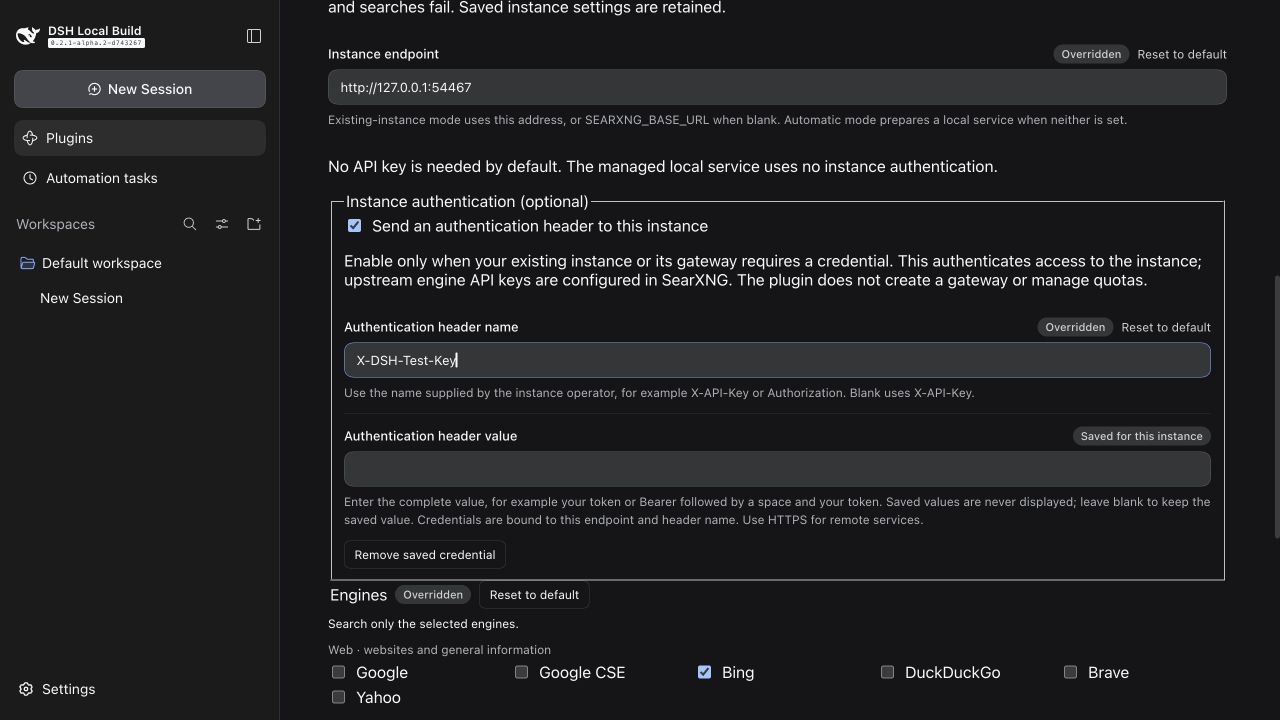
Actual 0.3.1 card in an isolated DSH test profile. The local fixture requires a custom header; the saved value is not displayed.
Search reports unavailable while preparing, stopped or failed, or when external mode has no endpoint. The card exposes status, retry and logs. Test search only calls SearXNG, never official fallback.
Version 0.4.1 has two independent, default-off paid switches: one Search API attempt after a failed SearXNG search, and one Fetch API attempt after an eligible local failure. Explicitly save each permission; legacy settings do not enable the new API paths. Cancellation and local safety refusals never trigger a paid retry. Successful fallback results disclose fees, and official fetch may still fail or return a verification page.
Public host credentials and the active rc.2 Web API configuration are reused. No host patch, private registry access or temporary route switching is required. For these retries keep searxng / searxng-http; the rc.2 built-in API switch overrides both routes. The top route/cost panel offers Restore plugin routes with a two-route review and manual steps. Saved fallback permissions stay unchanged; higher-priority refusals include instructions. See official API fallback.
Disable the entire dsh-web-search-searxng bundle, using its installed-bundle switch or dsh plugin --profile <name> disable dsh-web-search-searxng; enable uses the corresponding enable command. With HMR, route changes apply live; without HMR, restart. Removal uses dsh plugin --profile <name> remove dsh-web-search-searxng (stop a running profile first for CLI removal). The remaining bundle/profile/home/CLI layers determine the restored route, including a custom earlier provider or later manual override. Re-enabling appends the bundle and may change precedence relative to other bundles.
Disabling only the web-search-searxng provider row does not restore routing. Its bundle still selects searxng, so searches fail visibly with WEB_PROVIDER_CONFIGURED_MISSING; they do not silently use paid search. Enable that row again, or disable the whole bundle.
Version 0.3.0 retires configEffects, the activation journal gate and the companion host patch. Installation no longer writes route ownership to the profile; removal no longer rolls back card settings or arbitrary pre-install field values. Endpoint, engines, language and fallback choices saved by the user stay in the profile for reinstallation. Read upgrade notes if an earlier patched installation left a journal or explicit SearXNG route.
| Symptom | Cause | Fix |
|---|---|---|
SearXNG error (HTTP 401) | Instance requires authentication or rejected the credential | Check the card's authentication header name/value and the instance operator's instructions |
SearXNG error (HTTP 403) | Access denied, or search.formats lacks json | Check permissions/authentication; enable JSON in the instance if needed |
instance authentication is not ready | No saved credential for the current endpoint/header, invalid configuration, or unavailable credential service | Save a valid credential for this target, or disable authentication for an unprotected instance |
Search fails with provider unavailable (WEB_PROVIDER_CONFIGURED_UNAVAILABLE) | Local service is preparing/stopped/failed, or external mode has no endpoint | Check card status and retry; configure an address for external mode |
| Local startup reports address/port in use | An explicitly configured local port is occupied | Set Local port to 0 and save, or choose a free fixed port; the plugin does not remap an explicit choice |
| First setup fails during download or dependency installation | The DSH backend cannot reach the download/package services, or setup timed out | Read the card's diagnostic log, restore GitHub/PyPI access and retry |
| Local service re |
DeepSeek Harness(DSH)Web 插件聚合生态包 · 一切皆插件,创意工坊分发(dsh-market.com)
把回答做成一页可视化 HTML:模型只写简短的 Markdown 草稿,随包附带的 `am` 命令行生成页面,支持流程图、时序图、树、时间线、ER 图、表格和提示框。
在 dsh 里装上这个插件即可,无需登录、注册或填 API Key,就能使用包括 Muse Spark 1.3、MiMo V2.6 在内的前沿模型——完全免费,不限量。 All you do is install this plugin in dsh: no login, no sign-up, no API key — the frontier models are just there, Muse Spark 1.3 and MiMo V2.6 among them. Completely free, with no usage cap.

