
dsh-web
zhu1090093659/dsh-webDeepSeek Harness(DSH)Web 插件聚合生态包 · 一切皆插件,创意工坊分发(dsh-market.com)

DeepSeek Harness plugin: a model-facing `chrome` tool that drives the installed Google Chrome over CDP — screenshots returned as images, DOM/text/eval, console & network diagnostics, real input events. Runs in the Host, so no per-call approval and no bash sandbox limits.
A DeepSeek Harness plugin that gives the model a
chrome tool: it drives the Google Chrome installed on the machine over the Chrome DevTools
Protocol, so front-end work can navigate, screenshot, inspect, and interact with real rendered pages.
The tool runs inside the Harness Host process, which has two consequences worth knowing:
chrome call is an ordinary tool call; it never asks for shell or
sandbox permission.chrome_crashpad_handler: --database is required), so a plain
google-chrome --headless … bash command fails on a hardened Host. The Host process is not confined,
and the plugin runs there.Works on Linux, macOS, and Windows: the browser is located per platform, the sandbox flag follows the
platform, and Windows process-tree teardown uses taskkill.
Screenshots are returned as real images in the tool result (when the model route accepts image input) and written to a file, so the model sees the rendered UI while a human can open the exact PNG afterwards.
A real render, captured by the tool itself — astro.build at 1280×800:
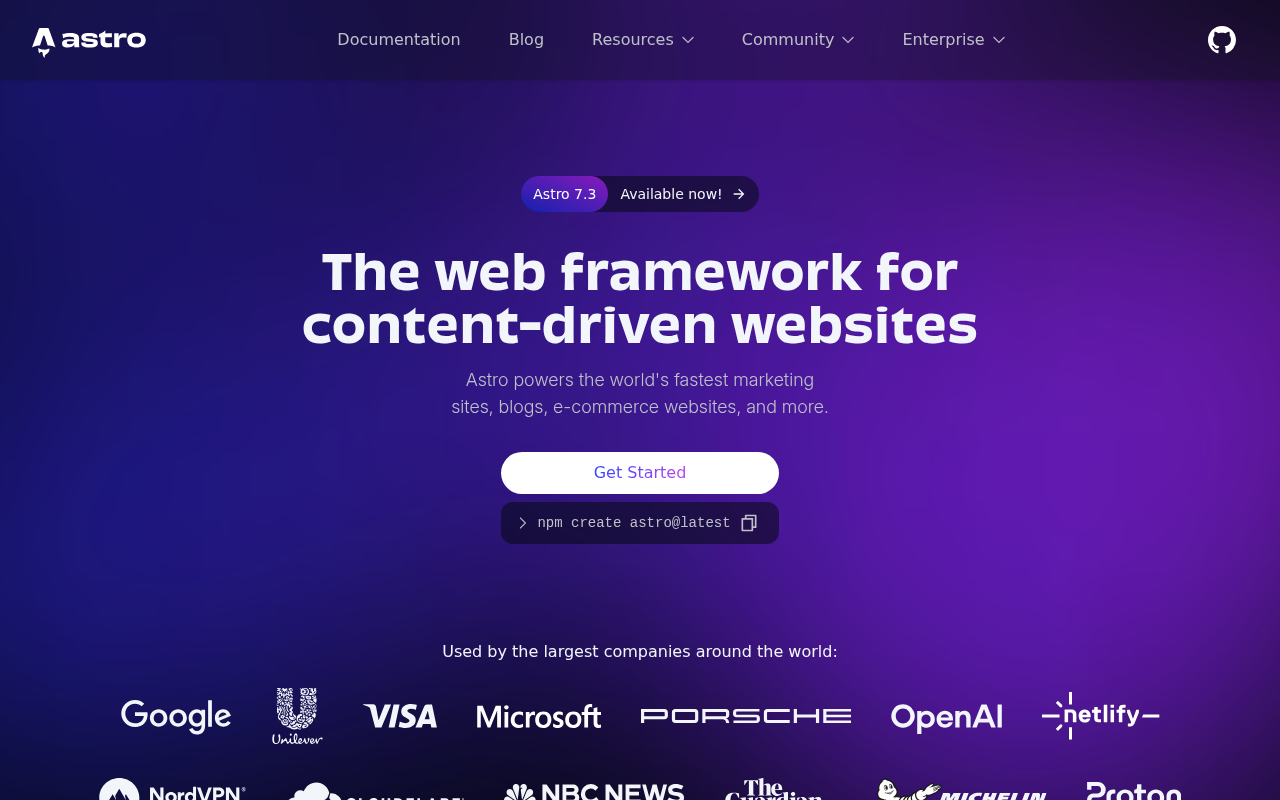
One tool, chrome, with an action parameter. Page ids (p1, p2, …) come from open; every
later action takes an optional page and otherwise uses the most recent one.
| Action | Key parameters | Result |
|---|---|---|
open | url, width, height, deviceScaleFactor, mobile | Starts Chrome if needed, opens a page. |
goto | url, page | Navigates an open page and waits for load. |
screenshot | path, fullPage, selector, width, height, scale | PNG image + saved path; viewport by default. |
viewport | width, height, deviceScaleFactor, mobile | Resizes the emulated viewport (responsive checks). |
dom | selector, maxChars | outerHTML of the document or of one element. |
text | selector, maxChars | innerText of the body or of one element. |
eval | expression, maxChars | Evaluates JavaScript in the page, returns the JSON value. |
click | selector or x/y, button, clickCount | Real mouse events at the element centre. |
type | selector, text, clear, submit, delayMs | Focuses, clears, inserts real input events. |
press | key | Enter, Tab, Escape, arrows, Home, End, PageUp, PageDown, Backspace, Delete, Space. |
wait_for | selector or text, timeoutMs | Polls until the selector matches or the text appears. |
console | clear, limit | Collected console.* calls, uncaught exceptions, browser log entries. |
network | clear, limit | Failed requests and HTTP 4xx/5xx responses seen while attached. |
pdf | path | Prints the page to a PDF file. |
tabs | – | Lists open pages. |
close | page | Closes one page. |
stop | – | Terminates Chrome and removes its temporary profile. |
WebSocket).apt-get install fonts-noto-cjk on Debian/Ubuntu, or the Noto CJK
fonts on Windows/macOS); without one, screenshots render those glyphs as empty boxes.The Host imports plugins only from its own module roots (the profile and the dsh installation), so the bundle must be installed as a real copy inside the profile, not as a link to a checkout:
npm pack # -> local-dsh-chrome-browser-<version>.tgz
Then install that tarball through the Harness plugin manager (plugin_manager, action: install_bundle, target = absolute tarball path). The Host reports restart-required when it
replaces an already installed package; restart dsh web to load the new module generation. A
version bump changes the dependency spec, which is what makes an update detectable.
The bundle patch sets these; apply merges them over its own defaults and validates them.
| Key | Default | Meaning |
|---|---|---|
chromePath | '' (auto-detect) | Browser executable. |
headless | true | Run without a window. |
noSandbox | true on POSIX, false on Windows | Pass --no-sandbox; required when the Host runs as root, unnecessary on Windows. |
userDataDir | '' (fresh temp dir per start) | Chrome profile directory; set it to a plain ASCII path if the system temp path upsets Chrome. |
defaultWidth / defaultHeight | 1280 / 900 | Default viewport. |
maxOutputChars | 100000 | Default cap for dom/text/eval output. |
navigationTimeoutMs | 30000 | Navigation and wait_for budget. |
artifactDir | '' (system temp) | Where screenshots and PDFs go when no path is given. |
The tool schema has no path parameter: the model never needs to know where the browser lives.
resolveChromePath resolves in this order and fails with an actionable message naming the config key
when nothing matches:
chromePath config;DSH_CHROME_PATH environment variable;/usr/bin/google-chrome, google-chrome-stable, google-chrome-beta,
/usr/bin/chromium, chromium-browser, /opt/google/chrome/chrome, /snap/bin/chromium,
/var/lib/flatpak/exports/bin/com.google.Chrome;/Applications/Google Chrome.app/Contents/MacOS/Google Chrome, the Chromium bundle,
and the per-user ~/Applications copy;%ProgramFiles% and %ProgramFiles(x86)% \Google\Chrome\Application\chrome.exe,
%LOCALAPPDATA%\Google\Chrome\Application\chrome.exe, then
%ProgramFiles(x86)%\Microsoft\Edge\Application\msedge.exe.For an unusual installation, set DSH_CHROME_PATH for the Host or edit the row's chromePath — no
code change is needed.
| Platform | Behaviour |
|---|---|
| Linux | Chrome runs with --no-sandbox by default because the Host usually runs as root. A Landlock-confined shell cannot start Chrome at all (chrome_crashpad_handler: --database is required); the Host process is not confined, which is where this plugin runs. |
| macOS | Same code path as Linux apart from the probe list; --no-sandbox is likewise the default. |
| Windows | --no-sandbox is off by default, the process is spawned with windowsHide (no console window), and stop/disposal terminates the whole tree with taskkill /pid <pid> /T /F — Windows has no POSIX process groups, so a plain child.kill() would leave renderers and the crashpad handler behind. |
If Chrome exits before exposing a DevTools endpoint on Windows, the usual causes are a policy block on
--remote-debugging-port, antivirus interception, or a profile path the browser cannot use; set
userDataDir to a plain ASCII directory to rule out the last one.
Two dependency-free suites drive real Chrome (no test framework required):
node test/engine.test.mjs   # CDP engine: browser resolution per platform, navigation, capture, input, console, network, teardown
node test/tool.test.mjs     # the real tool definition: schema validation, every action, error paths
Run them from the repository root; tool.test.mjs writes throwaway screenshots under .tmp/. Browser
resolution is injectable, so the Linux/macOS/Windows probe lists are covered even when the suite runs
on one of them.
stop (or plugin
disposal) terminates it and removes that profile. With userDataDir set, that directory is left in
place instead.screenshot still saves the PNG and
reports the path instead of attaching the image.MIT — see LICENSE.
DeepSeek Harness(DSH)Web 插件聚合生态包 · 一切皆插件,创意工坊分发(dsh-market.com)
把回答做成一页可视化 HTML:模型只写简短的 Markdown 草稿,随包附带的 `am` 命令行生成页面,支持流程图、时序图、树、时间线、ER 图、表格和提示框。
在 dsh 里装上这个插件即可,无需登录、注册或填 API Key,就能使用包括 Muse Spark 1.3、MiMo V2.6 在内的前沿模型——完全免费,不限量。 All you do is install this plugin in dsh: no login, no sign-up, no API key — the frontier models are just there, Muse Spark 1.3 and MiMo V2.6 among them. Completely free, with no usage cap.

